

KEY POINTS
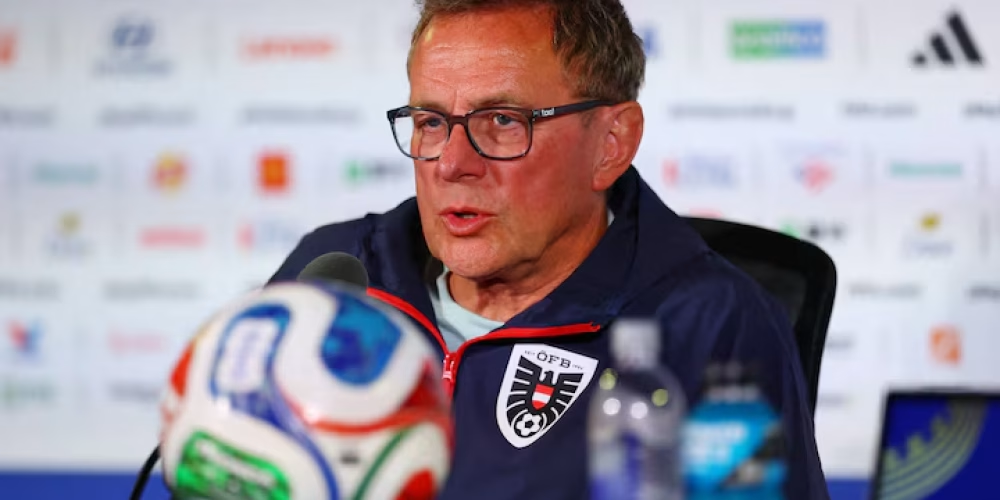
- Austria head coach Ralf Rangnick emphasizes that restricting the space of Spain’s teenage winger is crucial to pulling off a knockout stage upset.
- Spain enters the highly anticipated Round of 32 clash in California carrying an incredible 34-match unbeaten streak dating back to early 2023.
- Under Rangnick’s guidance, Austria is making its first appearances in a World Cup knockout round in over four decades after finishing second in Group J.
The knockout stage of the global soccer tournament brings a high-stakes clash of styles to Southern California as an ambitious underdog prepares to test the tournament favorites. Speaking ahead of the crucial Round of 32 matchup at Los Angeles Stadium in Inglewood, Austria head coach Ralf Rangnick identified containing Spanish phenom Lamine Yamal as his squad’s highest defensive priority. The veteran manager acknowledged that while football enthusiasts across the globe marvel at the teenager’s technical ability, his team must systematically deny the winger room to operate if they hope to advance.
What You Need to Know
The tournament setup has reached a critical juncture where group-stage consistency gives way to single-elimination pressure. Spain enters this phase of the competition maintaining a staggering 34-game undefeated run that stretches back to March 2023. Under manager Luis de la Fuente, the reigning European champions topped Group H with seven points, showcasing an elite defensive line that has yet to concede a single goal in the tournament, despite battling to a frustrating scoreless draw against Cape Verde in their opening fixture.
In sharp contrast, Austria is celebrating a historic milestone by participating in the World Cup knockout rounds for the first time in 44 years. Rangnick’s side secured their place as runners-up in Group J following a chaotic 3-3 draw against Algeria in their group finale, highlighting both their high-octane offensive capabilities and occasional defensive vulnerabilities. The Austrian squad has developed a reputation for executing a relentless, hyper-aggressive pressing philosophy, which they now intend to utilize against the most possession-heavy national team in modern sports.
Neutralizing Spain’s Primary Creative Spark
To engineer a monumental upset, Austria will have to solve the unique tactical puzzle presented by the 18-year-old Barcelona winger. After recovering from a hamstring tear sustained in club competition in April, the young forward has been carefully managed through the group phase, accumulating 141 minutes of playing time and scoring the opening goal in a dominant victory over Saudi Arabia. Rangnick expressed profound admiration for the teenager’s immense long-term potential but remained entirely focused on the immediate task of tracking his diagonal runs and explosive dribbling actions.
The tactical dynamic is further complicated by a wave of injuries impacting the Spanish flanks, with speedy wingers Nico Williams and Yéremy Pino sidelined after a physical group stage match against Uruguay. This personnel shortage places a heavier creative burden on the remaining healthy forwards, making the containment of the Spanish prodigy even more critical to Austria’s defensive game plan. Austrian captain David Alaba reinforced his manager’s sentiments, stating that while the squad deeply respects the individual quality and attractive style of their opponents, they have no intention of hiding in a defensive shell.
Operationally, Austria’s technical staff plans to counter Spain’s masterful midfield triangle of Rodri, Pedri, and Mikel Merino by disrupting their rhythm early in the build-up phase. Rangnick will have to adjust his defensive line due to the absence of injured defender Phillipp Mwene, but he remains confident that the team’s depth and structural cohesion can withstand the loss. The goal is to turn the match into a physical, high-tempo battle, suffocating passing lanes before the ball can ever reach the final third.
Why This Matters
For sports enthusiasts and international soccer followers across the United States, this specific matchup demonstrates how tactical evolution is narrowing the gap between historic heavyweights and rising nations. The inclusion of major American metropolitan venues as hosts for these premium knockout fixtures provides domestic fans with a firsthand look at elite tournament soccer. Observing how a disciplined, pressing team attempts to dismantle a traditional possession giant offers invaluable insights for developing football programs looking to compete on the global stage.
Beyond the tactical display, the encounter underscores the immense pressure placed on young professional athletes in the modern media landscape. At just 18 years old, individual players are carrying the tournament expectations of entire nations while opposing coaching staffs explicitly design entire defensive structures to neutralize them. For global viewers, monitoring how these young stars navigate hyper-focused defensive strategies offers a fascinating narrative framework that elevates standard match coverage into a compelling study of athletic composure.
NCN Analysis
The impending clash between the Austrian press and the Spanish passing carousel will serve as the ultimate litmus test for Rangnick’s tactical philosophy. While an aggressive approach can induce errors from the most composed midfields, a failure to win the ball cleanly will leave massive pockets of space for creative playmakers to exploit. If Austria can maintain their high-intensity physical output for a full 90 minutes, they possess the goal-scoring capacity to severely threaten a Spanish side that has occasionally struggled to turn overwhelming possession into clinical finishes.
Conversely, Spain’s veteran core is well-equipped to handle high-pressure environments, and their unbreached defensive record suggests they will not panic under early pressure. The critical factor will likely be the timing and efficiency of Spain’s transitional play once they bypass the initial wave of the Austrian press. If the tournament favorites can successfully feed their key winger in isolated one-on-one scenarios out wide, it could quickly dismantle Austria’s defensive shape and force the underdogs into a costly, reactive posture.
Both nations understand that a single tactical misstep will instantly conclude their summer tournament journey.
Reported by the NCN Editorial Team









