

KEY POINTS
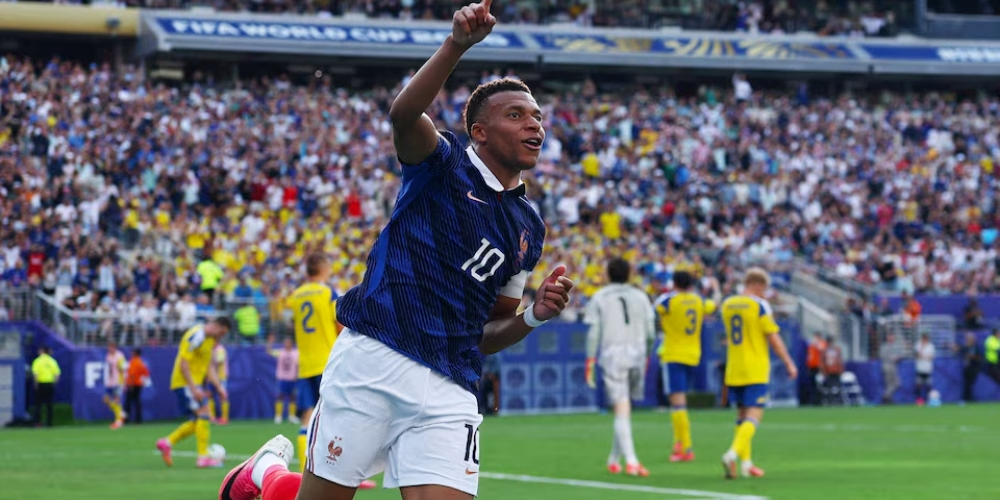
- France’s current offensive roster is drawing historical comparisons to the most prolific attacking units in the annals of international football.
- Statistical analysis of recent tournament performances positions this squad’s scoring efficiency at the top tier of all-time national teams.
- Coaches and analysts are questioning whether this current lineup possesses the necessary synergy to be crowned the greatest forward line in World Cup history.
The modern game of international football is defined by moments of individual brilliance, but every so often, a squad emerges that transcends talent to become something entirely more cohesive. France, currently competing in the 2026 global tournament, has built an offensive structure that is forcing football purists to rethink their historical rankings. As the knockout stages approach, the sheer volume and versatility of goals generated by the French front line have shifted the narrative from mere match-winning performance to a legitimate claim for the title of the greatest attacking unit ever assembled.
What You Need to Know
To evaluate the strength of a national team’s forward line, experts look at more than just the final scoreline. True greatness is measured by the ability of a unit to manipulate defensive structures, adapt to different tactical formations, and consistently provide scoring threats from every quadrant of the pitch. Historically, teams like the 1970 Brazil squad or the 1954 Hungarian “Golden Team” set the benchmark for offensive ingenuity, prioritizing movement, technical precision, and an almost intuitive understanding between forwards and midfielders.
The current French cohort benefits from an evolution in professional training and tactical data, which has allowed them to reach levels of fluidity that previous eras could only imagine. While legendary lines of the past relied heavily on one or two dominant individuals, this iteration of Les Bleus employs a balanced, multifaceted approach. By rotating playmakers and shifting attacking lanes during live play, they make it nearly impossible for opposing defenses to apply a singular focus, effectively turning every possession into a high-percentage scoring chance.
Analyzing the French Offensive Engine
The engine driving this French resurgence is a rare blend of pace, physical dominance, and tactical intelligence. Unlike previous teams that functioned through a traditional target man, this setup utilizes flexible forwards who operate effectively as wingers, central strikers, or creative midfielders depending on the flow of the match. This versatility allows the team to sustain pressure for full 90-minute stretches, a feat that is increasingly difficult to achieve as physical demands on players continue to rise in professional soccer.
Coaches facing France are finding that traditional marking schemes are largely ineffective against a unit that plays without a fixed point of attack. By encouraging overlapping runs and quick-touch passing sequences, the team forces defensive lines to break their shape, creating space that is exploited with clinical efficiency. Key players in this rotation have shown a remarkable ability to prioritize team objectives over personal statistics, a hallmark trait that often separates a collection of superstars from a truly dominant championship team.
The timeline for this team’s development has been as deliberate as it is impressive. Building on the core roster from the previous tournament cycle, management has integrated younger, high-speed forwards who bring a fresh intensity to the final third. This strategic blend of veterans who understand the pressure of international play and energetic youth has created a depth chart that remains potent even after substitutions are made late in the second half.
Why This Matters
For American soccer fans, the emergence of this French attack represents a shift in the global standard of play. As the sport continues its rapid growth across the United States, audiences are increasingly exposed to high-level tactical maneuvers that were once restricted to the European domestic leagues. Observing France’s performance provides a blueprint for what a cohesive offensive unit looks like, setting a high bar for future generations of American players and coaches who are looking to integrate similar high-tempo philosophies into their own programs.
On a broader scale, this level of dominance challenges the parity of the modern international tournament. When a forward line becomes this efficient, it forces smaller nations to rethink their defensive strategies, often leading to more compact, defensive-heavy styles of play that can fundamentally change the aesthetic of the game. For global commercial partners and broadcasters, the dominance of a prolific attacking force is a significant draw, driving viewership and increasing the cultural footprint of the World Cup well beyond traditional football strongholds.
NCN Analysis
The debate regarding whether this is the “greatest” forward line will ultimately be decided by silverware, not just style points. History is filled with talented offensive units that captured the world’s imagination only to fall short in the final rounds of knockout tournaments. For France to secure its place at the top of the pantheon, they must prove they can maintain this level of execution against the most sophisticated defensive systems in the world, which traditionally solidify in the semi-finals and final.
Looking ahead, fans should watch for how the team adjusts if an opponent successfully neutralizes their primary creative hub. Does the team possess a “plan B” that relies on set-piece dominance or long-range shooting, or is their entire identity tied to the current free-flowing movement? If they can survive a defensive standoff in the coming rounds, it will solidify the argument that they are not just the team of the moment, but an all-time great unit that fundamentally redefined the modern offensive structure.
France’s offensive performance continues to push the boundaries of what is possible in international competition.
Reported by the NCN Editorial Team









