KEY POINTS
- Roberto Mancini has been reappointed as the head coach of the Italian national soccer team following Gennaro Gattuso’s departure in April.
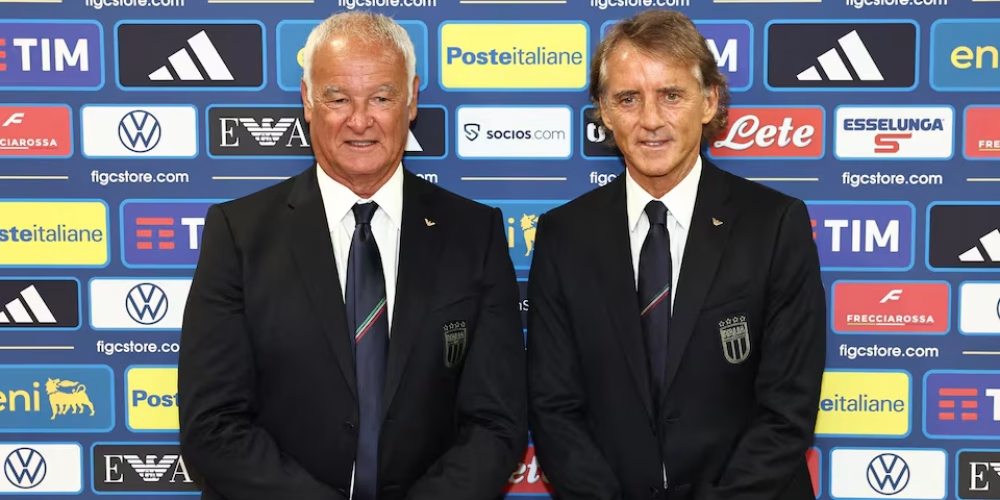
- Premier League winner Claudio Ranieri joins the Italian Football Federation as technical director alongside Mancini to oversee team operations.
- Mancini publicly apologized for his sudden departure in 2023 as he takes charge of an Azzurri side that recently missed a third consecutive World Cup.
The Italian Football Federation has officially reappointed Roberto Mancini as head coach of the men’s national soccer team, handing the veteran tactician a second chance to rescue the four-time world champions from crisis. Mancini, who famously guided Italy to European Championship glory in 2021 before abruptly stepping down two years later, replaces Gennaro Gattuso following another failed World Cup qualification attempt. His return coincides with the appointment of Leicester City legend Claudio Ranieri as technical director, signaling a complete overhaul of the nation’s soccer leadership.
What You Need to Know
To understand the weight of this decision, one must look at the unprecedented decline of one of soccer’s elite powers. Italy has not appeared on the sport’s biggest international stage since 2014. Despite capturing the Euro 2020 title under Mancini during a record-setting 37-match unbeaten streak, the Azzurri suffered a shock defeat to North Macedonia in the 2022 World Cup playoffs, condemning them to back-to-back tournament absences.
When Gattuso took the reins, hope remained that the national side could reset its identity and navigate qualification for the expanded 2026 tournament. However, a playoff final loss to Bosnia and Herzegovina in April sealed Italy’s fate, forcing a third consecutive World Cup miss. Gattuso stepped down immediately in the aftermath, leaving the Italian Football Federation (FIGC) searching for leadership during one of the darkest periods in Italian sports history.
The coaching search itself was marked by dramatic organizational turmoil. Former national team icon Paolo Maldini was hired as technical director to restructure operations, but his tenure lasted just 16 days. Maldini and his adviser Leonardo resigned after internal friction regarding coaching candidates—specifically when proposed candidate Andrea Pirlo was blocked due to commercial ties with a foreign gambling firm. With high-profile managers such as Pep Guardiola and Carlo Ancelotti declining offers, federation president Giovanni Malagò turned back to Mancini to anchor the rebuilding process.
Roberto Mancini Returns to Italy
Mancini’s return to the Azzurri bench represents a dramatic reconciliation between the manager and Italian soccer leadership. When Mancini quit unexpectedly in August 2023 to accept a lucrative contract with the Saudi Arabia national team, his departure left a bitter taste among fans and federation directors alike. Addressing reporters during his official unveiling, the 61-year-old former Manchester City manager expressed genuine regret over how he previously exited, stating that he was deeply sorry for leaving the team during a vital transition phase.
Federation officials acknowledged that while the manner of Mancini’s earlier departure required serious internal evaluation, his elite credentials ultimately outweighed past grievances. During his first five-year term from 2018 to 2023, Mancini modernized Italian football, shifting the squad away from its traditionally defensive posture toward an aggressive, possession-based attack. That tactical evolution yielded 37 wins across 58 matches and restored national pride during their Euro 2021 campaign.
Working alongside Mancini will be Claudio Ranieri, the 74-year-old manager famous for orchestrating Leicester City’s miraculous Premier League title run in 2016. Ranieri, who recently served as a senior advisor at AS Roma, brings decades of tactical experience and calm authority to the technical director post. Together, Mancini and Ranieri are tasked with establishing a unified sporting strategy that connects youth academies, domestic club development, and international selection.
The immediate roadmap for the duo offers little room for trial and error. Italy returns to competitive action in September and October for high-stakes UEFA Nations League fixtures against Belgium, Turkey, and France. With minimal preparation time before these matches, Mancini must quickly evaluate current Serie A talent, address depth issues in attack, and instill a renewed mental toughness in a squad battered by recent international setbacks.
Why This Matters
For soccer supporters in the United States and across North America, Italy’s prolonged absence from major international tournaments has left a noticeable void in the global sports market. The Italian national team boasts one of the largest and most passionate international fanbases across North American metropolitan areas. The ongoing struggle of the Azzurri impacts television ratings, merchandise distribution, and commercial sponsorships for international exhibition matches held in American stadiums.
Furthermore, the restructuring of traditional soccer powerhouses illustrates a broader shift in international sports governance. American investors holding significant stakes in Italian Serie A clubs—including ownership groups at AC Milan, AS Roma, and Atalanta—depend on a healthy national football system to maintain high asset valuations and talent development pipelines. A stabilized Italian national team managed by recognized figures like Mancini and Ranieri directly influences player market values and commercial interest across Western export markets.
NCN Analysis
The decision to rehire Roberto Mancini is a classic risk-reward calculation by the Italian Football Federation. On one hand, Mancini is a proven winner who already understands the intense pressure of the national team job and possesses a clear tactical blueprint. On the other hand, bringing back a manager whose unexpected exit created chaos three years ago highlights a distinct lack of long-term succession planning within Italian soccer governance.
Moving forward, soccer observers should monitor how effectively Ranieri and Mancini collaborate on youth integration. Italy’s primary structural issue is not merely coaching tactics, but a systemic failure to produce world-class goalscoring talent capable of competing with nations like France or Spain. If Mancini relies exclusively on aging veterans to secure short-term Nations League results, he risks delaying the essential generational shift required to ensure qualification for the 2030 World Cup.
The immediate focus will center on tactical discipline and squad morale during autumn international windows. If Italy can hold its own against elite European opponents over the coming months, Mancini will gain the political capital needed to execute a thorough overhaul of the national team system.
Italy must now focus on stability and long-term talent development to reclaim its standing among the elite forces of world soccer.
Reported by the NCN Editorial Team