

KEY POINTS
- Spain shattered French title hopes with a comprehensive 2-0 semifinal victory in Dallas, leaving a star-studded squad empty-handed.
- Didier Deschamps is stepping down, ending a historic 14-year tenure marked by immense stability and the 2018 global crown.
- Real Madrid legend Zinedine Zidane has a verbal agreement to take the helm and guide Les Bleus into a new era.
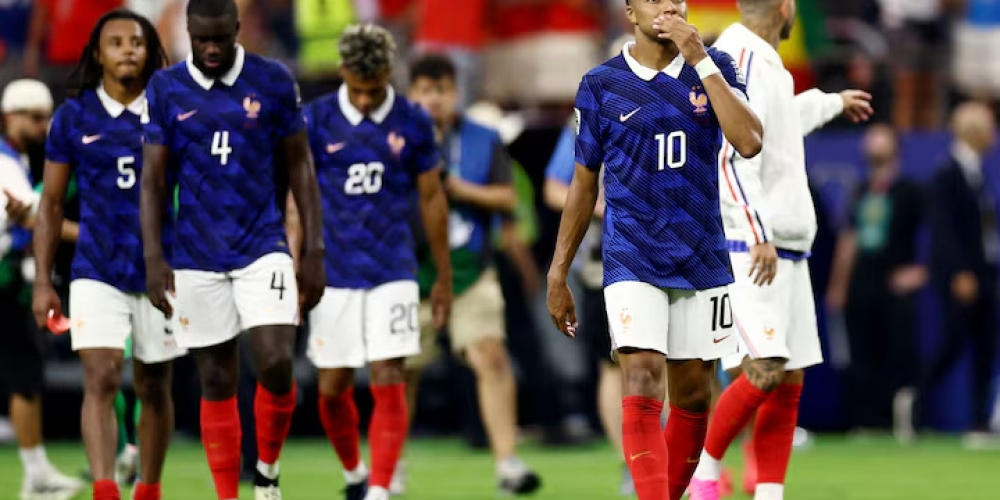
The dreams of a French golden generation crashed down in Texas on Tuesday night as a dominant Spanish side outclassed Les Bleus 2-0 in the 2026 World Cup semifinals. Played before a packed crowd in Dallas, the defeat marked a somber, anticlimactic conclusion to Didier Deschamps’ historic 14-year reign as manager of the national team. Yet, as one legendary era closes in heartbreak, an exciting new chapter is already taking shape with icon Zinedine Zidane poised to assume leadership.
What You Need to Know
For more than a decade, Didier Deschamps has been the unifying architect of French soccer’s modern golden age. Assuming the managerial role in 2012 following a period of deep internal dysfunction within the national squad, Deschamps restored discipline, tactical rigor, and a relentless winning mentality. His pragmatism consistently prioritized balance and defensive solidity over individual flair, a philosophy that repeatedly yielded elite results on the grandest stages.
Under his stewardship, France experienced an unprecedented run of international consistency. He captained Les Bleus to their first World Cup triumph on home soil in 1998 and, two decades later, guided them from the dugout to their second star at the 2018 World Cup in Russia. His trophy-laden tenure also featured a 2021 UEFA Nations League title, alongside heartbreakingly close runner-up finishes at Euro 2016 and the spectacular 2022 World Cup in Qatar.
Deschamps had previously confirmed his intention to step aside following the conclusion of the 2026 tournament in North America. This deliberate succession planning gave the French Football Federation ample opportunity to coordinate a smooth transition. That path has long pointed toward his former international teammate, Zinedine Zidane, who has patiently waited for the prestigious national job since departing Real Madrid in 2021.
Spain Outclasses Les Bleus in Dallas Showdown
The highly anticipated semifinal in Dallas proved to be a tactical masterclass by Spain, leaving a star-studded French attack looking frustrated and isolated. France arrived at the tournament as heavy favorites, boasting a deep reservoir of attacking talent, yet they struggled to impose their physical and technical qualities against a fluid Spanish midfield. Spain’s coordinated pressing game neutralised the dangerous French transitions and starved key playmakers of possession throughout the ninety minutes.
Spain took control of the match in the first half, exposing rare defensive lapses in the French backline to establish a comfortable two-goal cushion. Despite tactical adjustments and offensive substitutions from Deschamps in the second half, France failed to mount a sustained comeback. The final whistle brought a mix of disbelief and sorrow to the French players, who realized they had fallen short of delivering the fairytale ending their long-serving manager deserved.
Following the defeat, a visibly disappointed Deschamps acknowledged that his team had simply run into a superior opponent on the night. He noted that to survive at this elite stage of the tournament, a team must play at their absolute maximum, admitting his squad fell short of that standard. Despite the bitter nature of the exit, Deschamps leaves behind an unmatched legacy as one of the most influential figures in his nation’s sporting history.
Why This Matters
The dramatic transition of power within the French national team carries significant weight for soccer fans and stakeholders across the United States and the broader global market. As the co-host of this historic 48-team World Cup, North America has provided the ultimate stage for the sport’s elite evolution. The massive viewership numbers and packed stadiums in cities like Dallas underscore the commercial power of international soccer, which is increasingly capturing the attention of mainstream American sports fans.
Furthermore, the imminent arrival of Zinedine Zidane is set to spark immense global interest and commercial opportunities. Zidane is a household name whose legendary reputation transcends the boundaries of traditional soccer markets. His appointment will likely drive increased merchandise sales, television broadcast demands, and corporate sponsorships across North America, cementing the region’s position as a vital growth hub for the global game ahead of the next cycle.
NCN Analysis
Inheriting one of the deepest and most talented squads in world soccer is both a dream and a massive challenge for Zinedine Zidane. While Deschamps prioritized structure and defensive discipline, Zidane’s managerial history suggests he will introduce a philosophy centered on attacking fluidly, maintaining possession, and maximizing individual creativity. Fans can expect a more expansive style of play, designed to unlock the full potential of elite talents like Kylian Mbappé.
However, the pressure on the incoming manager will be relentless from day one. Zidane must translate his extraordinary club success—which included guiding Real Madrid to an unprecedented three consecutive UEFA Champions League titles—into the high-stakes world of international football. With the 2030 World Cup cycle on the horizon, the soccer world will be watching closely to see if “Zizou” can mold this heartbroken golden generation into a dominant global force once again.
The transition marks the end of a remarkable era, but the future of French soccer remains incredibly bright.
Reported by the NCN Editorial Team









