

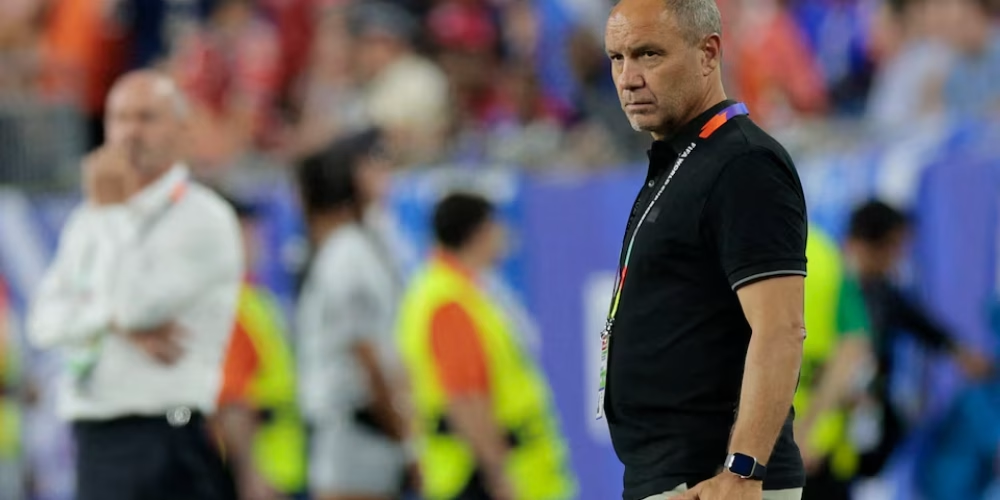
KEY POINTS
- The Haitian Football Federation has officially severed ties with head coach Sébastien Migné following the conclusion of the national team’s 2026 World Cup qualification cycle.
- Migné, who assumed control of the squad in March 2024, managed the team through a tumultuous period defined by displaced home matches and significant logistical hurdles.
- The search for a new manager begins immediately as the federation looks ahead to restructuring the national soccer program for upcoming regional tournaments.
The Haitian national soccer team is entering a new era of uncertainty after parting ways with head coach Sébastien Migné following their recent 2026 World Cup qualification campaign. The decision represents a sudden shift in direction for a team that has shown flashes of brilliance despite playing under some of the most challenging circumstances in international sports. For soccer fans across North America and the Caribbean, this managerial vacancy marks a pivotal moment for one of CONCACAF’s most resilient programs.
What You Need to Know
To understand the gravity of this decision, one must look at the immense challenges that have shadowed Haitian football in recent years. The domestic situation in Haiti has forced the national team, affectionately known as Les Grenadiers, to play their home fixtures on neutral ground, often traveling to neighboring nations like the Dominican Republic and Barbados. This lack of a true home-field advantage has put an immense strain on the players, coaching staff, and athletic federation, making any competitive success a remarkable achievement.
Sébastien Migné, an experienced French tactician with an extensive history of managing national teams across Africa and Asia, was brought in during the spring of 2024 to bring stability to the roster. His appointment was met with cautious optimism by supporters who hoped his disciplined, globetrotting approach would help Haiti navigate a highly competitive CONCACAF qualifying field. Throughout his tenure, Migné attempted to integrate domestic talents with prominent diaspora players based in leagues across the United States, France, and Canada.
Despite these efforts, the structural limitations surrounding the team proved difficult to overcome. Managing a national team without a stable domestic league to scout from, combined with the ongoing administrative hurdles of the Haitian Football Federation (FHF), ultimately limited the long-term viability of Migné’s tactical project. The separation, described as a mutual recognition that a change in leadership was necessary, signals a desire from the federation to rebuild its sporting identity from the ground up.
The Haitian Soccer Team’s Coaching Shakeup
The timeline of Migné’s departure highlights the rapid pace of change in international soccer management. After taking the reins in 2024, the French manager immediately focused on organizing a cohesive defensive block and utilizing the athletic strengths of Haiti’s forward line. The qualifying matches for the 2026 World Cup served as the ultimate test for this strategy, as Haiti sought to capitalize on a unique tournament format where traditional regional powerhouses—the United States, Mexico, and Canada—automatically qualified as co-hosts, leaving more open slots for Caribbean nations.
While the team put up spirited performances, the lack of consistent preparation and the inability to host training camps in Port-au-Prince hindered their tactical growth. Crucial matches during the qualification phases exposed vulnerabilities in depth and tactical consistency, leading to frustrations within the federation’s leadership. Although the players remained publicly supportive of Migné’s work ethic, the underlying feeling was that the team had hit a competitive ceiling under his guidance.
The official announcement from the Haitian Football Federation confirmed that both parties agreed to end their working relationship. This move leaves Haiti looking for a manager who can not only design winning tactics on the pitch but also navigate the complex geopolitical and administrative realities that define Haitian sports. The federation is expected to prioritize candidates with strong ties to the Caribbean region or those who have experience managing under highly volatile organizational conditions.
Why This Matters
The managerial vacancy in Haiti has direct implications for soccer fans and communities across the United States. The Haitian diaspora in major metropolitan areas such as Miami, New York, and Boston maintains an incredibly passionate connection to Les Grenadiers. For these communities, the national team is a powerful symbol of national pride and resilience, making any major coaching change a front-page story in local diaspora media outlets.
Furthermore, the stability of Haiti’s national program directly affects the competitive balance within CONCACAF. Major Major League Soccer (MLS) clubs and lower-division American leagues frequently scout and sign Haitian talent. A well-run Haitian national team acts as a vital shop window for these athletes, providing them with international exposure that can lead to lucrative professional contracts in North America. When the national team struggles or enters a period of transition, it can slow down the pipeline of Caribbean talent entering the American soccer ecosystem.
NCN Analysis
This coaching change is a double-edged sword for Haitian soccer. On one hand, parting ways with an experienced manager like Migné risks throwing the team into a period of tactical disarray just as preparations for the next Gold Cup cycle begin. On the other hand, it offers the Haitian Football Federation a clean slate to build a more sustainable technical framework. The next appointment must be a leader capable of uniting a geographically scattered player pool and maximizing the potential of young players developing in European and American academies.
To truly progress, the federation must look beyond a quick-fix appointment. The incoming coach will need to work closely with international soccer bodies to secure better training facilities and establish a consistent base of operations outside of Haiti until local conditions improve. If the federation can attract a high-caliber manager who embraces these unique challenges, Haiti possesses the raw athletic talent to remain a formidable opponent in the region.
The coming months will reveal whether this decision was a calculated step toward progress or a premature reaction to the immense pressures of international qualifying.
Haiti’s soccer federation must now act swiftly to secure a visionary leader capable of transforming their undeniable raw talent into a cohesive, globally competitive squad.
Reported by the NCN Editorial Team









