

KEY POINTS
- SoFi Stadium successfully concluded its eight-match World Cup hosting duty, cementing its status as an elite global sports hub.
- Venue executives expressed heightened confidence in operations after seamlessly managing specialized crowd flows and complex security matches.
- The multi-week football experiment serves as a critical operational template ahead of the 2027 Super Bowl and the 2028 Los Angeles Olympics.
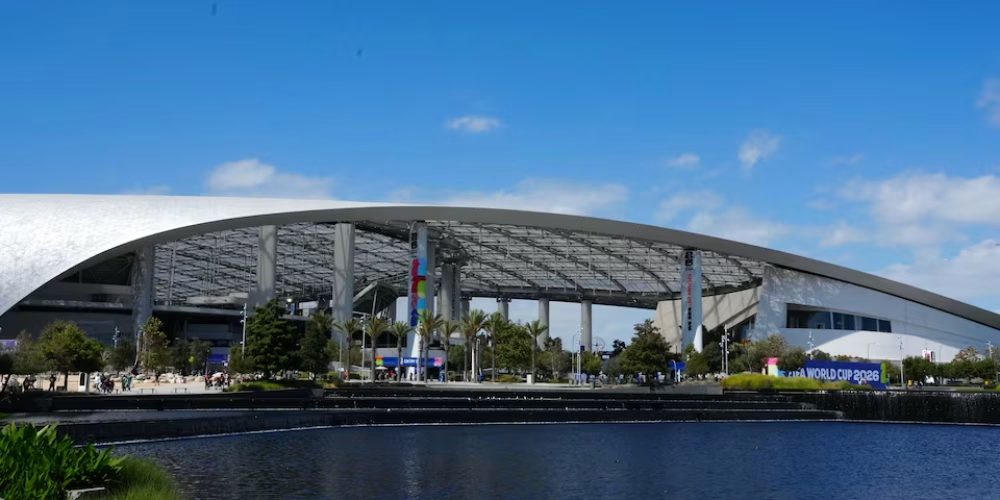
SoFi Stadium has officially wrapped up its high-profile hosting duties for the 2026 FIFA World Cup, building immense organizational momentum ahead of its upcoming mega-events. The state-of-the-art facility in Inglewood, California, concluded its multi-week tournament obligations by seamlessly accommodating massive international crowds across eight matches without any major logistical disruptions. Venue management confirmed that the demanding international soccer project has fully validated the stadium’s core infrastructure, setting a flawless baseline for future global spectacles.
What You Need to Know
The multi-billion-dollar athletic palace, which initially opened its doors in September 2020, was meticulously engineered to challenge traditional stadium design boundaries. While the venue serves as the permanent home for two prominent National Football League franchises, its architectural blueprint always targeted elite global events from inception. Over the past month, the stadium truly realized that grand vision by operating under the intense, unyielding scrutiny of international football enthusiasts and global sports governing bodies.
The structural adaptations required to host international soccer matches at the Inglewood venue involved significant engineering feats. Because standard domestic stadium configurations cater strictly to gridiron dimensions, technicians had to implement a completely temporary natural grass surface to meet strict international field requirements. Cultivating and maintaining an organic pitch over multiple weeks inside an architectural canopy required specialized agricultural interventions, making it a critical talking point among groundskeepers worldwide.
Historically, managing the unique behavioral patterns of international soccer crowds has presented massive administrative challenges for North American stadium operators. Unlike domestic sports fans who generally stagger their concession visits across multiple quarters, international soccer crowds remain glued to their seats until the half-time whistle triggers a massive, simultaneous surge toward local concourses. Navigating these sudden waves of consumer demand required years of meticulous operational simulations by the stadium’s logistics divisions.
Flawless Security and Logistical Stress-Testing
The overarching success of the tournament run was heavily defined by the smooth execution of complex security strategies during politically sensitive group stage matches. The stadium successfully coordinated operations for eight high-stakes matches, including the opening match for the United States Men’s National Team and two high-visibility fixtures involving Iran. Managing these sensitive international dynamics required seamless communication networks between local police forces, private security firms, and federal law enforcement agencies.
Otto Benedict, senior vice president of facility and campus operations at SoFi Stadium and Hollywood Park, emphasized that the multi-week operation fully vindicated their long-term planning frameworks. Benedict noted that ticketing scanners, crowd-flow barriers, and general transport infrastructure functioned at optimal capacity throughout the tournament. Even during peak transit hours, the venue’s wide concourses accommodated the massive physical volume of fans, preventing dangerous bottlenecks from materializing near major entry portals.
The commercial and hospitality systems inside the arena also adapted effectively to the distinct buying habits of global soccer tourists. Concession stands and retail outlets handled unprecedented transactional volumes during the compressed fifteen-minute half-time periods without experiencing severe point-of-sale failures. These operational milestones provided invaluable real-world data that stadium engineers will analyze extensively to refine future menu structures and queue management systems.
The temporary natural turf surface also drew widespread technical praise from participating national teams and international media representatives. Despite early concerns regarding how a temporary grass system would handle heavy slide-tackling, the organic carpet actually improved in physical durability as the tournament advanced. While maintaining a permanent natural field remains unfeasible due to the stadium’s dense subterranean depth and packed corporate concert calendar, the temporary experiment proved that the venue can rapidly transition its surface to host elite events at a moment’s notice.
Why This Matters
For corporate businesses, major commercial sponsors, and municipal planning departments across Southern California, the flawless execution of this global tournament delivers a massive economic boost. Demonstrating that the region’s premier sports facility can accommodate hundreds of thousands of international visitors without straining local public transportation systems solidifies Los Angeles’ status as a prime destination for global commerce. The economic windfalls generated by international tourism over the past month provide a powerful financial justification for the continuous expansion of local hospitality infrastructure.
Furthermore, the successful tournament run directly impacts the international sports broadcasting and entertainment markets. Media executives and global brands can allocate major marketing budgets to future Los Angeles events with total confidence, knowing that the physical infrastructure will support premium, uninterrupted global broadcasts. This operational stability translates into long-term commercial value, assuring corporate stakeholders that upcoming entertainment projects will unfold within a secure and world-class environment.
NCN Analysis
The operational triumphs recorded at the Inglewood venue indicate a major shift in how North American arenas prepare for multi-sport legacy eras. By successfully managing the unique security and logistical hurdles of international football, the stadium’s executive staff has effectively completed a high-intensity dress rehearsal for their next massive undertakings. The valuable data gathered regarding crowd psychology and concession surges will allow management to fine-tune their operations ahead of the 2027 Super Bowl.
Looking even further ahead, this successful tournament run positions the facility perfectly to anchor the 2028 Los Angeles Olympic and Paralympic Games. The arena is scheduled to host the swimming competitions alongside the iconic opening and closing ceremonies, requiring an unprecedented level of operational flexibility. Having proved that their core infrastructure can thrive under maximum international pressure, the venue’s management can approach the complex logistical demands of the Olympic movement with absolute confidence, ensuring that Southern California remains the epicentre of global sports entertainment.
Reported by the NCN Editorial Team









