

KEY POINTS
- Tournament match officials cover between 12 and 13 kilometers per game, matching the physical workload of midfield players.
- FIFA implemented a strict four-year training regimen to prepare referees for extreme environmental variations, from coastal humidity to high altitude.
- Sports science data tracks officials’ metrics with the same precise detail used for competing squads to prevent fatigue-driven tactical errors.
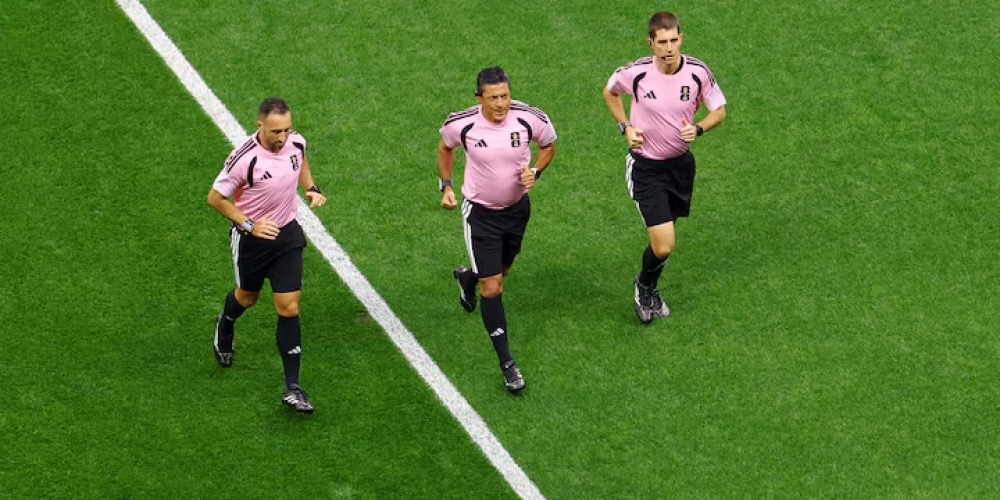
The immense physical evolution of modern soccer has forced an unprecedented transformation in how international sports officials prepare for the world stage. While millions of fans lock their eyes onto forward lines and tactical masterminds, the tournament’s true endurance runners remain almost completely overlooked. To arrive at critical decision-making moments before controversy does, referees are pushing their bodies to absolute physical limits, matching elite wingers and midfielders stride for stride.
What You Need to Know
Modern international football has evolved into a hyper-athletic showcase defined by relentless pressing, high-speed transitions, and minimal natural stoppages. Data collected across recent major tournaments confirms that while the total distance covered by athletes has remained relatively steady, the volume of high-intensity sprinting has skyrocketed. This shift means that a referee can no longer rely on structural positioning from a distance; they must possess the raw acceleration to follow a 40-yard counter-attack without losing an optimal viewing angle.
According to data compiled by FIFA, top-tier match officials routinely cover 12 to 13 kilometers (approximately 7.5 to 8 miles) during a standard 90-minute fixture. More importantly, high-intensity running and dead-stop sprints account for more than a third of their total movement, driving heart rates up to 80% to 100% of their maximum capacity. This physical reality has completely dismantled the outdated archetype of the passive, middle-aged arbiter, replacing them with finely-tuned sports performers.
Recognizing this operational shift, soccer’s global governing body initiated a comprehensive preparation project nearly four years ago to build elite athletic resilience among its officiating pool. The necessity of this training became painfully apparent during earlier tournament cycles, where the sheer pace of the game resulted in high-profile muscle failures on the pitch. In one notable group-stage clash involving the United States, German official Felix Zwayer collapsed with severe cramping during stoppage time, requiring players from both competing squads to manually stretch his legs so he could blow the final whistle.
Navigating Environmental Extremes and High-Intensity Demands
The current tournament structure introduces a logistical nightmare that complicates physical preparation: unprecedented climate and geographic diversity. An officiating crew may find themselves monitoring a high-tempo match in the suffocating, dense humidity of Miami, only to board a long-haul flight days later to police a fixture at an elevation of over 2,200 meters in Mexico City. Dealing with oxygen-depleted air and rapid time zone adjustments creates an environment where physical exhaustion can easily compromise cognitive performance.
To combat these extreme variables, FIFA heavily relied on technical data and physiological lessons extracted from the 2025 Club World Cup hosted across North America. Match officials now wear identical GPS tracking equipment, heart-rate sensors, and blood-lactate monitors utilized by elite club sports scientists. This wealth of biometric information allows specialized performance coaches to adjust individual training workloads with clinical precision, balancing short, explosive speed work with active recovery cycles.
The three days leading up to an assignment feature carefully simulated match scenarios, while the immediate 48 hours following a game are dedicated exclusively to active regeneration, deep tissue massage, and advanced cryotherapy. Furthermore, dietary adjustments—including specialized hydration supplements and tightly manipulated training schedules designed to avoid direct, draining sunlight—have been systematically introduced. The overarching goal of this sports science initiative is to mitigate systemic fatigue, which academic research directly links to narrowed field vision and delayed psychological reaction times.
Why This Matters
For sports consumers, media networks, and data analytics firms operating across the United States and the global English-speaking market, the immense physical standard required of modern referees reshapes our understanding of sports performance. As sports betting markets and corporate sponsorships turn every single penalty box sequence into a multi-million dollar variable, the physical fitness of the referee is just as critical to commercial stability as the health of the star players. A single stride lost to a lingering hamstring strain or altitude sickness can result in a missed foul that alters the financial trajectory of an entire national federation.
For the expanding North American soccer fan base, appreciating the athletic standard of the officiating crew adds a layer of depth to viewing the global game. It demonstrates that the transition toward hyper-athletic, continuous play requires a total modernization of sports governance, proving that human eyes must be backed by human engines capable of running an endurance race. The dedication to tracking referee metrics provides a blueprint that major domestic leagues—such as the NFL and NBA—will likely analyze as they continue to integrate data-driven sports science into their own official development pipelines.
NCN Analysis
Treating referees like elite sports performers is a crucial administrative evolution, but it highlights a deeper vulnerability within modern soccer. As tactical systems become faster and sports science pushes human athletes to run quicker every year, international football is approaching a threshold where the physical demands placed on a single field referee may surpass human biological limitations. Even with world-class cryotherapy and personalized nutrition, expecting an official to maintain a perfect viewing angle while sprinting at maximum capacity in extreme altitude is an immense ask.
This inevitable physical ceiling is precisely why the role of technology, such as the video assistant referee (VAR), will continue to expand despite public pushback from traditionalists. The future of sports officiating will likely see a hybrid model where the on-field referee acts less as an isolated judge and more as an athletic executor of a decentralized, data-fed command center. Until that transition is complete, the tournament’s outcome will remain balanced on the lungs and legs of the sport’s hidden runners.
The most critical asset on the pitch isn’t the ball—it is the breath of the person holding the whistle.
Reported by the NCN Editorial Team









