

KEY POINTS
- Adidas experienced a massive 70% spike in clothing sales during May, holding onto its strong momentum straight into June.
- Retail location tracking reveals that brick-and-mortar foot traffic at Adidas outlets far outpaced competitor Nike during the opening week of the tournament.
- Despite trailing in overall sales growth, Nike scored a key logistical win by selling out its product inventory at a significantly higher rate.
The global sportswear battleground has reached a fever pitch during the 2026 FIFA World Cup, with early consumer data indicating that German apparel giant Adidas is currently outpacing its long-time American rival, Nike. Both multi-billion-dollar conglomerates have funneled unprecedented financial resources into capturing the attention of soccer enthusiasts during this summer’s tournament, which is being played across North America. However, preliminary retail metrics suggest that Adidas’ deep historical roots with the sport and its official FIFA partnership are paying massive dividends, allowing the company to capture the lion’s share of early tournament expenditure.
What You Need to Know
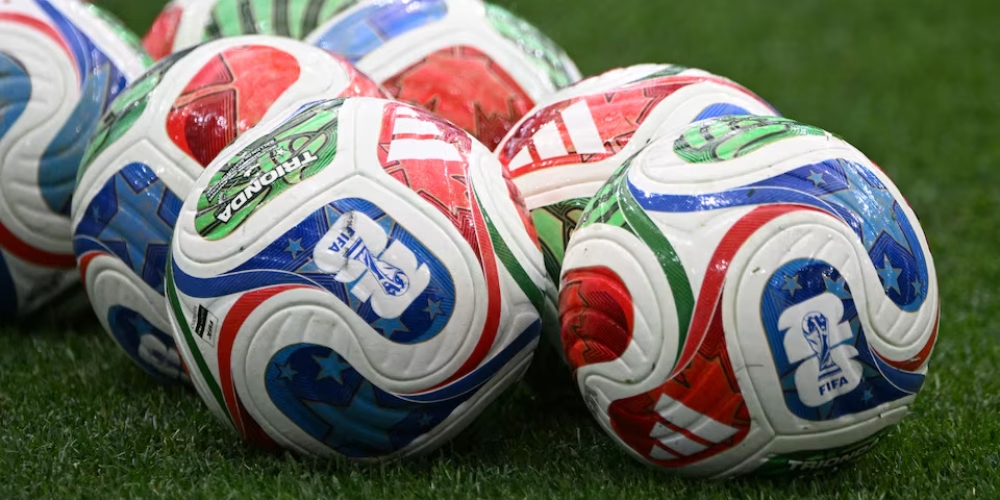
The corporate rivalry between Nike and Adidas for international soccer dominance spans decades, with the World Cup serving as the ultimate quadrennial theater for consumer engagement. In this iteration of the tournament, Adidas holds a slight structural advantage on the field, outfitting 14 national teams and supplying the highly visible official tournament match ball. Nike, by contrast, has secured the kit sponsorships for 12 national delegations, while executing an expansive retail strategy that features specialized gear and collaborations across more than 5,000 corporate and wholesale retail spaces globally.
This corporate showdown arrives at a uniquely critical juncture for the American brand. Over the past several fiscal cycles, Oregon-based Nike has experienced a persistent erosion of its global footwear market presence, dropping from a commanding 29.2% market share in 2022 to 22.9% last year. The decline has been driven by cooling domestic demand for its historically reliable heritage lines, such as Air Jordans and Dunks, alongside aggressive market share gains from newer, specialized athletic brands. Consequently, external financial analysts note that Nike is relying far more heavily on a successful tournament campaign to revitalize its brand image and stabilize its financials ahead of upcoming quarterly earnings declarations.
Conversely, Adidas enters this competitive cycle backed by robust operational momentum and elevated investor confidence. The German brand has benefited extensively from cultural retro apparel trends and a hyper-focused return to core performance sports. By positioning its marketing campaigns squarely within the traditional infrastructure of global football, Adidas has managed to maximize the visibility of its trademark three-stripes aesthetic, setting up a clear contrast with Nike’s broader lifestyle-oriented marketing playbook.
Adidas Gains Ground in Global Jersey Sales
Market intelligence data confirms that the commercial surge for Adidas began well before the opening whistle of the tournament. Spending on the company’s apparel lines skyrocketed by 70% year-over-year during the month of May, sustained by robust international demand that carried seamlessly into June. Industry researchers trace this substantial spike directly to an explosion in authentic national team jersey sales, as fans across the globe rushed to secure gear ahead of the group stage fixtures. While Nike’s soccer-related apparel segment has also reported positive trajectory, its growth rate continues to lag behind the explosive pace set by its primary European competitor.
The commercial disparity between the two giants is further illustrated by physical retail foot traffic analysis within the United States. During the critical opening week of World Cup competition, guest visits to standalone Adidas retail locations experienced an astronomical 47% increase compared to their baseline averages for the year. In comparison, Nike’s domestic factory outlets managed an 11% increase over their annual benchmarks. Year-over-year comparisons paint an even starker picture: the opening week of the tournament yielded a 16% rise in retail traffic for Adidas over the previous year’s metrics, while Nike’s factory outlets experienced an overall decline in customer volume.
Retail performance data from major regional distributors reinforces these findings. International sportswear retailer JD Sports reported that the Adidas-produced Mexico national team jersey emerged as its single highest-selling piece of apparel during mid-June, outperforming all other competitive offerings. The United States national team jersey, manufactured by Nike, managed to secure the second position in overall sales volume, demonstrating that local regional loyalties continue to provide a vital financial cushion for the American athletic brand despite intense international competition.
However, the corporate narrative is not entirely one-sided. Financial data reveals a highly profitable silver lining for Nike, which has recorded exceptionally strong inventory sell-through rates since the tournament’s inception. Approximately 28% of Nike’s specialized World Cup inventory in the United States sold out entirely during the opening fortnight of play, vastly eclipsing the 7% sell-through rate posted by Adidas. This suggests that while Adidas managed to generate higher raw traffic and overall volume through massive product availability, Nike’s streamlined merchandise assortment generated higher immediate, concentrated consumer demand.
On the pitch itself, the physical footwear preferences of the players remain neck-and-neck. A comprehensive roster analysis of tournament starters revealed that 232 elite athletes opted to wear Nike boots during their opening matches, compared to 218 players taking the field in Adidas footwear. This high-profile on-field visibility guarantees that both brands remain deeply embedded in the cultural consciousness of the global viewing audience, regardless of shifting retail store trends.
Why This Matters
For American consumers, business analysts, and sports enthusiasts, the high-stakes battle between Nike and Adidas offers a fascinating look at how major corporations leverage multi-billion-dollar sporting spectacles to influence retail buying habits. The fierce competition directly influences the availability, pricing, and aesthetic design of athletic merchandise found in suburban shopping malls and digital storefronts across the country. As both brands pull out all the stops to win over consumers, soccer fans are enjoying unprecedented access to innovative product designs, localized streetwear collaborations, and immersive retail experiences.
From an economic perspective, the tournament’s retail outcomes highlight a structural shift in how modern consumer brands must manage supply chains and inventory cycles. Nike’s ability to rapidly liquidate more than a quarter of its specialized inventory points to an agile, data-driven manufacturing strategy that minimizes overhead costs. For broader American corporate interests, the data demonstrates that even when a competitor captures initial market buzz and foot traffic, superior inventory efficiency can still protect corporate profit margins and deliver vital fiscal stability during challenging economic turnarounds.
NCN Analysis
The initial data from this World Cup brand war indicates that Adidas has successfully utilized its official FIFA sponsorship status to corner the high-volume jersey market. By turning its apparel into an essential component of the fan experience, the German brand has successfully translated tournament hype into immediate retail revenue. However, inventory management metrics suggest that Adidas faces a longer operational cycle, meaning any failure to sustain this consumer demand post-tournament could result in costly surplus inventory and steep markdown cycles in the autumn.
For Nike, the stakes of the remaining tournament fixtures are incredibly high. With a corporate transition underway under Chief Executive Officer Elliott Hill, the brand has explicitly committed to reclaiming its historical obsession with performance sports over pure lifestyle fashion. While the initial sales data shows that the road to market recovery will be long and difficult, Nike’s immense global footprint—which remains nearly double the size of Adidas in total footwear market share—means it possesses the financial capital to absorb these initial hits and mount a furious counter-offensive as the tournament transitions into the high-stakes knockout rounds.
Ultimately, the ultimate corporate victor of this summer retail battle may well depend on which national teams advance to the final weekend, proving that in sports marketing, on-field success dictates off-field profit.
Reported by the NCN Editorial Team









