

KEY POINTS
- Belgium advanced to the quarter-finals of the global tournament by executing a collective, high-intensity system rather than relying on aging individual star power.
- Head coach Rudi Garcia successfully transitioned the squad away from its historic “Golden Generation,” emphasizing defensive work-rate and transitional speed.
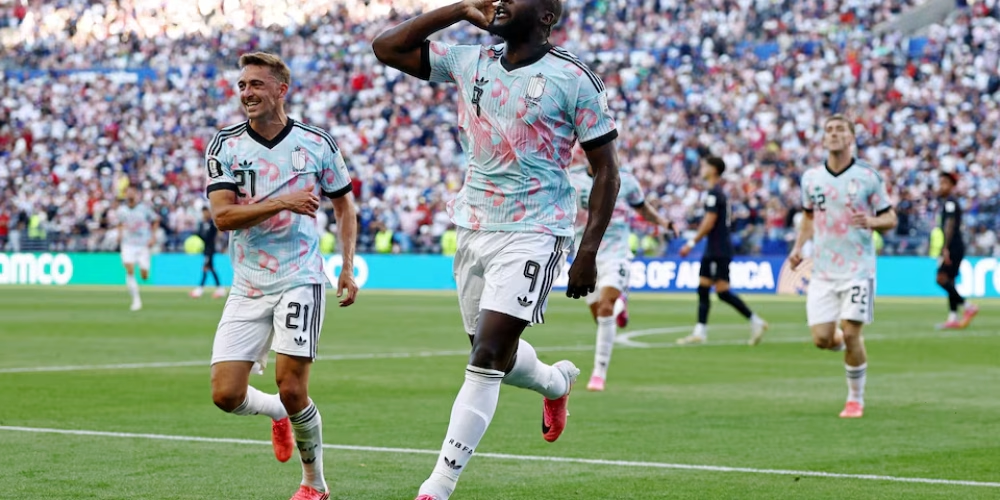
- The rewritten tactical approach paid massive dividends on Tuesday afternoon as the Red Devils comfortably outclassed the tournament hosts in Seattle.
A tactical revolution came to full fruition on Tuesday as a rebranded Belgian squad officially stepped out from the shadow of its decorated past. Deploying a high-intensity, collective pressing structure completely devoid of the fading superstars that defined their previous decade, the Red Devils thoroughly outmatched their opponents to book a spot in the quarter-finals. The decisive performance in Seattle proves that tactical harmony and youthful hunger can comfortably trump individual star power on the grandest stage in international sport.
What You Need to Know
For more than a decade, Belgian football was inextricably linked to its famous “Golden Generation,” a collection of world-class individuals who plied their trade at the absolute pinnacle of European club football. While that star-studded era yielded a historic third-place finish at Russia 2018, it ultimately failed to capture a major international trophy, leaving a legacy defined by underachievement and internal friction. Recent major tournaments exposed severe pacing deficiencies within the aging core, culminating in an embarrassing group-stage exit in Qatar and a lacklustre showing at the subsequent European Championship.
Following those structural failures, the national association initiated a comprehensive overhaul of its technical infrastructure, appointing Rudi Garcia to oversee a delicate transitional phase. The newly appointed tactician faced immediate skepticism from domestic sports commentators after making the brave decision to phase out several veteran figures in favor of lesser-known, highly energetic domestic and European prospects. The strategic shift required a complete abandonment of possession-centric, slow-tempo football in favor of a modern, vertically direct system dependent on extreme physical conditioning and collective defensive responsibility.
The newly constructed team faced a massive psychological hurdle early in the knockout rounds, narrowly escaping an intensive round-of-32 clash against Senegal. After falling into a dangerous two-goal deficit, Garcia utilized a second-half hydration break to radically realign his players, sparking an emotional comeback that galvanized the young squad. That gritty victory provided the essential validation this inexperienced group required, setting the stage for their masterclass performance during Tuesday’s high-stakes encounter in the Pacific Northwest.
Tactical Harmony and Youthful Hunger Push Red Devils Forward
The tactical adjustments implemented by Garcia were on full display from the opening whistle in Seattle, completely suffocating the opposing midfield through a coordinated counter-pressing scheme. Unlike previous iterations of the national team, which frequently allowed opponents to control the tempo while waiting for an individual moment of brilliance, this modern unit operated as a unified defensive block. The front three attackers spearheaded the defensive effort, executing continuous high sprints to disrupt the opposition’s build-up phase and force frequent operational turnovers in the middle third of the pitch.
This relentless physical pressure bore fruit early in the first half, allowing the European side to exploit space on the flanks through rapid, direct transitions. Rather than overcomplicating their attacking sequences with short lateral passes, the Belgian midfielders immediately looked to deliver vertical balls behind the opposing backline, stretching the defense and creating clear numerical advantages inside the penalty box. This collective approach yielded multiple goals before the halftime interval, effectively neutralizing the crowd energy and putting the match entirely out of reach for the home nation.
In the second half, the Red Devils demonstrated impressive tactical maturity by seamlessly transitioning into a compact, disciplined low block to preserve their commanding advantage. The younger central defenders, who entered the competition under intense scrutiny due to their lack of senior international experience, displayed exceptional positional awareness and structural discipline. By completely neutralizing the opposition’s aerial threats and tracking wide runners with flawless precision, Belgium closed out the match without conceding significant scoring opportunities, finalizing a convincing 4-1 victory.
Why This Matters
For soccer fans and digital sports executives across the United States and global English-speaking markets, Belgium’s successful transformation offers a fascinating blueprint for program development. It demonstrates that mid-tier footballing nations do not need to possess transcendent global icons to build a highly competitive, deeply entertaining tournament roster. This systemic triumph serves as a powerful reminder that cohesive team chemistry and a clear, well-rehearsed tactical identity are far more valuable in single-elimination formats than marketing hype or individual star power.
Furthermore, this rapid evolution provides crucial insights for commercial brands and sports marketers who rely heavily on individual player endorsements to drive fan engagement. The tournament progress of a team built on collective unity suggests that modern sports audiences are increasingly captivated by high-stakes tactical drama and collective resilience rather than isolated superstar narratives. Moving forward, digital media coverage and marketing campaigns may shift their focus toward highlighting tactical ingenuity and group dynamics, reflecting the changing landscape of elite team sports.
NCN Analysis
The comprehensive victory in Seattle cements Garcia’s status as an elite international strategist who successfully executed one of the most difficult rebuilding projects in modern sports. By prioritizing physical work-rate and tactical adaptability over historical reputations, the manager has unlocked a refreshing level of energy that was sorely missing during the twilight years of the Golden Generation. However, the technical staff must ensure that this young squad maintains its emotional equilibrium, as the tactical challenges will become significantly more complex as they advance into the final rounds in Kansas.
The next tactical obstacle will test whether this high-pressing system can remain effective against elite, possession-based opponents who excel at bypassing midfield traps. While their defensive stability against direct counter-attacks has improved dramatically since the group stage, minor lapses in communication could still be ruthlessly punished by world-class playmakers. Global readers should watch closely to see how Garcia modifies his pressing triggers in the upcoming quarter-final, as this functional flexibility will ultimately dictate whether Belgium can transform this promising run into a historic championship triumph.
The revamped European side proved that a unified, hard-working collective is vastly superior to a fractured group of aging superstars, permanently altering the trajectory of the national program.
Reported by the NCN Editorial Team









