

KEY POINTS
- Javier Aguirre has officially departed his role as head coach of the Mexican national team following the conclusion of their 2026 World Cup campaign.
- The veteran manager expressed immense pride in the team’s performance and structural progress during his third stint leading El Tri.
- Aguirre strongly endorsed his assistant and legendary former defender Rafael Marquez to take over the managerial reins for the next cycle.
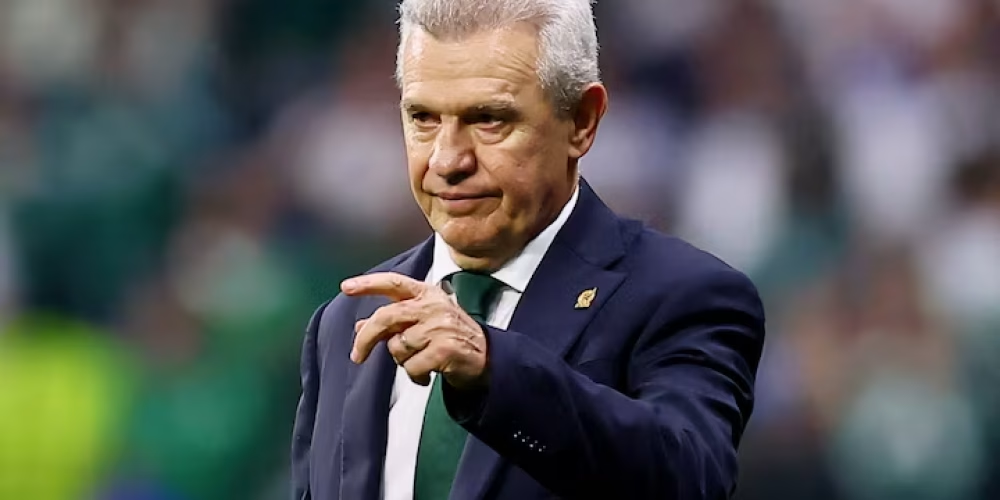
The Mexican men’s national soccer team is entering a new era as Javier Aguirre steps down from his role following the official conclusion of the co-hosts’ tournament journey. Fresh off the final matches of Mexico’s campaign, the veteran tactician announced his departure to facilitate a smooth transition of power. Aguirre leaves the position with a sense of immense pride, strongly backing his top assistant and iconic former national team captain Rafael Marquez to guide the federation forward.
What You Need to Know
The 2026 FIFA World Cup represented a watershed moment for North American soccer, with Mexico co-hosting the prestigious tournament alongside the United States and Canada. For the Mexican Football Federation (FMF), the tournament was not merely a competitive challenge but a critical opportunity to restore national pride after a string of disappointing international performances in recent years. To stabilize a volatile national team environment, football executives turned to Javier Aguirre in mid-2024, handing him the managerial reins for an unprecedented third time in his storied career.
Aguirre, affectionately known as “El Vasco,” previously rescued Mexican World Cup campaigns in both 2002 and 2010. His appointment two years ago came with a specific, dual-purpose mandate: navigate the intense pressure of a home World Cup and prepare a long-term successor. Central to this strategy was the immediate hiring of Rafael Marquez, one of Mexico’s greatest ever players, to serve as Aguirre’s primary assistant. The explicit plan from the outset was for Marquez to learn under Aguirre’s mentorship before eventually taking full control of the national team program.
As co-hosts, El Tri faced unique challenges leading up to the summer of 2026. Deprived of competitive continental qualifiers, Aguirre had to rely on high-profile international friendlies and regional tournaments to forge a cohesive squad. The pressure from a passionate fan base and intense media scrutiny demanded immediate stability, a hallmark of Aguirre’s pragmatic managerial style. With the home tournament now reaching its business end, the moment Javier Aguirre steps down marks the completion of his short-term rescue mission and the activation of the federation’s long-term succession blueprint.
Javier Aguirre Legacy and the Rise of Rafael Marquez
Following Mexico’s elimination from the knockout stages of the tournament, Aguirre finalized his departure during an emotional press conference. Reflecting on his brief but intense third tenure, the 67-year-old manager emphasized that he felt profound satisfaction with the competitive spirit and discipline injected into the squad. Rather than viewing the exit as a failure, Aguirre framed the campaign as a foundational stepping stone for a young generation of international players who proved they could compete under the highest stakes on home soil.
The focal point of Aguirre’s farewell address was his unconditional endorsement of Rafael Marquez. Aguirre praised Marquez’s tactical evolution, leadership qualities, and the immense respect he commands within the dressing room. Having captained Mexico in five consecutive World Cups, Marquez possesses an unparalleled understanding of the unique psychological and cultural pressures associated with wearing the green jersey. Aguirre noted that Marquez is not simply ready for the position, but is the ideal visionary to implement a modern, progressive style of play that fans have long craved.
Marquez’s impending elevation to head coach represents a significant tactical shift for El Tri. While Aguirre was renowned for his defensive organization, grit, and motivational capabilities, Marquez brings an ethos heavily influenced by his highly successful playing career at FC Barcelona. Having played under legendary managers like Pep Guardiola, Marquez is expected to prioritize a possession-oriented, proactive philosophy. His experience coaching Barcelona’s athletic reserve squad, Barça Atlètic, also provides him with proven credentials in developing elite youth talent, a vital attribute for a refreshing Mexican roster.
The structural reality that Javier Aguirre steps down after fulfilling his short-term mandate ensures that the Mexican Football Federation requires absolute continuity. The post-tournament debrief will undoubtedly focus on tactical shortcomings in the decisive knockout matches, but Aguirre’s structural framework remains intact. By stepping aside gracefully, the veteran manager has shielded Marquez from immediate blame, allowing the younger coach to inherit a disciplined squad that has already adapted to his daily training methods over the past twenty-four months.
Why This Matters
For global soccer enthusiasts and particularly sports fans in the United States, the administrative and tactical direction of Mexican soccer has a direct, tangible impact on the North American sports landscape. The rivalry between the United States Men’s National Team (USMNT) and Mexico remains the undisputed crown jewel of CONCACAF soccer. A stable, tactically sophisticated Mexican team elevates the competitive quality of the entire region, driving television ratings, ticket sales, and commercial investments to record heights across North American stadiums.
Furthermore, Major League Soccer (MLS) and Liga MX continue to intertwine through collaborative tournaments like the Leagues Cup. The strategic direction of the Mexican national team influences player valuation, development pipelines, and scouting networks that directly affect American club soccer. With Rafael Marquez expected to take the helm, American soccer executives and fans will closely monitor how a rejuvenated Mexico alters the balance of power in regional tournaments like the CONCACAF Gold Cup and upcoming iterations of the Nations League.
NCN Analysis
From an editorial perspective, Javier Aguirre’s departure is an example of masterful succession planning in an industry notorious for reactive, short-sighted decisions. The Mexican Football Federation has historically suffered from a lack of patience, frequently changing managers at the first sign of turbulence. By pairing Aguirre with Marquez in 2024, the federation insulated the team from structural chaos, ensuring that the conclusion of the 2026 World Cup would bring an orderly evolution rather than a destructive rebuild.
The true test for Rafael Marquez begins immediately. Transitioning from a revered assistant and legendary player to the ultimate decision-maker is a notoriously difficult journey in international football. He will no longer have the luxury of working in Aguirre’s shadow and must quickly establish his authority while managing the transition of aging veterans out of the national setup. Football analysts should watch how quickly Marquez establishes his possession-based philosophy and whether the federation gives him the multi-year patience required to build a team capable of dominating the 2030 cycle.
The orderly passing of the managerial baton from Aguirre to Marquez secures a stable, forward-looking future for Mexican soccer after the intense pressures of their home World Cup campaign.
Reported by the NCN Editorial Team









