

KEY POINTS
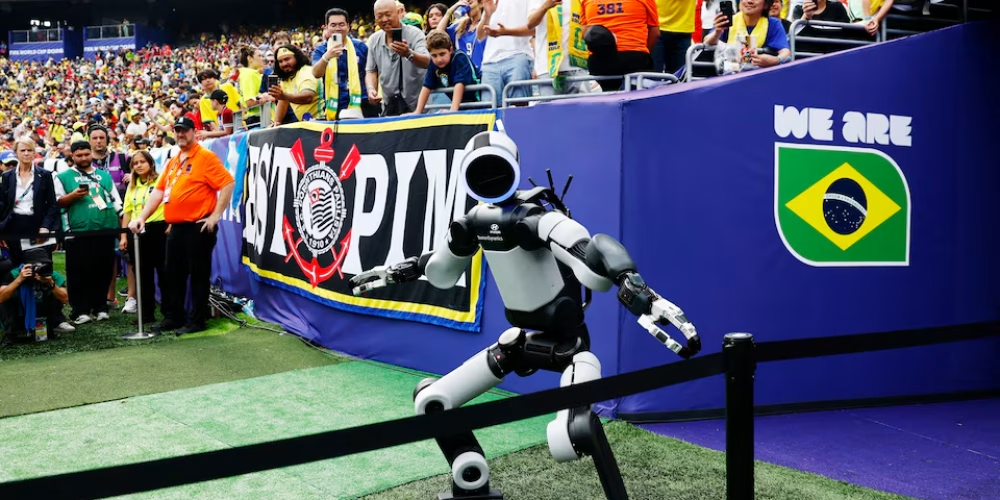
- Boston Dynamics’ famous Atlas humanoid robot made a surprise appearance during a major World Cup knockout fixture in New Jersey.
- The advanced machine walked onto the pitch at halftime to deliver the official match ball, executing several iconic player goal celebrations.
- Engineers overcame massive stadium wireless interference and soft grass terrain to pull off the high-tech promotional showcase.
The intersection of elite sports and cutting-edge automation reached a stunning milestone this weekend as a humanoid robot officially joined the World Cup festivities. Spectators at New York New Jersey Stadium were treated to an unexpected spectacle when Atlas, the highly advanced bipedal machine, walked onto the grass to deliver the match ball. The technical display highlighted how rapidly robotics technology is advancing into the mainstream public consciousness during global cultural events.
What You Need to Know
The 2026 World Cup has consistently served as a launchpad for technological innovation, from enhanced video officiating to advanced stadium logistics. However, integrating autonomous robotics directly onto the field of play represents an entirely new frontier for tournament organizers. The event was orchestrated in partnership with tournament sponsor Hyundai Motor, which has invested heavily in the robotics sector over recent years.
The machine used for this pitchside debut is Atlas, a humanoid robot developed by Boston Dynamics that has garnered global internet fame for its agility, capability to perform parkour, and uncanny human-like movements. Historically confined to highly controlled laboratory environments and pre-recorded promotional clips, deploying the bipedal machine inside a live stadium packing tens of thousands of screaming sports fans presented a massive engineering challenge.
Operating a delicate piece of machinery on a sports field requires solving physical and digital obstacles that do not exist in a laboratory. Turf surfaces are inherently uneven, soft, and unpredictable compared to flat concrete floors, requiring the machine to dynamically adjust its balance with every step. Additionally, the sheer volume of mobile data signals generated by fans inside a modern stadium creates an electronic environment that can easily disrupt standard robotic control systems.
A High-Tech Halftime Show in New Jersey
The historic moment occurred during the halftime interval of the high-stakes Round of 16 match between Brazil and Norway in East Rutherford. As the players retreated to the locker rooms, the bipedal machine stepped onto the pitch carrying the official match ball. To the delight of the crowd, the robot did not simply walk in a straight line; it mimicked famous goal celebrations, including the iconic seated meditation pose popularized by Norwegian star striker Erling Haaland.
To ensure the demonstration went off without a hitch, engineering teams had to implement several custom modifications to the machine’s software and hardware infrastructure. Because standard Wi-Fi communication was entirely unusable due to the heavy congestion from fan cellphones, technicians outfitted the machine with a specialized radio device strapped directly to its back. This dedicated communication channel allowed handlers to maintain a secure, uninterrupted link with the machine throughout its time on the field.
Modifying how the machine interacted with the ground was equally critical to the success of the demonstration. Software engineers had to fundamentally alter the algorithm governing how the robot walks, jumps, and runs, programming it to be significantly more robust to handle the shifting texture of natural stadium grass. The successful delivery of the match ball to the officiating crew demonstrated that modern bipedal machines are becoming highly adaptable to real-world environments.
The demonstration also served as a major marketing showcase for Hyundai’s long-term industrial strategy. The automotive conglomerate has announced plans to aggressively push toward the mass production of these humanoid machines, with a targeted deployment at its US manufacturing facilities in Georgia scheduled to begin in 2028. The goal of that initiative is to utilize humanoids to automate repetitive, high-risk assembly line tasks, reducing workplace injuries.
Why This Matters
For technology enthusiasts, businesses, and everyday consumers across the United States and the globe, this stadium demonstration signals that humanoid robotics are transitioning from experimental novelties into viable commercial tools. Seeing a machine successfully navigate a packed sports stadium proves that autonomous systems are reaching a level of maturity where they can operate alongside humans in highly chaotic, public settings.
From a commercial standpoint, this event underscores how major global brands are leveraging international sporting events to normalize the presence of artificial intelligence and robotics in daily life. As these technologies migrate from stadium half-time shows into domestic manufacturing plants and eventually fulfillment centers, the implications for the future labor market, automation strategies, and corporate logistics will be felt across every major economic sector.
NCN Analysis
The deployment of Atlas at the World Cup is a brilliant piece of public relations, but it also provides a glimpse into the accelerating timeline of the robotics revolution. While critics might dismiss a robot mimicking a soccer celebration as a mere gimmick, the underlying engineering required to stabilize a bipedal machine on grass amidst heavy radio interference is extraordinarily complex. This successful public test validates the heavy capital investments being made by automotive and tech giants.
Readers should watch closely for how quickly these machines transition from promotional events into actual commercial operations over the next 24 to 36 months. As industrial giants prepare their domestic factories for robotic integration, the lessons learned from high-pressure deployments like the World Cup will directly inform how these machines are programmed to interact with human coworkers and variable factory floor environments.
The line between science fiction and professional sports has officially blurred on the world’s biggest stage.
Reported by the NCN Editorial Team









