

KEY POINTS
- San Antonio Spurs head coach Mitch Johnson and New York Knicks head coach Mike Brown both developed under legendary mentor Gregg Popovich.
- Brown served as a key assistant under Popovich from 2000 to 2003, winning a championship ring during San Antonio’s historic 2003 title run.
- Johnson stepped up after Popovich’s retirement to guide a transformed roster to a 62-20 regular season record and a Western Conference crown.
As the San Antonio Spurs and the New York Knicks prepare to clash on basketball’s grandest stage, the unmistakable shadow of a coaching legend looms large over both benches. The highly anticipated championship series features a fascinating master-versus-apprentice narrative that stretches across multiple generations of league history. Both San Antonio head coach Mitch Johnson and New York front-man Mike Brown spent their formative coaching years studying the game under the guidance of retired Hall of Famer Gregg Popovich.
What You Need to Know
The concept of a coaching tree is deeply embedded in professional sports culture, representing how a singular mentor’s philosophy ripples across the league through their former assistants. Popovich, who stepped away from active coaching following a mild stroke in late 2024, is universally regarded as one of the finest program builders in sports history. Over nearly three decades at the helm of the Texas franchise, his meticulous attention to detail, emphasis on ball movement, and corporate culture transformed a small-market team into a five-time champion.
Former assistants who studied under the legendary tactician have gone on to build elite programs of their own, frequently implementing the strategic foundations and communication styles they observed in San Antonio. These principles center around continuous player development, maintaining locker room connectivity, and tuning out external media distractions.
This professional lineage has converged at the absolute pinnacle of the sport. As the championship series opens, the primary strategists mapping out defensive schemes and offensive adjustments are executing philosophies born in the exact same film rooms and practice facilities.
Parallel Paths From San Antonio to the Finals
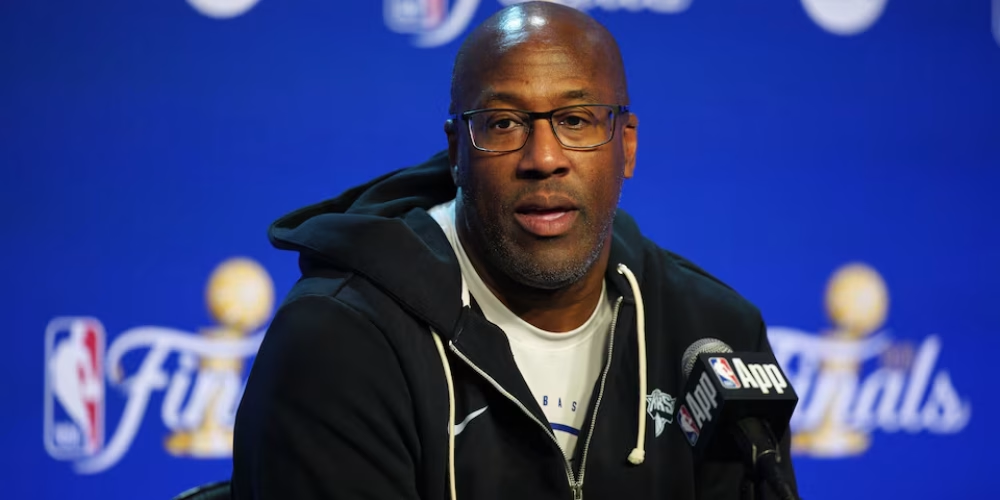
The professional journeys of the two modern finalists illustrate just how far the former mentor’s reach extends. Brown, the seasoned leader of the New York franchise, served on the bench under the Hall of Famer from 2000 to 2003, culminating in a dominant championship victory over the New Jersey Nets. Reflecting on his formative years on Tuesday, the veteran strategist fondly recalled how the experience deeply shaped his personal and professional approach to team management, even jokingly reminiscing about a youth flag football league the pair dominated during their shared time in Texas.
In stark contrast, Johnson represents the contemporary branch of the organizational tree. Having started his professional ascent with the franchise’s G League affiliate in Austin, he moved to the main bench as an assistant in 2019. When the legendary executive suffered a sudden health crisis in November 2024, Johnson seamlessly stepped into the interim role before being named the permanent head coach in May 2025. In his first full season at the helm, the young strategist orchestrated a phenomenal turnaround, engineering a spectacular 62-20 regular season record and outlasting the defending champions in a grueling seven-game conference final.
Despite stepping out from the towering shadow of his predecessor, Johnson noted that the legendary figure remains an invaluable active asset. Currently serving as the organization’s president of basketball operations, the Hall of Famer regularly communicates with the young coach, offering guidance while granting him the complete freedom to implement his own modern operational vision.
Why This Matters
For basketball enthusiasts and sports business analysts across North America and global markets, this architectural matchup demonstrates the profound, enduring power of institutional culture. The fact that both championship contenders are guided by executives rooted in the same basketball program underscores that corporate continuity and structural alignment remain the ultimate drivers of professional success.
Furthermore, the contrasting styles of the two finalists reflect how the original blueprint can be successfully adapted over time. Brown has blended those foundational lessons with decades of independent head coaching experience to build a resilient, disciplined East Coast powerhouse. Meanwhile, Johnson has applied those exact same concepts to maximize a hyper-athletic, modern roster featuring elite international talent. For fans watching worldwide, the series serves as a celebration of strategic excellence and shared heritage.
NCN Analysis
The tactical chess match between these two brilliant minds promises to be an absolute masterclass in adjustment and counter-adjustment. Because both strategists share an intimate familiarity with the core principles of their former mentor, executing predictable schemes will be completely ineffective. Success in this series will ultimately hinge on which coach can faster implement subtle, unexpected wrinkles to catch the opposing defense off guard.
Expect the organizational wisdom passing from the front office down to the floor to play a massive factor as the pressure mounts. While Johnson commands a roster short on championship series experience, having a five-time champion readily available in the building provides an unparalleled competitive safety net. This rich background of historic success ensures that regardless of how the opening games unfold, both benches possess the psychological framework needed to sustain a long, grueling championship battle.
The legacy of an elite program has set the standard of excellence that will dictate the boundary lines for the next champion.
Reported by the NCN Editorial Team









