

KEY POINTS
- The intense soccer rivalry between England and Argentina reflects deeply contrasting, evolving ideas of national identity played out on the global stage.
- England’s footballing identity has shifted from historic isolationist superiority to a diverse, multicultural symbol of modern British society.
- Argentina’s sporting culture remains firmly anchored in a century-old origin myth centered on the clever, street-smart archetype known as the “pibe.”
The high-stakes 2026 World Cup semifinal match between England and Argentina represents far more than a battle for a spot in the tournament final. When these two soccer powerhouses share the pitch, they bring together decades of historical friction, tactical innovation, and deeply contrasting philosophies of national belonging. For sports enthusiasts across North America and the global English-speaking community, this historic fixture offers a fascinating look into how ninety minutes of soccer can mirror the evolving soul of entire nations.
📝 What You Need to Know
To fully appreciate the cultural forces at play in this match, one must examine the vastly different historical foundations that have shaped each country’s soccer identity. In England, the sport was born as an expression of institutionalized pride. Having codified the modern rules of the game in the nineteenth century, the English footballing establishment initially operated with a distinct sense of isolationist superiority. This deep-seated belief in their own natural dominance was so pervasive that England famously declined to participate in the first three FIFA World Cups, viewing their domestic competitions as the only true measure of excellence.
Argentina’s soccer identity, by contrast, emerged in direct cultural opposition to the structured, physical British style introduced to South America by expatriates. During the 1920s, Argentine sports journalists and cultural thinkers actively rejected the rigid, athletic approach of the English. Instead, they championed a unique style born in the crowded urban pastures of Buenos Aires. This homegrown philosophy celebrated individual artistry, trickery, and improvisation, establishing a sporting identity that felt entirely distinct from its European roots.
The defining symbol of this Argentine soccer mythology is the archetype of the “pibe”—a romanticized street child characterized by his small stature, untamed dark hair, and a mischievous, street-smart smile. Popularized in legendary 1928 sports editorials by the publication El Gráfico, the pibe came to represent the idealized Argentine footballer: a player who relies on cunning, agility, and pure instinct to overcome larger, more powerful opponents. This powerful imagery laid the foundation for generations of Argentine soccer, finding its ultimate real-world manifestation decades later in the career of Diego Maradona.
⚔️ The Modern Evolution of English and Argentine Soccer Culture
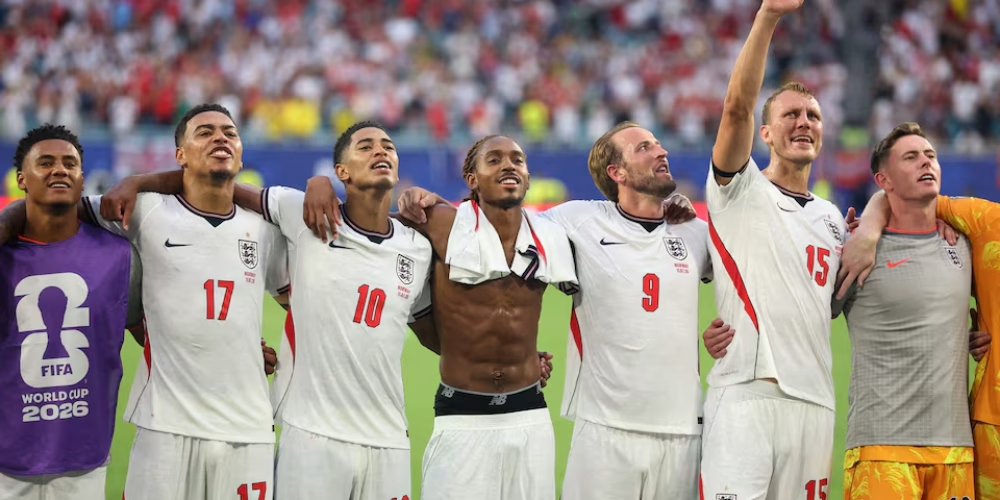
As both societies transformed over the latter half of the twentieth century and into the early twenty-first, their respective national soccer teams continued to mirror these societal shifts. In England, the national squad has evolved from a historically homogenous institution into one of the country’s most powerful symbols of modern multiculturalism. The contemporary English roster features second- and third-generation immigrants from across the globe, reflecting the diverse reality of modern British cities. Cultural analysts note that for a country without a singular, unified national institution, the English soccer team has played a profound role in redefining the social parameters of what it means to be English in the twenty-first century.
This cultural transition has not been without its challenges, as evidenced by the intense public scrutiny and online racial abuse directed at minority players following high-profile tournament heartbreaks in recent years. However, the collective resilience of the squad has continually fostered a shared sense of national purpose. Icons like Jude Bellingham have galvanized a diverse, modern fanbase, with traveling supporters singing along to classic British anthems at the conclusion of massive victories, illustrating how a sports team can build a unified national narrative centered on shared hope rather than ancestry.
Argentina’s soccer culture has faced its own modern pressures, particularly as economic volatility and globalisation have driven the country’s elite young talent to sign with wealthy European clubs at increasingly early ages. Despite these global migrations, the core mythology of Argentine football remains remarkably preserved. The modern national team, guided by senior veterans and exciting prospects, still carries the heavy expectations of the pibe tradition. Furthermore, contemporary geopolitical narratives continue to intertwine with sports culture, as modern fan anthems actively blend references to past tournament triumphs with emotional nods to national sovereignty, demonstrating that for Argentines, the soccer pitch remains a vital space for expressing collective identity.
🌍 Why This Matters
For American sports enthusiasts and cultural observers observing the tournament from the United States, this fascinating contrast highlights the unique sociological power of soccer. Unlike traditional domestic sports in North America, international soccer serves as a direct canvas for showcasing competing national values, political histories, and cultural philosophies on the world’s most visible platform.
Understanding these deep-rooted societal narratives enriches the viewing experience for a rapidly growing American soccer fanbase preparing for future major tournaments on home soil. It elevates a standard athletic competition into a captivating story of human geography, proving that the tactical choices made on the grass are often deeply connected to the historical and social landscapes of the countries involved.
📊 NCN Analysis
From an editorial perspective, the tactical matchup between England and Argentina is a beautifully complex collision of modern sporting philosophies. England enters the match playing a globalized, highly structured style that relies on athletic power, meticulous positioning, and high-intensity transitions. Argentina, conversely, still retains that signature spark of unpredictable individual brilliance, utilizing quick passing combinations and a stubborn collective grit that mirrors their century-old sporting mythology.
As international football continues to become more globalized through shared coaching methodologies and European club environments, this semifinal matchup stands as a glorious reminder of the sport’s enduring local souls. Whichever nation triumphs on the pitch will not only secure a spot in the final but will also validate their country’s contemporary story, proving that soccer remains international sports’ most powerful generator of collective national identity.
The legendary clash between these two footballing titans reminds us that a World Cup match is never just a game, but a profound cultural mirror reflecting how nations see themselves and the world around them.
Reported by the NCN Editorial Team









