

KEY POINTS
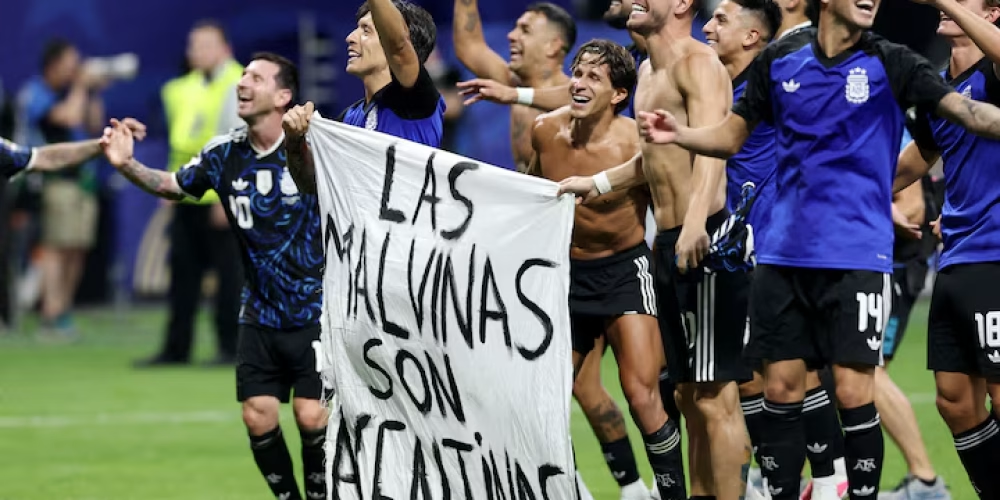
- Argentina players celebrated their World Cup semifinal victory by displaying a political banner claiming the Falkland Islands.
- The message “Las Malvinas son Argentinas” was displayed on the pitch, in direct violation of governing body protocols.
- FIFA is expected to launch a disciplinary probe that could result in substantial fines or match-day restrictions.
Defending champions Argentina have triggered a major geopolitical controversy following their dramatic 2-1 World Cup semifinal victory over England on Wednesday night. During the post-match celebrations at the Mercedes-Benz Stadium in Atlanta, several prominent Argentine players brandished a highly charged political banner asserting sovereignty over the Falkland Islands. The provocative gesture has overshadowed their remarkable on-field comeback and placed the national association at risk of severe disciplinary action from soccer’s global governing body.
What You Need to Know
The dispute over the Falkland Islands, known in Spanish as Las Malvinas, is a deeply sensitive geopolitical issue that has strained relations between Argentina and the United Kingdom for centuries. Situated in the South Atlantic Ocean roughly 300 miles off the Argentine coast, the archipelago is a self-governing British Overseas Territory. The diplomatic friction culminated in a bloody 74-day war in 1982 after Argentina’s military junta invaded the islands, resulting in the deaths of 649 Argentine military personnel, 255 British servicemen, and three islanders.
Despite the conflict ending more than four decades ago with a decisive British victory, Argentina continues to claim sovereignty over the territory. The country’s political leaders and public institutions frequently assert this claim, integrating it deeply into the national identity. For generations of Argentines, the territorial dispute remains an active and unresolved grievance, which frequently spills over into high-profile sporting fixtures between the two nations.
Soccer’s governing authorities maintain an incredibly strict stance against the injection of politics into stadiums. The International Football Association Board (IFAB) and FIFA explicitly ban players and teams from displaying any political, religious, or personal slogans, statements, or images during matches. Under these strict guidelines, national associations are held directly responsible for the behavior of their personnel, with violations routinely resulting in financial penalties, stadium bans, or even point deductions in extreme circumstances.
Geopolitical Tension Spills onto the Pitch in Atlanta
The controversy unfolded immediately after the final whistle blew on Argentina’s spectacular 2-1 comeback victory. Amid the chaotic celebrations on the Atlanta pitch, midfielder Giovani Lo Celso and defender Nicolas Otamendi were observed holding up a banner that read “Las Malvinas son Argentinas” (The Malvinas are Argentine). While the banner originally appeared to have been handed down from supporters in the stands, the players willingly displayed it before Lo Celso laid it out across the grass during the height of the celebrations.
The political display occurred despite prior efforts by tournament organizers and security personnel to keep the sovereignty dispute out of the stadium. Before kickoff, Argentine Security Minister Alejandra Monteoliva had stated that fans would not be permitted to bring flags or banners incorporating images of the Falkland Islands into the venue. However, the passion surrounding the historic rivalry proved impossible to contain, as fans repeatedly engaged in political chanting throughout the ninety minutes.
This is not the first time the Argentine Football Association (AFA) has run into regulatory trouble over the Falkland Islands issue. Ahead of the 2014 World Cup, FIFA fined the AFA £20,000 after players displayed an identical “Las Malvinas” banner before a warm-up match against Slovenia in La Plata. The repetition of the offense, combined with the incredibly high profile of a World Cup semifinal, suggests that any impending disciplinary response from the governing body will be significantly more severe.
Why This Matters
The intersection of international sports and geopolitical disputes poses a complex challenge for stadium operators, security firms, and corporate sponsors across the United States. As co-hosts of the expanded 48-team World Cup, American venues are tasked with hosting matches that carry deep-seated historical animosities between competing nations. Managing these politically charged atmospheres requires delicate diplomatic navigation to ensure spectator safety while upholding the strict neutrality standards demanded by global sponsors.
Furthermore, the immediate political fallout demonstrates how international athletic achievements are routinely co-opted for domestic political purposes. Following the match, Argentine Vice President Victoria Villarruel took to social media to celebrate the victory, explicitly linking the team’s sporting triumph to the territorial claim and sharing historical military footage. For global corporate brands investing billions of dollars into the tournament, such politically polarizing narratives present a persistent public relations challenge that can complicate marketing campaigns targeting diverse international audiences.
NCN Analysis
The decision by Argentina’s players to parade a political banner on the pitch was a highly calculated gamble that will almost certainly result in swift disciplinary action. While the squad’s emotional attachment to the Falklands issue is deeply rooted in their cultural upbringing, professional athletes must recognize that violating FIFA’s strict neutrality regulations carries tangible consequences. A substantial financial penalty is the most likely initial outcome, though more restrictive measures cannot be entirely ruled out as the governing body seeks to protect its brand image.
Looking ahead to Sunday’s highly anticipated final against Spain, the AFA must act quickly to quiet the diplomatic noise and ensure the squad’s focus remains entirely on the pitch. Facing a highly disciplined and tactically superior Spanish side will require Argentina’s absolute concentration, free from the distractions of an ongoing regulatory investigation. Whether this controversy serves as a motivating force or a costly distraction for the defending champions will be revealed when they step onto the field in New Jersey.
The boundary between national pride and political provocation remains a razor-thin line in the modern game.
Reported by the NCN Editorial Team









