

KEY POINTS
- Norway is ending a agonizing 28-year absence from the global stage after storming through a dominant qualifying campaign.
- Led by Manchester City superstar Erling Haaland, the Scandinavian side boasts one of the most fearsome attacking units in the tournament.
- Severe fitness and rhythm concerns surrounding key defensive pillars threaten to derail the nation’s long-awaited tournament return.
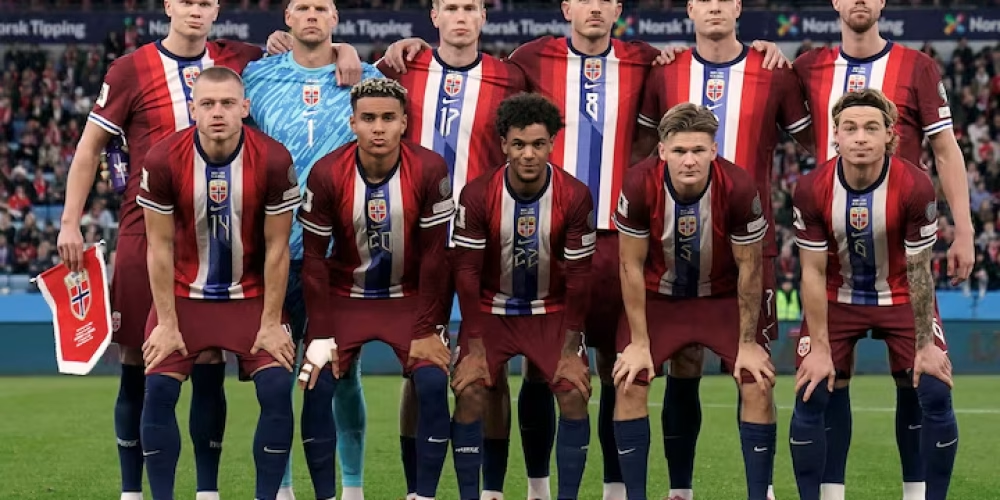
Norway will arrive at the upcoming global tournament carrying the immense weight of a golden generation and the deep-seated anxiety that naturally accompanies it. After a relentless qualifying campaign powered by some of the most prominent names in European club football, manager Ståle Solbakken’s squad looks physically equipped to convert decades of unfulfilled promise into a genuine national fairytale. However, for a country defined by generations of tournament heartbreak, local optimism remains heavily guarded by defensive hesitation.
What You Need to Know
To fully appreciate the magnitude of Norway’s return to the world stage, one must look back to 1998, the last time the Scandinavian nation competed at a men’s global finals. For nearly three decades, Norwegian football fans have watched major tournaments from the sidelines, gaining an unwanted reputation for stumbling precisely when expectations peaked. This historical drought has finally been shattered by an unprecedented influx of elite individual talent, creating what sports analysts widely consider the finest generation of players the country has ever produced.
The central catalyst behind this national soccer renaissance is Erling Haaland. The prolific Manchester City striker enters the tournament in the absolute prime of his career at 25 years old, having single-handedly torn through the qualification process with a staggering 16 goals. His qualification haul included a ruthless five-goal performance against Moldova and a decisive brace in the final qualifier against Italy, ensuring Norway cruised through their group with an unblemished record.
While Haaland acts as the team’s primary spearhead, Norway’s offensive strategy is far from a one-man operation. Solbakken has cultivated a highly imposing attacking cast that features Atlético Madrid’s powerful forward Alexander Sørloth and RB Leipzig’s unpredictable winger Antonio Nusa. The critical engine room is anchored by Arsenal captain Martin Ødegaard, who serves as the tactical glue connecting a hardworking midfield to the team’s devastating frontline firepower.
Superpower Attack Collides With Defensive Fragility
As Norway prepares to navigate a challenging Group I campaign that features heavyweight clashes against France, Senegal, and Iraq, the primary concern remains the uneven composition of the roster. While the forward line rivals any elite squad in the tournament layout, the defensive infrastructure is facing a race against time. The contrast between Norway’s world-class attacking options and their unproven backline has become the defining talking point of their tournament build-up.
Norway Tournament Group I Lineup:
1. France (European Powerhouse)
2. Norway (Nordic Attackers)
3. Senegal (African Champions)
4. Iraq (Asian Contenders)
The tactical dilemma intensified following recent fitness setbacks to central defensive pillars. Bologna defender Torbjørn Heggem, who emerged as a reliable mainstay during the qualification campaign, has been managing persistent fitness issues, leaving his match sharpness for the opening fixtures under a cloud of doubt. Compounding the issue is a noticeable lack of regular playing rhythm among Solbakken’s other preferred center-back options.
To mitigate these defensive vulnerabilities, Solbakken has leaned heavily on tactical discipline from his central midfielders and high-intensity pressing from wide areas. Young talents such as Oscar Bobb, Andreas Schjelderup, and Jørgen Strand Larsen provide excellent tactical flexibility, allowing Norway to seamlessly shift structures depending on the opposition. However, football analysts warn that structural adjustments cannot entirely mask individual defensive errors when facing elite international attackers.
Why This Matters
Norway’s long-awaited return introduces an incredibly dynamic element to the global sports landscape. For millions of casual sports fans, seeing global icons like Haaland and Ødegaard finally showcase their skills on the grandest international stage adds immense star power and commercial value to the tournament ecosystem. Their presence alone elevates Group I into one of the most highly anticipated and heavily viewed sections of the opening round.
On a broader scale, Norway’s trajectory highlights the profound challenge smaller footballing nations face when attempting to balance top-heavy rosters. The team represents a fascinating modern test case in sports science and tournament strategy: can a world-class offense single-handedly carry a defensively vulnerable team deep into a knockout bracket? The outcome of their campaign will offer valuable lessons for international teams relying on an exceptional generation of attacking specialists.
NCN Analysis
Ståle Solbakken has successfully engineered a high-scoring, fearless identity that has effectively banished the psychological demons of past Norwegian failures. However, tournament football is historically cruel to teams that lack defensive stability. While Haaland is entirely capable of winning individual matches through sheer athletic brilliance, navigating a brutal group that includes a disciplined French side will require an level of defensive resilience this roster has yet to consistently demonstrate under maximum pressure.
Readers should watch closely to see how effectively Ødegaard manages the tempo of matches during the opening group fixtures. If the Arsenal playmaker can successfully dictate the pace and starve opposing midfields of possession, he can effectively shield Norway’s vulnerable backline from sustained exposure. If the defensive infrastructure can simply perform at an average, mistake-free level, Norway possesses the raw, explosive firepower required to mount a historic dark-horse run deep into the summer.
Norway’s breathtaking offensive capabilities make them the tournament’s most captivating wild card, capable of matching any global powerhouse if their fragile defense can hold firm.
Reported by the NCN Editorial Team









