

KEY POINTS
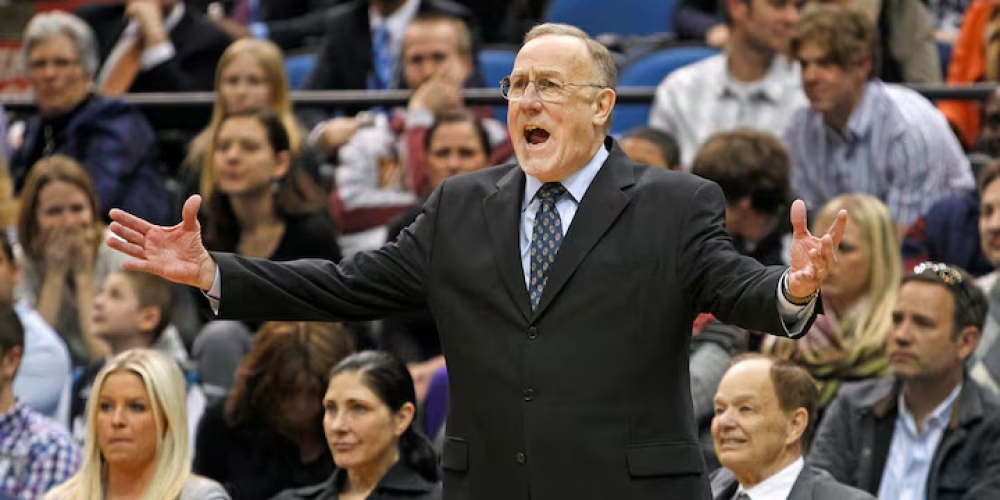
- Rick Adelman, the legendary NBA head coach who won 1,022 games over a storied 23-year career, has passed away at the age of 79.
- He famously guided the Portland Trail Blazers to two NBA Finals appearances and transformed the Sacramento Kings into an offensive powerhouse.
- Enshrined in the Naismith Memorial Basketball Hall of Fame in 2021, Adelman ranks among the winningest coaches in professional basketball history.
Rick Adelman, the master tactician whose fluid offensive systems revolutionized modern basketball strategy, has passed away at the age of 79. Over a distinguished 23-year career on the sidelines, Adelman cemented his legacy as one of the most successful head coaches in NBA history, compiling 1,022 regular-season victories. His death marks the loss of a foundational figure in professional sports who left an indelible footprint on multiple franchises across the United States.
What You Need to Know
To understand the scope of Rick Adelman’s influence, one must look at the state of professional basketball during his coaching peak in the late 1980s through the early 2000s. Before modern analytics prioritized high-volume three-point shooting, Adelman engineered an intricate, fast-paced offensive philosophy known as the “Corner Offense.” This system relied on high-post passing, constant off-ball motion, and versatile big men who could distribute the ball. His teams consistently ranked among the most entertaining and efficient units in league history, challenging the traditional, isolation-heavy styles of his contemporaries.
Adelman’s journey in professional sports began long before he donned a sharp suit on the bench. He was drafted into the league in 1968 after a stellar collegiate career at Loyola University New Orleans. As a player, he spent seven seasons as a gritty, intelligent point guard, playing for teams including the San Diego Rockets, the Portland Trail Blazers, and the Chicago Bulls. This on-court experience deeply informed his player-centric management style, earning him a reputation as a coach who could empower his athletes and maximize their unique skill sets.
His transition to coaching began at the collegiate level in Oregon before he ascended to the professional ranks as an assistant. When he finally took over the reins as an NBA head coach, he demonstrated an immediate knack for turning promising rosters into championship contenders. His quiet dignity, tactical flexibility, and refusal to court media drama made him a beloved figure among players, colleagues, and fanbases nationwide.
Engineering Dominance in Portland and Sacramento
The definitive chapters of Adelman’s coaching narrative were written in the Pacific Northwest and northern California. Taking over the Portland Trail Blazers mid-season in 1989, he quickly engineered a golden era for the franchise. Armed with a powerhouse roster featuring Clyde Drexler, Terry Porter, and Jerome Kersey, Adelman led the Trail Blazers to the NBA Finals in 1990 and 1992. Under his guidance, Portland became a perennial Western Conference juggernaut, defined by an aggressive transition game and stifling defensive pressure that electrified sports fans across the region.
Following brief stints coaching the Golden State Warriors and acting as an assistant, Adelman accepted the head coaching position with the Sacramento Kings in 1998. It was here that his creative genius achieved its highest expression. Turning a historically struggling franchise into a cultural phenomenon, Adelman’s Kings became known as “The Greatest Show on Court.” Featuring a dazzling core of Chris Webber, Vlade Divac, Jason Williams, and Mike Bibby, Sacramento pushed the legendary Los Angeles Lakers to the absolute brink in an iconic, hard-fought seven-game Western Conference Finals series in 2002.
Adelman would later continue his winning ways with the Houston Rockets and the Minnesota Timberwolves. In Houston, he orchestrated a spectacular 22-game winning streak during the 2007-2008 season, a feat that stands as one of the longest unbeaten runs in professional sports history, accomplished despite severe injury disruptions to star players. By the time he retired from coaching in 2014, he was one of only a select few individuals to surpass the elusive 1,000-win milestone. His immense contributions were formally recognized with his induction into the Naismith Memorial Basketball Hall of Fame in 2021.
Why This Matters
The passing of Rick Adelman resonates deeply across the American sports landscape because his innovative strategies laid the groundwork for how the game is played today. The beautiful game aesthetics favored by contemporary championship teams—characterized by positionless basketball, elite passing from center positions, and rapid ball movement—are direct descendants of the schemes Adelman perfected decades ago. For millions of basketball fans who grew up watching his thrilling teams, his passing represents the conclusion of a defining era in sports culture.
Beyond the tactical evolution, Adelman’s career serves as an enduring blueprint for leadership and workplace management. In an industry increasingly defined by volatile personalities and public friction, he proved that a calm, collaborative approach could command immense respect and yield elite results. His ability to foster harmony across diverse locker rooms offers timeless lessons for sports executives, organizational leaders, and community mentors throughout the United States.
NCN Analysis
From an editorial perspective, Rick Adelman remains one of the most underappreciated geniuses in the annals of American sport. While he never secured an elusive NBA championship ring as a head coach, measuring his impact solely by titles misses the broader truth of his legacy. He routinely encountered some of the greatest dynasties ever assembled—namely Michael Jordan’s Chicago Bulls and the Shaquille O’Neal-Kobe Bryant Lakers—yet his teams always remained fiercely competitive, pushing those historic squads to their absolute limits.
Looking forward, Adelman’s influence will continue to shine through the massive coaching tree he left behind. Dozens of his former players and assistant coaches currently populate benches across collegiate and professional ranks, passing down his core tenets of spacing, trust, and offensive freedom to the next generation of athletes. As the basketball community pauses to honor his memory, historians will increasingly validate his role as a vital bridge between the rigid, physical play of the 20th century and the fluid, globalized game of the modern era.
Rick Adelman changed the rhythm and flow of professional basketball, proving that tactical brilliance and quiet leadership could build a timeless sports legacy.
Reported by the NCN Editorial Team









