

KEY POINTS
- Spain manager Luis de la Fuente finalized his 26-man roster on Monday with zero players representing 15-time Champions League winners Real Madrid.
- Rival club Barcelona forms the absolute core of the national team with eight individual selections, including teenage sensation Lamine Yamal.
- The coaching staff expressed complete confidence that key injured stars will achieve full fitness before the tournament commences in Atlanta.
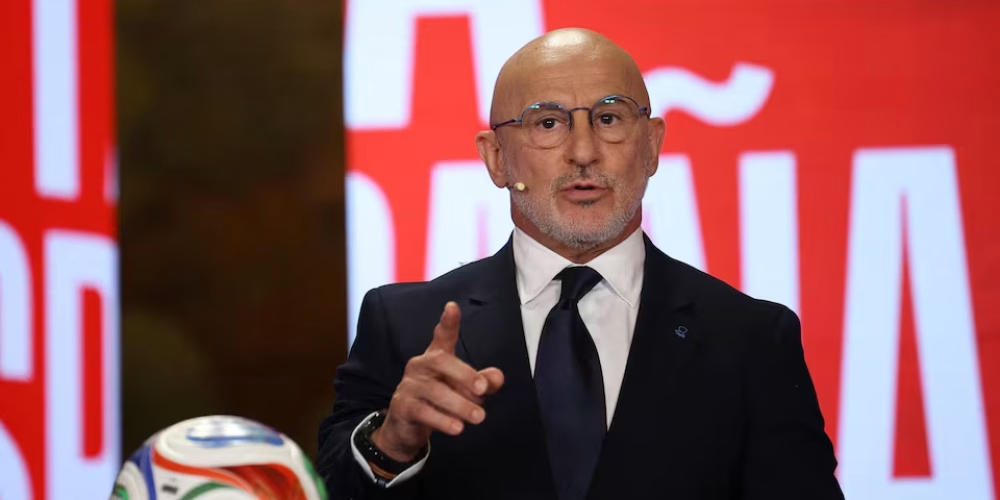
Spain head coach Luis de la Fuente triggered shockwaves throughout the global soccer landscape on Monday by completely excluding Real Madrid players from his official 26-man traveling roster for the upcoming tournament. This historic decision represents the first time since 1950 that the multi-time global champions will enter the premier international competition without a single representative from the prominent Madrid institution. Instead, the national team boss has placed his faith squarely in a youthful contingent heavily dictated by fierce domestic rivals Barcelona.
What You Need To Know
The historic rivalry between Barcelona and Real Madrid has traditionally formed the dual pillars of Spanish international football excellence. Across historic triumphs, including their dominant consecutive European achievements and the iconic 2010 global tournament victory in South Africa, national team managers routinely balanced the physical power of the capital city club with the intricate, possession-based philosophy engineered in Catalonia. This delicate domestic equilibrium has been fundamentally shattered by the latest roster announcement.
A variety of localized circumstances contributed directly to this unprecedented positional shift. Prominent veteran full-back Dani Carvajal was completely omitted from the final list following a highly disruptive, injury-riddled domestic campaign, while ascending defensive prospect Dean Huijsen was entirely sidelined due to a late-season medical setback. Furthermore, established figures like former team captain Alvaro Morata have transitioned out of the primary squad loop, paving the way for an aggressive generational overhaul.
Conversely, the current tactical philosophy deployed by the reigning European champions aligns seamlessly with the current crop of exceptional talent emerging from Barcelona. Despite enduring their own localized physical management challenges over the past several calendar months, the Catalan club’s technical profiles dominate the structural blueprint favored by the coaching staff. This intense structural familiarity is viewed as a significant competitive advantage as the squad prepares to face elite international opposition across North American venues.
Generational Shift as De la Fuente Prioritizes Catalan Talent
The official roster reveal event, held at the Telefónica building in Madrid, established a definitive blueprint for the team’s upcoming tournament strategy. The final 26-man selection features an impressive eight-player block originating directly from Barcelona, highlighting the extensive influence of the club’s development infrastructure. The designated Catalan group features high-profile names such as teenage winger Lamine Yamal, creative playmakers Pedri and Gavi, central defender Pau Cubarsi, alongside versatile assets Dani Olmo, Ferran Torres, Eric Garcia, and goalkeeper Joan Garcia.
Addressing the immediate media frenzy surrounding the total absence of capital club representation, the national team manager vigorously defended his selections as entirely merit-based. He emphasized that personal coaching responsibilities dictate evaluating individual performance profiles rather than geographical origins or institutional affiliations. The manager stated that his objective is to build a cohesive national unit driven by shared pride, completely detached from the typical local biases or club allegiances held by passionate domestic supporters.
Beyond the massive domestic contingent, the final roster reflects a substantial English influence, with seven selected players currently operating within the demanding environment of the Premier League. Arsenal is heavily represented with three critical inclusions, specifically goalkeeper David Raya alongside central midfielders Martin Zubimendi and Mikel Merino. Additionally, Manchester City anchor Rodri maintains his position as the indispensable operational heartbeat of the midfield unit, providing essential tactical balance to support the team’s creative attacking options.
A primary talking point emerging from the squad announcement involves the immediate availability of explosive wide attackers Yamal and Nico Williams, both of whom are managing persistent hamstring complaints. Despite lingering anxieties among fans regarding their readiness for the tournament opener on June 15 against Cape Verde in Atlanta, the head coach sought to project absolute serenity. He reinforced that the national team medical staff maintains constant communication with club doctors, asserting with absolute certainty that all key offensive assets will achieve peak performance condition in time for the opening group stage fixtures.
Why This Matters
This seismic roster shift holds fascinating implications for soccer enthusiasts and major sports entertainment stakeholders across the United States. Spain enters the expanded tournament as one of the definitive betting favorites following their masterful continental triumph in Germany, and their star-studded matches are projected to be prime television attractions. The presence of world-class talents like the 18-year-old Yamal serves as a massive commercial catalyst for American broadcast networks and tournament organizers who are eager to showcase the sport’s most exciting young entities to domestic audiences.
Additionally, the unique construction of this squad adds an extra layer of intrigue for casual American sports fans who follow global club soccer. Major cities such as Atlanta, which will host Spain’s introductory clash in Group H, will become temporary epicenters for a fascinating social experiment in sporting chemistry. Witnessing whether a national team entirely devoid of Real Madrid’s signature winning mentality can replicate their previous tournament successes provides a compelling storyline that transforms standard group matches into mandatory viewing for sports fans across North America.
NCN Analysis
The complete exclusion of Madrid-based personnel marks a monumental ideological turning point for the national team, signaling a total commitment to fluid, high-tempo modern possession football. While traditionalists within the Iberian press will inevitably criticize the lack of veteran defensive steel typically provided by the capital club, the head coach has made a calculated gamble that youth, technical speed, and systemic familiarity will overcome any perceived deficiencies in tournament experience. The sheer density of Barcelona players means the squad will benefit from pre-existing on-field chemistry that usually takes weeks of international training camps to develop.
The true test of this experimental selection philosophy will manifest during potential adverse situations in the knockout rounds. The immense pressure of a global tournament often requires the rigid, uncompromising defensive resilience that individuals like Carvajal historically provided during tight matches. If the youthful backline, anchored by prospects like Cubarsi, can maintain structural discipline against physical counter-attacking opponents, this bold selection strategy will be hailed as a masterstroke of modern squad modernization. All eyes must remain fixed on their upcoming warm-up friendlies against Iraq and Peru to gauge how effectively this localized core integrates with their Premier League-based counterparts.
The ultimate takeaway from this historic squad selection is that tactical compatibility and shared stylistic alignment have officially triumphed over traditional institutional reputation.
Reported by the NCN Editorial Team









