

KEY POINTS
- France and Morocco prepare to battle for a semifinal berth amid decades of complex shared history.
- Six Moroccan squad members were born in France, highlighting the deep athletic diaspora shaping the fixture.
- The neutral American setting offers a harmonious, family-friendly backdrop compared to high-security European venues.
A deeply symbolic sporting narrative unfolds in New England as France and Morocco face off in a highly anticipated quarterfinal matchup. While tactical battle lines are being drawn on the pitch, the fixture is entirely defined by inseparable cultural, political, and familial bonds that span generations. With numerous players holding dual heritage and close personal friendships bridging the two squads, this high-stakes encounter transcends the boundaries of standard international sport.
What You Need to Know
The historical relationship between France and Morocco is rooted in the colonial era, with Morocco remaining under a French protectorate from 1912 until it secured independence in 1956. Over the subsequent seven decades, the two nations have remained fundamentally intertwined through immigration, economic partnerships, and extensive educational exchanges. This constant movement of people across the Mediterranean has created a massive, vibrant Moroccan diaspora within France, transforming French society and, by extension, the footballing structures of both countries.
Nowhere is this complex shared history more visible than in the composition of the modern Moroccan national team. Six members of the current tournament squad were actually born on French soil, while several other key contributors developed their skills within France’s elite youth academy networks or compete weekly in Ligue 1. This strategic utilization of dual-national talent has allowed Morocco to build an incredibly competitive squad that blends rigid European tactical discipline with a distinct, passionate playing style.
A perfect illustration of these overlapping identities is found in teenage sensation Ayyoub Bouaddi. Born in France and developed through the youth ranks at Lille, the young midfielder represented France at the youth international level before ultimately electing to pledge his senior allegiance to Morocco. When these two teams step onto the pitch, it is not an encounter between strangers, but a reunion of athletes who have shared dressing rooms, training complexes, and personal histories since childhood.
Global Diaspora Redefines the Quarterfinal Narrative
The logistical realities of hosting this massive fixture in the United States have drastically altered the atmospheric dynamics surrounding the game. In European cities, matches of this magnitude are routinely subjected to intensive police deployments and strict security cordons due to the underlying geopolitical friction that can sometimes manifest within large immigrant communities. However, the selection of Boston as the neutral battlefield has lent the entire build-up an overwhelmingly peaceful, harmonious feel.
The metropolitan Boston area boasts an established, highly educated Moroccan community consisting of students, business professionals, and multigenerational families. Rather than dividing neighborhoods down rigid nationalist lines, the upcoming match has fostered a spirit of shared celebration among local fans. In the days leading up to kickoff, more than a thousand supporters gathered peacefully in Boston Common, waving flags and singing traditional chants in an atmosphere that resembled a massive, cross-cultural outdoor festival rather than a hostile sporting preamble.
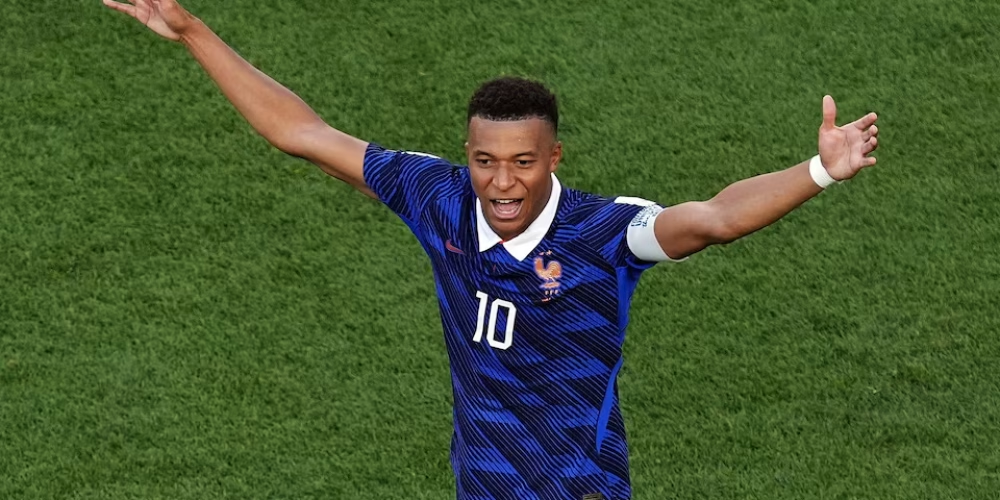
This unique environment is further personalized by high-profile friendships that span the competitive divide, most notably the famous bond between French talisman Kylian Mbappé and Moroccan defender Achraf Hakimi. The two superstars forged a deep, public brotherhood during their overlapping seasons together at Paris Saint-Germain. While both are hyper-competitive athletes who will stop at nothing to secure a place in the semifinals, their mutual affection mirrors the broader, highly interconnected relationship of the fans watching from the stands.
Why This Matters
For sports fans, cultural analysts, and migrant communities throughout the United States and the wider English-speaking world, this fixture serves as a brilliant case study in the power of sports to reflect global migration patterns. It moves the conversation away from outdated notions of isolated national identity, illustrating how modern international sports teams are increasingly shaped by fluid, transnational backgrounds. As America prepares to anchor more global sporting events over the coming years, seeing how diaspora communities enrich the fan experience offers a highly positive preview of the country’s sporting future.
Furthermore, the peaceful gathering of French and Moroccan supporters in historic American venues demonstrates the unique unifying capability of soccer when detached from regional political baggage. For domestic audiences accustomed to localized sports rivalries, witnessing a match where fans from both sides share meals, residences, and mutual respect provides a refreshing perspective on athletic community. The match proves that globalized tournaments can act as cultural bridges rather than geopolitical flashpoints.
NCN Analysis
Morocco arrives at this quarterfinal stage no longer wearing the comfortable, low-pressure mantle of the heartwarming underdog that characterized their historic 2022 run in Qatar. Over the last four years, the Moroccan federation has successfully institutionalized its talent identification pipeline, creating a formidable footballing machine capable of trading blows with traditional elite empires on equal terms. France, despite boasting one of the most explosive attacking units in the modern game, recognizes that this Moroccan side possesses the tactical intelligence to exploit any moments of structural complacency.
What analysts should watch for as the match progresses is how the emotional familiarity between the players impacts the early tactical rhythm. When opponents know each other’s physical tendencies and psychological triggers intimately from domestic club play, matches frequently turn into highly strategic, low-scoring chess games where patience becomes the ultimate virtue. The squad that can most effectively compartmentalize the immense sentimental weight of this historic matchup will likely be the one celebrating a semifinal berth when the final whistle blows.
The geographic borders may separate the nations, but the footballing family remains entirely whole.
Reported by the NCN Editorial Team









