

KEY POINTS
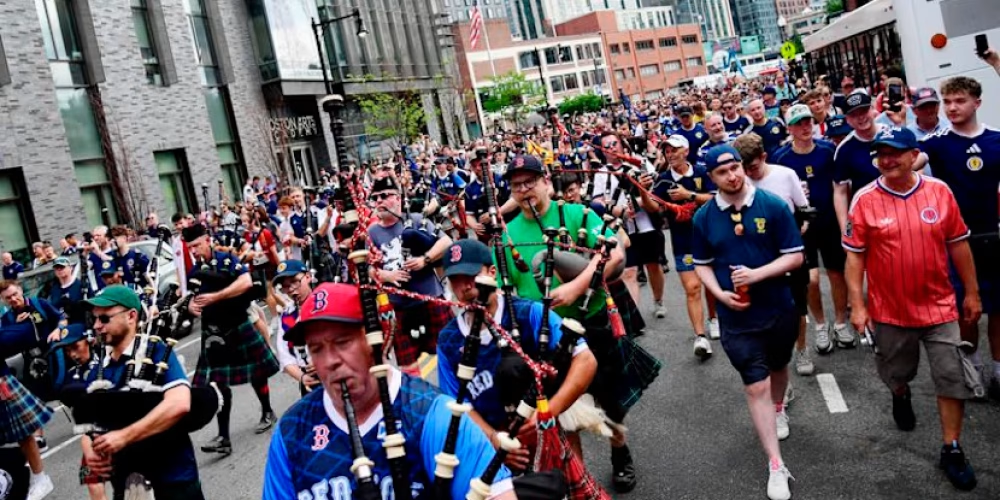
- Tens of thousands of traveling Scottish soccer supporters have nearly emptied downtown Boston establishments of their beer supplies.
- Local business owners reported unprecedented sales metrics that easily surpassed traditional St. Patrick’s Day records.
- City officials and hospitality workers are scrambling to secure emergency logistics ahead of Scotland’s next match.
The historic streets of Boston have been transformed into a vibrant sea of blue and white as tens of thousands of passionate Scottish soccer fans stretch the city’s hospitality infrastructure to its absolute breaking point. Local pubs, restaurants, and liquor distributors are working around the clock to restock their inventories after the visiting “Tartan Army” consumed unprecedented quantities of alcohol over a single weekend. For American business owners experiencing the cultural phenomenon of global soccer fandom for the first time, the massive influx of international tourists has provided a historic financial windfall alongside significant logistical challenges.
What You Need to Know
The arrival of the Scottish national team in New England marks the country’s historic return to international football’s premier global showcase, ending a frustrating tournament drought that dates back to 1998. Generation of fans who had never witnessed their team compete on the world stage have traveled across the Atlantic, eager to make up for lost time. This passionate fan base, colloquially known as the Tartan Army, is globally celebrated not just for their vocal matchday support, but for their famously convivial and boisterous approach to tournament tourism.
Boston was selected as one of the major operational hubs for the competition, with matches taking place at Gillette Stadium in nearby Foxborough, Massachusetts. The region’s deep historical ties to the United Kingdom and Ireland made it a natural destination for traveling European spectators, who have effectively occupied the downtown historic district. The celebration reached a fever pitch following Scotland’s hard-fought 1-0 opening group-stage victory over Haiti, sparking city-wide festivities that continued uninterrupted for several days.
Historically, Boston’s service industry handles massive crowd surges during major domestic sporting events, such as a Boston Red Sox playoff run or the annual Boston Marathon. Furthermore, the city’s world-famous St. Patrick’s Day celebrations are traditionally regarded as the benchmark for peak single-day beverage sales in New England. However, local hospitality veterans confess that the sheer scale and sustained velocity of consumption exhibited by the visiting Scottish supporters has completely redefined their expectations for high-volume event management.
Why This Matters
The unprecedented beverage shortage in Massachusetts offers a compelling case study on how massive international sporting events can instantly alter localized economic ecosystems within the United States. For commercial breweries, supply chain logistics operations, and municipal planning departments, the Scottish fan surge underscores the necessity of flexible infrastructure that can handle sudden shifts in consumer demand. Failing to accurately project these consumption patterns doesn’t just result in lost revenue for small businesses; it risks creating localized supply chain strains that ripple outward to regional distributors.
Additionally, this cultural intersection demonstrates the immense soft power and economic potential of international soccer as the sport deepens its commercial roots across the North American market. The enthusiastic welcome extended by city leadership highlights how major American metropolitan areas can leverage global sports tourism to stimulate hospitality, retail, and transit sectors. As the tournament continues to expand its footprint across various states, corporate brands and municipal leaders will be analyzing Boston’s logistical scramble to better prepare for future international fan migrations.
NCN Analysis
The incredible scene playing out across Boston’s hospitality sector highlights a beautiful reality of tournament football: the fans are just as central to the spectacle as the elite athletes competing on the pitch. While sports media naturally focuses its analytical attention on tactical formations and goal-scoring metrics, the cultural exchange occurring in local communities is what truly defines the legacy of a global event. The fact that the Tartan Army has managed to comfortably out-drink Boston’s legendary St. Patrick’s Day crowds will undoubtedly become a piece of local sports folklore for decades to come.
Looking forward, local distributors and bar managers have very little time to rest, with Scotland scheduled to face Morocco in their next highly anticipated group-stage fixture. Furthermore, the city is bracing for a potential second wave of intense hospitality demand as Scotland’s historical sporting rivals, England, prepare to arrive in the region for their upcoming clash against Ghana. The ability of New England’s supply chains to successfully adapt to these compounding cultural waves will serve as a definitive test for the region’s commercial infrastructure.
Boston’s service industry has received a legendary financial boost, but the true test of logistical endurance lies in keeping the taps flowing for the remainder of the summer showcase.
Reported by the NCN Editorial Team









