

KEY POINTS
- Belgium dominant in a comprehensive victory to eliminate the United States from the tournament.
- Midfielder Nicolas Raskin noted an internal sense of injustice motivated the Belgian squad.
- The pre-match buildup was heavily dominated by the reversal of Folarin Balogun’s suspension.
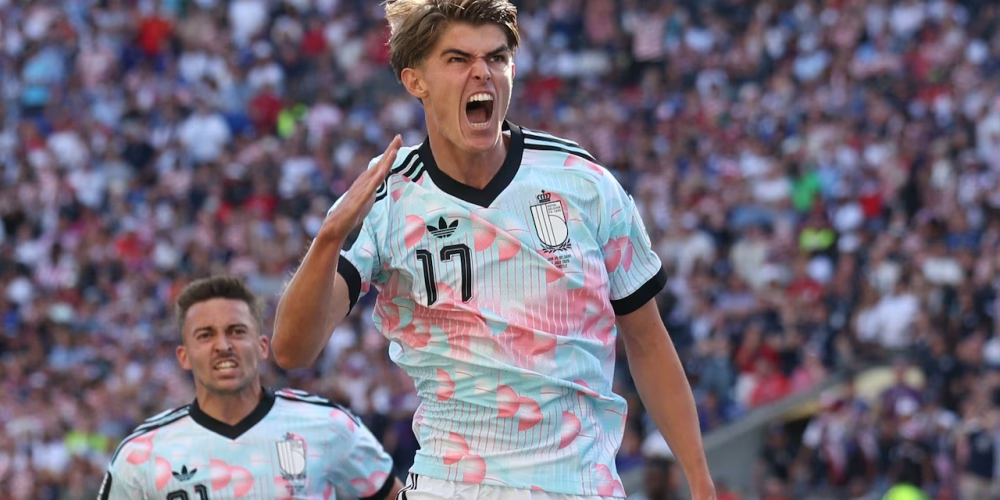
The United States men’s national soccer team saw its home World Cup campaign come to a crushing conclusion on Monday following a decisive knockout defeat against a ruthless Belgium side in Seattle. Charles De Ketelaere netted two goals as the Red Devils comfortably exposed defensive lapses from the tournament hosts to seal a spot in the final eight. However, the comprehensive athletic result was completely overshadowed by the lingering fury surrounding a controversial regulatory decision that allowed an American forward to play despite a prior red card.
What You Need to Know
The tournament buildup to Monday’s high-stakes knockout match was dominated by unprecedented administrative drama that shook the foundational principles of international soccer governance. United States forward Folarin Balogun had received a direct red card during a tense group-stage encounter against Bosnia and Herzegovina, an infraction that carries a mandatory one-match suspension. However, following an extraordinary and highly publicized public intervention by United States President Donald Trump, FIFA’s disciplinary committee abruptly paused the suspension, granting the star striker immediate eligibility to face Belgium in the Round of 16.
This ruling provoked immediate, widespread condemnation from rival European federations and soccer purists worldwide, who argued that political pressure from a host nation had corrupted standard sporting protocols. Within the Belgian camp, the administrative move was viewed not as a standard legal appeal, but as a direct threat to the competitive fairness of the world’s premier sporting event. Rather than demoralizing the squad, the external administrative theater acted as an unexpected catalyst, transforming a standard tactical match preparation into a deeply personal mission for the European side.
On the pitch, the structural contrast between the two nations could not have been starker. The United States entered the stadium riding a massive wave of domestic euphoria, having cruised through the initial phases of the competition backed by capacity home crowds and intense media hype. Belgium, meanwhile, arrived under the radar, possessing a mature roster determined to re-establish their standing among the elite powerhouses of global soccer after navigating their own challenging tournament path.
The Battle of Seattle
From the opening kickoff, the emotional undercurrent of the administrative row manifested clearly in Belgium’s relentless intensity. The Red Devils required only nine minutes to silence the crowd of 67,000 spectators at Seattle Stadium. Capitalizing on a weak defensive clearance from American fullback Alex Freeman, Belgian midfielder Nicolas Raskin intercepted the ball and delivered a precise, low service across the goalmouth, allowing Charles De Ketelaere to comfortably tap home the opening goal from close range. The early breakthrough forced the United States to trail for the first time all tournament, exposing immediate structural anxieties in the American backline.
The United States responded with a spell of sustained attacking pressure and managed to find a temporary equalizer in the 31st minute when Malik Tillman converted a set-piece opportunity. Interestingly, the free kick that led to the goal had been won by Folarin Balogun, marking his singular notable contribution to the match. However, the American joy proved short-lived, as Belgium’s tactical maturity immediately wrestled back control of the tempo. Just two minutes after the equalizer, De Ketelaere struck again, ghosting past a static American defense to restore the Belgian advantage before the halftime interval.
The second half exposed the widening gulf in execution and focus between the two sides. The United States struggled to sustain meaningful possession or establish any rhythm on the ball, frequently turning it over in dangerous areas. Belgium capitalised on these errors with clinical efficiency, extended their lead in the 57th minute when veteran midfielder Hans Vanaken scored, effectively breaking the spirit of the home side. United States coach Mauricio Pochettino attempted to alter the dynamics with tactical substitutions, but the team’s attacking sequences remained thoroughly flat and uninspired.
As the match entered its final moments, the structural collapse of the home side was finalized in stoppage time when elite striker Romelu Lukaku added a fourth goal, capping off a definitive victory. The final whistle confirmed a comprehensive exit for the host nation, ensuring that the United States joined co-hosts Canada and Mexico on the sidelines. For Belgium, the celebration was a validation of their collective focus, though the victory came at a cost, as midfielder Amadou Onana suffered a serious knee injury that threatens to end his tournament participation ahead of their upcoming quarter-final matchup against Spain in Los Angeles.
Why This Matters
The definitive exit of the United States men’s national team delivers a massive commercial and cultural blow to the sports economy across North America. Millions of casual American viewers who had tuned in to witness a historic home-soil run will now likely disengage from the remaining rounds of the tournament, impacting prime-time television ratings and domestic merchandise sales. Media conglomerates and corporate sponsors must now pivot their marketing strategies away from national pride and focus strictly on the global appeal of traditional footballing giants.
Furthermore, the manner of the American defeat provides a stark reality check for the development of the sport within the United States. Despite massive financial investment, state-of-the-art facilities, and overwhelming home-field advantage, the domestic squad proved completely unequipped to handle the tactical sophistication and mental resilience of an elite European opponent. This failure will likely ignite a intense period of introspection within United States Soccer, forcing a re-evaluation of coaching methodologies and player development pipelines ahead of future international cycles.
NCN Analysis
The post-match comments from midfielder Nicolas Raskin, who explicitly stated that the squad felt a profound sense of injustice that ultimately motivated them to respond on the field, reveal the ultimate psychological failure of the American administrative strategy. By aggressively pursuing a political avenue to bypass a standard disciplinary suspension, the United States inadvertently handed their opponents the ultimate motivational tool. Elite international athletes thrive on perceived disrespect, and Belgium utilized the Balogun controversy to forge an unbreakable collective focus that completely overwhelmed the Americans.
Looking ahead, Belgium’s quarter-final showdown against Spain promises to be an absolute tactical masterclass, though the potential loss of Amadou Onana creates a massive void in their central midfield structure. For the United States, the focus must immediately shift toward structural stability and away from reliance on individual stars or political leverage. The 2026 World Cup has proven that while executive influence can manipulate administrative rules off the pitch, it remains entirely powerless against tactical excellence and collective resolve once the ball is in play.
The American World Cup dream ended not because of administrative controversy, but because of a superior opponent that turned a perceived injustice into a dominant athletic statement.
Reported by the NCN Editorial Team









