

KEY POINTS
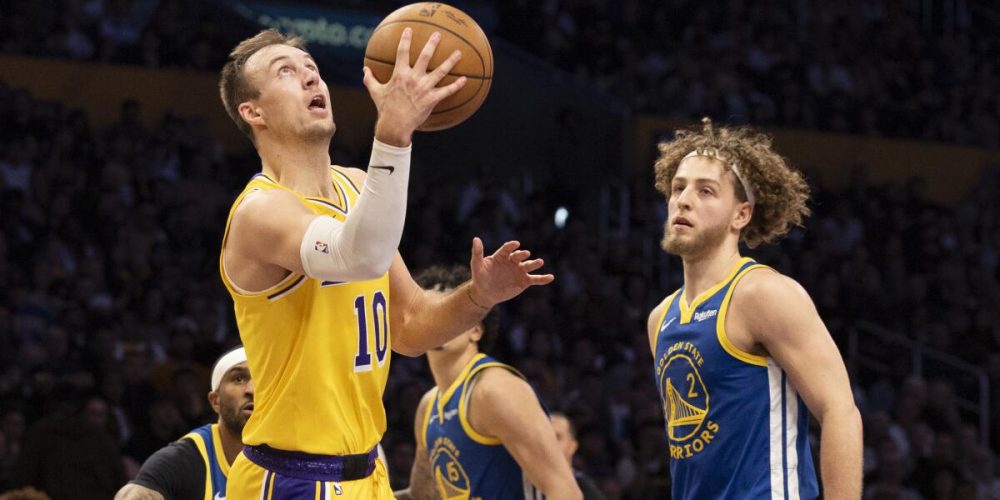
- Luke Kennard delivered a masterful 27-point performance, shooting a perfect 5-of-5 from three-point range to lead the Lakers to a 107-98 victory.
- The Lakers triumphed despite the absence of star guards Luka Doncic and Austin Reaves, showcasing deep roster resilience in their playoff opener.
- Houston’s offense faltered due to the late scratch of Kevin Durant, leaving the Rockets trailing 0-1 as the series moves toward Game 2.
The Los Angeles Lakers successfully navigated a high-stakes playoff environment on Saturday night, overcoming significant personnel challenges to defeat the Houston Rockets. In a display of tactical discipline and perimeter precision, the home team managed to dictate the pace at Crypto.com Arena, securing a 107-98 win that shifts the early momentum of the Western Conference first-round series in their favor.
What You Need to Know
The NBA postseason is fundamentally a test of attrition, where the ability to adapt to sudden roster changes often determines which teams advance and which are sent home early. Entering Saturday, the Lakers found themselves in an precarious position; their offensive hierarchy had been disrupted by the indefinite absences of Luka Doncic and Austin Reaves. Such a scenario would typically deflate a franchise, yet the team’s current structure under head coach Dan Hurley emphasizes a system of collective contribution that transcends individual star power.
Historically, teams that lose their primary scoring options in the playoffs struggle to generate quality looks against elite defenses. However, the modern NBA era has seen an uptick in specialized perimeter play, allowing role players to step into larger roles when injuries strike. The Rockets, meanwhile, are navigating their own frustrations, having entered the matchup with high expectations only to face an unexpected health hurdle that forced a late-game reshuffling of their primary rotation.
A Masterclass in Perimeter Efficiency
The catalyst for the Lakers’ victory was undoubtedly Luke Kennard, whose performance was as efficient as it was unexpected. Acquired as a depth piece earlier this season, Kennard elevated his game to match the intensity of the postseason, recording 27 points while missing only four of his thirteen total shot attempts. His composure from beyond the arc—where he did not record a single miss—forced the Rockets to stretch their defense thin, creating the necessary lanes for LeBron James to facilitate the offense effectively.
James finished the contest with a commanding 19 points and 13 assists, acting as the steady hand that kept the Lakers focused despite the defensive pressure applied by Houston’s frontcourt. Deandre Ayton proved equally instrumental, anchoring the paint with a double-double that neutralized many of the Rockets’ second-chance opportunities. The synergy between James’ court vision and the shooting touch of the supporting cast allowed Los Angeles to maintain a comfortable cushion for much of the second half, despite brief flurries of offensive success from the opposition.
For the Rockets, the night was defined by missed opportunities and a search for offensive rhythm. With Kevin Durant sidelined by a knee injury, the responsibility fell upon Alperen Sengun and Amen Thompson to spearhead the attack. While the duo combined for significant production, the team’s overall shooting percentage remained stalled in the high 30s. Houston’s failure to convert on a staggering 21 offensive rebounds proved to be the decisive factor, as the team could not turn those extra possessions into points against a locked-in Lakers defensive rotation.
The timeline of the game showed a Lakers team that was consistently one step ahead, establishing a lead in the first quarter and methodically defending it throughout the remainder of regulation. Every time the Rockets appeared poised to ignite a run, a timely defensive stop or a high-percentage bucket from the Lakers’ perimeter shooters dampened their momentum. This consistency is the hallmark of a team that has clearly bought into a specific, high-execution game plan designed to weather the volatility of the playoffs.
Why This Matters
This opening victory is critical for the Lakers beyond the simple tally in the series column. It signals to the Western Conference that the team is not reliant on a singular offensive engine, which complicates the scouting and defensive strategy for opposing coaches. For the American basketball public, the game served as a stark reminder that playoff success is as much about chemistry and tactical execution as it is about star talent. Business-wise, the Lakers’ success with a modified rotation reinforces the value of deep, flexible roster construction in an era where player availability is increasingly unpredictable.
For the Houston market and the Rockets’ ownership, the result highlights the fragility of relying on a superstar-heavy lineup in the postseason. When key components are unavailable, the team must demonstrate an ability to execute half-court sets with high precision, something they struggled with throughout Saturday’s game. The impact of this loss extends to the fans and sponsors alike, as the pressure mounts for the team to capitalize on their physical advantages in Game 2 or risk falling into an insurmountable series hole.
NCN Analysis
The Lakers’ ability to secure Game 1 without their primary stars is a testament to the culture established in Storrs and now translated to the professional level under Hurley. The coaching staff has successfully minimized defensive lapses and emphasized ball security, which are the primary determinants of playoff longevity. If Kennard continues to play with this level of confidence, the Lakers effectively shorten the learning curve for their younger players and put immense pressure on Houston to defend the entire floor.
Looking ahead, all eyes will be on the injury report for Game 2. The Lakers’ medical staff will likely exercise extreme caution with Doncic and Reaves, as they have already proven they can win without them. Meanwhile, the Rockets need to find an offensive spark to complement their rebounding dominance. If they cannot improve their shooting efficiency, this series could end in a sweep regardless of the talent on their roster. Expect a more aggressive, physical approach from the Rockets on Tuesday as they attempt to reclaim home-court advantage before the series travels.
The Lakers take a 1-0 series lead into Tuesday’s Game 2, looking to maintain their disciplined defensive form.
Reported by the NCN Editorial Team









