

KEY POINTS
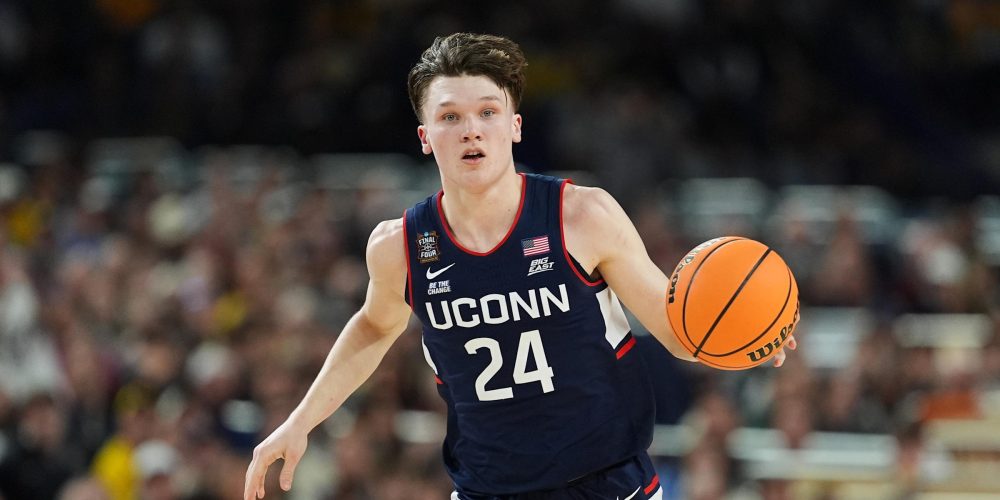
- Braylon Mullins has officially opted to return to the University of Connecticut for his sophomore season, bypassing the 2026 NBA Draft despite being a projected first-round prospect.
- The 6-foot-6 guard, whose late-tournament heroics propelled the Huskies to the Final Four, will rejoin head coach Dan Hurley’s roster as a central piece for the 2026-27 season.
- Mullins’ decision provides significant stability for Connecticut, which continues to reload its lineup with high-profile transfer additions alongside core returning talent.
Connecticut basketball secured a vital boost on Saturday as standout freshman guard Braylon Mullins announced he will return to Storrs for his second collegiate season. The decision halts immediate speculation regarding his transition to the professional level, as the talented perimeter threat was widely considered a likely first-round selection in the upcoming 2026 NBA Draft. Instead of testing his luck as a borderline lottery candidate this June, Mullins is betting on another year of development under the Huskies’ rigorous system.
What You Need to Know
The collegiate basketball landscape is currently undergoing a massive shift, driven by the increasing financial competitiveness of Name, Image, and Likeness (NIL) deals and the changing risk-reward calculation for young stars. For prospects like Mullins, the choice between immediate professional entry and returning for further maturity is no longer just about scouting reports—it is about long-term professional sustainability. Coaches are now navigating these decisions as part of their standard roster construction, often helping players weigh their current draft stock against the potential to improve their position in future, potentially weaker draft classes.
At UConn, this cycle has become a hallmark of the program’s sustained dominance. Dan Hurley has mastered the art of managing elite talent while simultaneously integrating transfer portal pieces, creating a pipeline that keeps the Huskies in constant contention for national titles. Mullins is not the first, and certainly will not be the last, player to prioritize a refined skill set and increased NIL earnings over an early departure to the professional ranks.
Strengthening the Huskies’ 2026-27 Core
Mullins’ emergence as a household name was fueled by one of the most memorable shots in recent NCAA history: a deep 35-foot triple that toppled Duke during the Elite Eight, effectively punching UConn’s ticket to the Final Four. Across his debut campaign, he displayed flashes of elite shooting and poise, averaging 12.0 points per contest despite an early-season ankle injury that hindered his ability to hit his stride immediately. By opting back into the college game, he signals an intent to transition from a “breakout” freshman to a consistent, go-to offensive engine.
The roster he rejoins is shaping up to be formidable. Alongside his return, the program has been aggressive in the transfer market, recently landing Duke transfer Nikolas Khamenia, a high-upside player who thrived in ACC tournament play. These additions are designed to replenish the depth lost to graduation and the portal, ensuring that the team remains a preseason favorite. With other key veterans like Silas Demary Jr. also committing to stay, Connecticut appears positioned to maintain its status as a premier national contender.
Beyond the raw statistics, Mullins’ presence provides a psychological advantage for the team. His teammates and coaching staff now have a known quantity around which to build their offensive sets, minimizing the disruption that often occurs during roster turnover. The continuity allows for more complex tactical implementation from the coaching staff, who can lean on Mullins’ experience to anchor the backcourt while younger prospects adapt to the collegiate pace. This chemistry will be essential as the Huskies look to navigate the challenges of the Big East and prepare for another deep post-season run.
Why This Matters
For American sports fans and the broader collegiate ecosystem, Mullins’ decision serves as a bellwether for the “stay-or-go” dynamic defining the sport. It highlights a maturing market where college stars are increasingly viewing their final undergraduate years not as a delay, but as a strategic professional investment. For families and athletes, the security of NIL compensation paired with the opportunity to refine one’s game in a high-pressure, televised environment can outweigh the uncertainty of sitting at the end of a professional bench or bouncing between developmental leagues.
This trend also impacts the business side of the sport, as athletic departments and boosters are essentially competing directly with professional franchises for the right to feature premier talent. Schools that can successfully balance the financial needs of their athletes with world-class coaching environments—like those cultivated in Storrs—are finding themselves with a significant competitive edge. As the lines between professional and amateur compensation continue to blur, the decision to delay entry into the NBA draft is becoming a sophisticated career management move rather than an emotional or nostalgic choice.
NCN Analysis
Looking ahead, the pressure on Mullins will undoubtedly rise. By choosing to return, he has signaled his ambition to climb into the top-10 of draft projections. This will require not just increased scoring production, but improved consistency from the perimeter and a more refined defensive profile. If he can turn those high-ceiling flashes into reliable, night-in and night-out dominance, he may prove that the extra year was a masterclass in career planning.
However, the risk remains. College basketball is notoriously volatile, and a dip in performance or a lack of team success could stagnate his draft stock. Fans and analysts should keep a close watch on how the Huskies’ offense evolves under Hurley’s direction. If Mullins can successfully integrate with the incoming transfers and elevate his overall efficiency, he will enter the next draft cycle as a more complete and NBA-ready prospect, potentially securing a significantly higher professional contract as a result.
The decision to return to college ensures that one of the sport’s most electrifying young guards will remain a focal point of the American collegiate stage for at least one more season.
Reported by the NCN Editorial Team









