

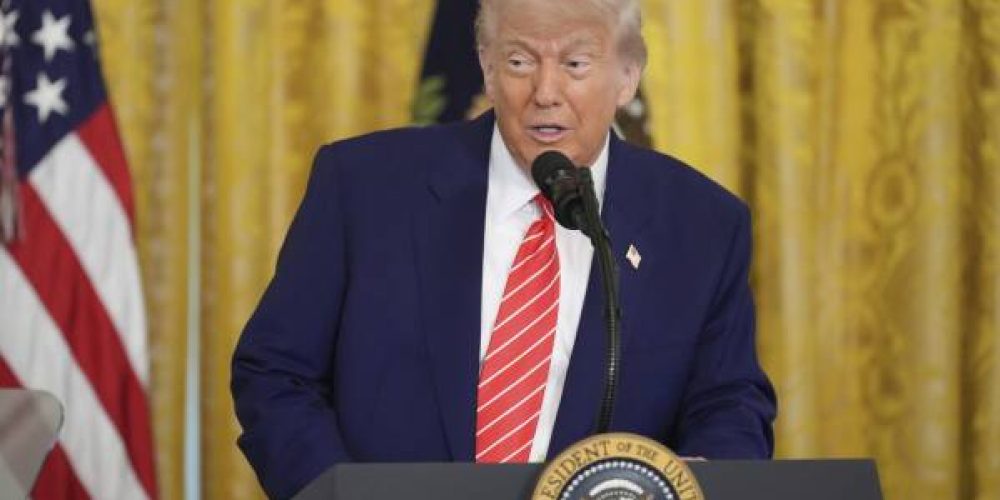
U.S. President Donald Trump has announced plans to impose an additional 100% tariff on all imports from China starting next month, intensifying an already fragile trade relationship between the world’s two largest economies.
In a series of social media posts, Trump also said his administration would place export controls on critical software, accusing Beijing of becoming “very hostile” following China’s move to tighten export rules on rare earth materials — essential components used in electric vehicles, smartphones, and defense technologies.
The president suggested he might pull out of an upcoming meeting with Chinese leader Xi Jinping, though he later clarified that while he hasn’t canceled it, he’s uncertain if it will take place. “I’m going to be there regardless,” Trump told reporters at the White House.
Market Shock and Beijing’s Countermoves
Financial markets reacted sharply to Trump’s announcement. The S&P 500 fell 2.7%, marking its steepest decline since April, as investors braced for another round of trade volatility.
China, which controls about 90% of global rare earth production, recently unveiled new restrictions on exports of these critical materials and launched a monopoly investigation into U.S. tech giant Qualcomm, potentially derailing its acquisition of another chipmaker.
Beijing also announced new port fees for ships owned or operated by U.S. companies — a move seen as a symbolic warning of escalating trade hostilities. “Some very strange things are happening in China,” Trump wrote online. “They are becoming very hostile.”
Fragile Trade Truce Under Strain
The announcement threatens to unravel a delicate trade détente reached in May, when both nations agreed to roll back triple-digit tariffs that had crippled trade flows. Under that deal, U.S. tariffs on Chinese imports remained roughly 30% higher than at the start of the year, while U.S. exports to China faced a new 10% levy.
Since then, officials from both countries have been holding talks covering topics like TikTok, agriculture, rare earths, and semiconductors. The next meeting was expected to occur this month at a summit in South Korea, but the new tariffs have cast uncertainty over those plans.
Strategic Posturing on Both Sides
Analysts say Xi’s latest moves aim to increase Beijing’s leverage ahead of negotiations. “He’s looking for ways to seize the initiative,” said Jonathan Czin of the Brookings Institution, noting that the rare earth export curbs don’t take effect immediately. “The Trump administration is having to play a game of whack-a-mole.”
Czin added that China appears confident it can withstand another trade escalation. “From their perspective, the Trump administration blinked during previous tariff cycles,” he said.
Meanwhile, experts warn that China’s latest export rules specifically target overseas defense manufacturers, a move with major national security implications. “Nothing makes America move like targeting our defense industry,” said Gracelin Baskaran, director of the Critical Minerals Security Program at the Center for Strategic and International Studies (CSIS). “In an era of rising geopolitical tension, the U.S. will have to negotiate — it has limited options.”
While a Trump-Xi summit now appears uncertain, analysts say diplomacy remains possible. “Negotiations are likely imminent,” Baskaran added. “Who leads them and where they happen will be determined with time.”









