

KEY POINTS
- England captain Harry Kane admitted the team’s attempt to defend a narrow lead backfired.
- Conceding two late goals to Argentina extinguished the Three Lions’ hopes in the World Cup semifinal.
- Kane emphasized that passive play is punished at the absolute highest level of the game.
- England captain Harry Kane expressed profound disappointment following his team’s
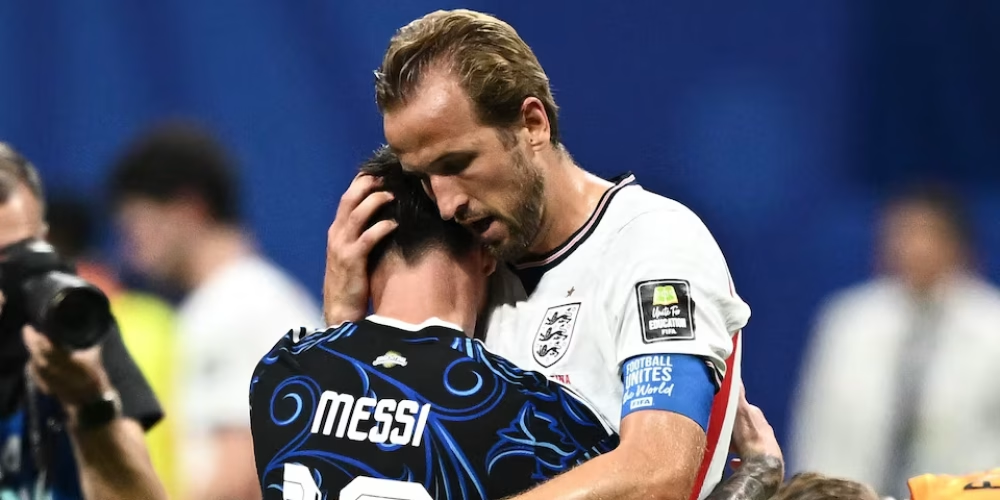
England captain Harry Kane expressed profound disappointment following his team’s heartbreaking 2-1 World Cup semifinal defeat to Argentina on Wednesday in Atlanta. Despite taking a second-half lead, the Three Lions retreated into a defensive low block, inviting relentless pressure that culminated in two late goals for the defending champions. Speaking to reporters after the match, a visibly dejected Kane admitted that trying to hold onto a slim 1-0 lead proved to be their ultimate undoing.
What You Need to Know
The age-old tactical debate surrounding how to manage a narrow lead in knockout football was illustrated in painful fashion for England fans. Historically, teams that drop deep to protect an advantage frequently find themselves starved of possession and unable to escape their own half. This passivity transfers all control of the match tempo to the trailing side, making a defensive error or a moment of individual brilliance from the opposition almost inevitable.
For Harry Kane, this latest exit adds to a highly decorated but frustratingly trophy-less career for both club and country. The 33-year-old striker has reached the final stages of multiple major tournaments—including a World Cup semifinal in 2018, the Euro 2020 final, and the Euro 2024 final—only to fall short each time. Despite his individual scoring achievements, the ultimate prize continues to elude the England skipper.
The defeat also marks a disappointing end to manager Thomas Tuchel’s first major campaign with the England squad. Appointed with the explicit mandate of delivering a major trophy to end decades of disappointment, Tuchel’s conservative tactical adjustments in the second half of the semifinal have drawn immediate criticism. The failure to sustain offensive pressure in the final half-hour will undoubtedly dominate post-tournament post-mortems in the British press.
Wave After Wave of South American Pressure
The match seemed to be going entirely to plan for England when Anthony Gordon broke the deadlock in the 55th minute, sliding home a perfect cross from Morgan Rogers. However, rather than kicking on to find a decisive second goal, the English side collectively retreated. Kane noted that once they went ahead, the team defaulted to a defensive mindset, which he described as a natural but ultimately fatal psychological reaction.
With England sitting deep, Argentina seized complete control of the midfield and began to mount continuous attacks on the English penalty area. Kane described the final half-hour as defending against constant pressure, with the English backline desperately throwing bodies in the way of shots and crosses. The lack of a transition outlet meant England could not relieve the pressure, leading to Enzo Fernandez’s equalizer in the 85th minute and Lautaro Martinez’s stoppage-time winner.
Despite the tactical retreat, Kane insisted that the pre-match instruction from the coaching staff had been to press forward and extend the lead. However, the physical toll of matching Argentina’s energetic midfield, combined with the pressure of the occasion, prevented the players from executing that game plan. Once Argentina scored their two goals, England simply lacked the momentum and energy to mount a counter-response.
Why This Matters
The psychological collapse of the English national team on the world’s biggest stage offers critical insights for sports psychologists and coaches across the United States. It highlights the immense difficulty of managing performance anxiety under high-stakes conditions, a challenge that affects athletes across all professional sports leagues. Understanding how to maintain a proactive, confident mindset while leading is a key focus area for modern athletic programs looking to build champions.
Additionally, the gripping drama of the match has further fueled the soccer explosion in North America. For millions of American viewers watching the World Cup, the emotional roller coaster experienced by England and Argentina showcases the unparalleled narrative power of international football. This dramatic spectacle is helping to cultivate a highly knowledgeable and passionate fan base that will continue to drive the sport’s commercial growth long after the tournament concludes.
NCN Analysis
Harry Kane’s honest assessment of England’s passive approach highlights a fundamental flaw that continues to plague the national team in major tournaments. Under successive managers, England has possessed the attacking talent to dominate matches but has consistently lacked the tactical courage to finish off elite opponents. The tendency to retreat and defend a lead has turned what should be a formidable attacking unit into a reactive, vulnerable side.
As the team prepares for the third-place playoff against France, the English Football Association faces a period of deep reflection. To transition from perpetual contenders to actual champions, the squad must develop the psychological ruthlessness required to kill off games. Whether Thomas Tuchel can instill this proactive philosophy in the players before the next qualification cycle begins remains the defining question for the future of English football.
The quest to bring football home must wait for another tournament.
Reported by the NCN Editorial Team









