

KEY POINTS
- Agronomists spent five years conducting advanced scientific turf research to standardize surfaces across all host cities.
- The elite hybrid grass in Dallas concludes its heavy operational lifecycle following Tuesday’s blockbuster semifinal match.
- Specialized cold-resistant sod was shipped from Colorado to survive the unique indoor air-conditioning demands.
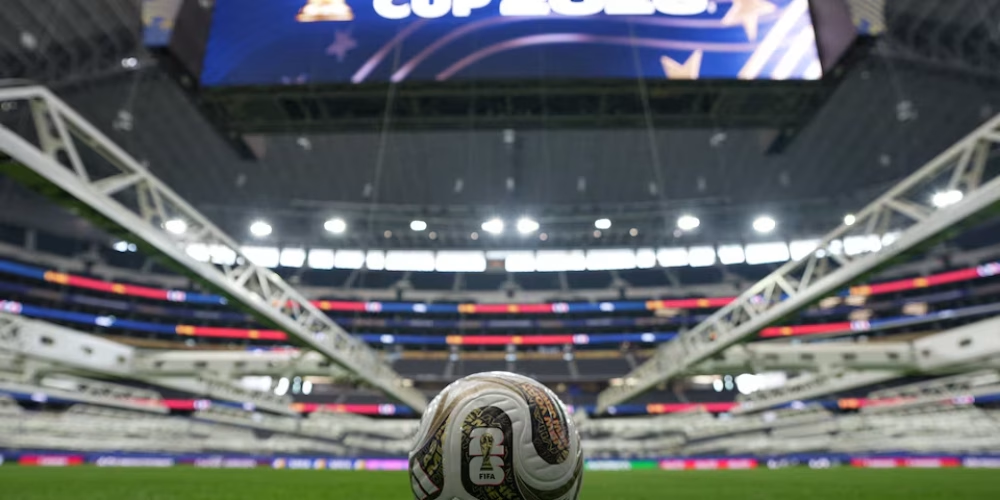
The temporary natural grass surface at Dallas Stadium is prepared for its ninth and final appearance before being completely decommissioned after Tuesday’s high-stakes semifinal between France and Spain. Agronomists and sports engineers spent half a decade conducting intensive scientific turf research to guarantee flawless playing surfaces across North America. The ultimate test for this engineered field will unfold under closed roof conditions as two European giants battle for a spot in the championship final.
What You Need to Know
Converting massive multi-purpose stadiums into elite soccer venues required unprecedented scientific innovation before the current tournament expanded to 48 teams. Traditionally configured for American football, several host venues feature permanent artificial turf that is entirely non-compliant with strict international soccer requirements. To solve this dilemma, soccer organizers established a massive multi-institutional research project designed to engineer natural sod systems capable of resting securely on top of synthetic fields without slipping or shifting.
The extensive scientific initiative combined the technical expertise of turf grass management departments at the University of Tennessee and Michigan State University alongside specialized groundskeepers. The primary mandate prioritized complete structural consistency, ensuring that identical ball behavior, bounce metrics, and traction thresholds were maintained across 16 geographically diverse host venues. This continuous uniformity was deemed vital to protecting player health and sustaining elite passing sequences throughout the grueling summer heat.
Managing an organic field within a massive indoor colosseum like the home of the Dallas Cowboys presented severe environmental hurdles that standard outdoor stadiums never encounter. Because the permanent architecture relies completely on structural shade and intensive indoor air-conditioning, natural sunlight is virtually non-existent on the stadium floor. To combat these hostile growing conditions, agronomists had to look far outside the borders of Texas to find a highly specialized variation of sod that could thrive under artificial environments.
The Engineering Behind the Dallas Stadium Pitch
The complex logistics behind cultivating the temporary pitch required the local grounds management team to implement highly creative agricultural methodologies. FIFA’s venue pitch manager, Ian Craig, explained that providing premium playing surfaces for world-class athletes required rewriting the traditional turf management playbook. Because native Texas grass variations require massive amounts of natural heat and direct sunlight to maintain root density, technicians opted to import a specific, cold-tolerant grass species grown in the elevated climate of Colorado.
Once the specialized sod arrived in Texas, engineering teams constructed a massive modular sub-base directly over the existing synthetic field to insulate the natural root zones. The indoor climate-control settings were monitored around the clock, with massive commercial grow-light structures wheeled across the grass surface during overnight hours to replicate the natural solar cycle. This artificial ecosystem allowed the turf to handle intense physical wear and tear across eight preceding matches without displaying severe structural degradation or tearing away during high-impact slide tackles.
Tuesday’s marquee semifinal match marks the absolute operational limit for this engineered system. After hosting multiple group-stage matches and intense knockout rounds, the organic root systems are reaching the end of their calculated lifecycle under artificial air-conditioning. Maintaining structural integrity across nine high-intensity football games within an indoor stadium represents a massive victory for the sports science community, setting a new benchmark for multi-purpose stadium retrofitting.
Immediately following the final whistle between France and Spain, a massive logistical deconstruction process will commence in Arlington. The temporary sod modules, soil layers, and protective sub-structures will be entirely dismantled to return the arena to its standard configuration ahead of upcoming domestic sporting events. This rapid transformation highlights the incredible adaptability demanded of modern entertainment venues hosting mega-events on the global stage.
Why This Matters
For sports facility operators, stadium architects, and engineering firms across the United States, the ultimate validation of this scientific turf research transforms the economics of major stadium management. The successful execution of a world-class soccer match on a temporary indoor field proves that multi-purpose American arenas can seamlessly adapt to host any premier international sporting event without permanent structural changes. This technological breakthrough expands the future hosting capacity of American cities competing for profitable international conventions, rugby tournaments, and soccer exhibitions.
Furthermore, the domestic academic collaborations behind the tournament fields will leave a permanent legacy across the American landscape. The deep-rooted partnerships established between elite public research universities and global sporting bodies have accelerated innovations in sustainable agriculture and drought-resistant turf management. These advanced methodologies will directly benefit local golf courses, community parks, and collegiate sports complexes across North America, proving that elite tournament science delivers long-term public value.
NCN Analysis
The incredible engineering feat accomplished by the grounds management staff will play a silent but defining role in determining the tactical outcome of Tuesday’s semifinal. Spain’s fast-paced, possession-heavy passing style relies heavily on a perfectly leveled, predictable surface where the ball moves without unexpected friction or micro-bounces. If the Colorado sod holds up perfectly under intense central pressure, Rodri and Fabian Ruiz will be able to orchestrate their precise transitional sequences with absolute confidence.
Conversely, any unexpected tearing or loosening of the turf modules in high-traffic areas could inadvertently favor France’s direct, highly physical approach. If the pitch begins to show signs of wear in the central third, it could disrupt Spain’s delicate timing, forcing a more chaotic match style that utilizes long vertical balls to unlock defensive lines. The true measure of the five-year scientific research project will be whether the surface remains a neutral, invisible canvas, allowing pure athletic talent to decide the next finalist.
Reported by the NCN Editorial Team









