

KEY POINTS
- The United States Men’s National Team was eliminated from the tournament after suffering a decisive defeat in the opening knockout round, failing to match their opponent’s tactical execution.
- Despite entering the tournament with a highly anticipated generation of European-based talent, the squad struggled to create consistent offensive pressure against elite-tier opposition.
- The early departure leaves American soccer authorities facing critical questions regarding the developmental direction and leadership of the national program ahead of future cycles.
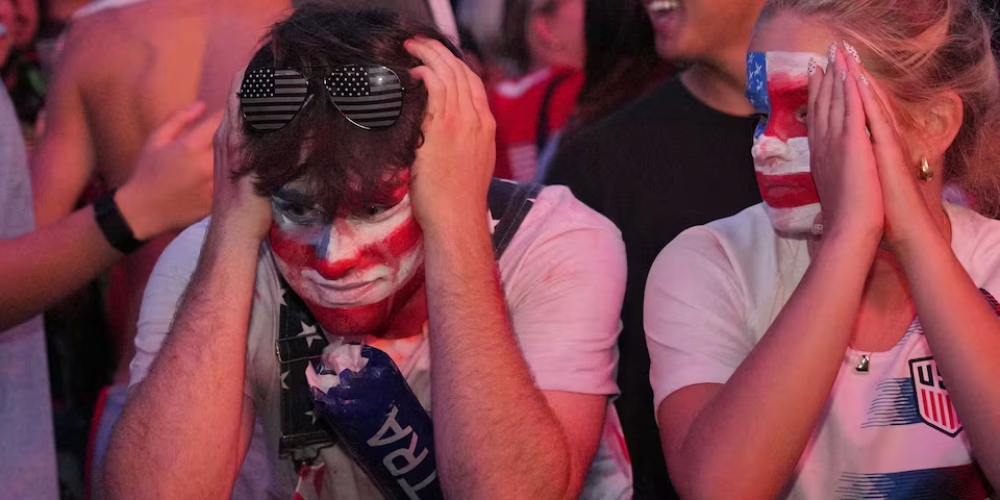
The high-stakes journey for the United States Men’s National Team came to an abrupt and sobering end on Tuesday evening, as their ambitious global ambitions collided with the harsh realities of elite international soccer. Before an expectant home crowd, the American squad struggled to establish their rhythm and succumbed to a tactical masterclass from their opponents. The disappointing result eliminates the host nation from the knockout stage, leaving domestic supporters to process a premature exit from the biggest sporting event on the continent.
What You Need to Know
The tournament arrived on North American soil amid unprecedented marketing momentum and massive public interest, representing a critical inflection point for the sport in the United States. With billions of dollars invested in infrastructure, media broadcasting, and stadium preparations across multiple host cities, domestic soccer authorities viewed this cycle as a golden opportunity to permanently move soccer into the mainstream American sports landscape. The squad featured a core of players competing at the absolute highest levels of European club football, generating widespread optimism that this group could achieve a historic breakthrough.
Historically, the American men’s program has struggled to bridge the gap between regional dominance in CONCACAF and the disciplined, high-intensity tactical setups encountered in the latter stages of global tournaments. While past generations relied primarily on athleticism, physical endurance, and grit, the modern iteration of the team aimed to implement a proactive, possession-based style of play. However, navigating the high-pressure environment of a home tournament requires a level of collective experience and tactical maturity that this relatively young squad is still working to develop.
The pressure on the coaching staff and the roster was immense, as domestic sports analysts and casual viewers alike demanded a deep run into the advanced knockout phases. This collective expectation created a volatile atmosphere where anything short of a quarter-final appearance would be viewed as a significant underachievement for the program.
Tactical Breakdown of a Heartbreaking Defeat
From the opening whistle, the physical and technical differences between the two teams became immediately apparent to the capacity crowd in attendance. The opposition structural block completely neutralized the American midfield, cutting off the passing lanes that typically allow wide attackers to utilize their pace on the flanks. The United States struggled to retain possession in the middle third of the field, consistently turning over the ball and allowing their opponents to launch dangerous, direct counter-attacks.
As the first half progressed, the defensive vulnerabilities of the host nation were ruthlessly exposed through a sequence of set-piece lapses and positional errors. The opposition capitalised on a swift transition down the left channel, delivering a precise low cross that bypassed the central defenders and found an unmarked attacker to open the scoring. The goal visibly deflated the domestic squad, forcing them to alter their defensive shape and commit more numbers forward in an increasingly desperate search for an immediate equalizer.
The second half brought a series of attacking substitutions from the American bench, but the tactical adjustments failed to break down a remarkably disciplined defensive unit. Every forward foray by the United States was met with a wall of defenders, resulting in speculative long-range efforts that rarely forced the opposing goalkeeper into difficult saves. A late defensive miscalculation in stoppage time allowed the visitors to score a second decisive goal, putting the match entirely out of reach and sealing the fate of the host nation.
Why This Matters
For domestic sports commercial partners, major television networks, and stadium organizers, the premature elimination of the host nation presents a substantial challenge for the remaining duration of the tournament. Consumer engagement and prime-time television viewership metrics traditionally experience a sharp decline when the home country is no longer competing in a major global event. Advertisers who invested millions of dollars in marketing campaigns centered around American soccer success must now pivot their strategies to focus on neutral international storylines.
Furthermore, this exit forces a profound re-examination of how the sport is organized, scouted, and developed within the United States. Despite substantial financial resources and a massive youth playing population, the American system continues to struggle to produce world-class creative playmakers who can unlock disciplined international defenses. This tactical shortfall suggests that structural changes may be required at the academy and club levels to foster higher technical proficiency and cognitive awareness in future generations of American players.
NCN Analysis
The ultimate failure of this tournament run highlights a persistent disconnect between the media narrative surrounding American soccer and the actual tactical capabilities of the squad. While individual players possess undeniable athletic traits and execute well within their specific club structures in Europe, the national team lacked a cohesive tactical identity when facing elite opposition. The technical leadership must take accountability for failing to devise an effective alternative strategy when their primary game plan was completely neutralized early in the encounter.
Looking toward the next international cycle, a thorough evaluation of the entire management infrastructure is absolutely necessary to ensure progress is not stalled. The next generation of American talent will require a coaching philosophy that prioritizes tactical flexibility, clinical finishing, and structural defensive discipline rather than relying solely on individual star power. Supporters should watch closely to see how the federation responds in the coming weeks, as the decisions made during this impending reflection period will shape the trajectory of American soccer for the next decade.
The American squad was thoroughly outmatched on the big stage, proving that closing the gap with elite soccer nations requires structural evolution rather than marketing hype.
Reported by the NCN Editorial Team









