

KEY POINTS
- Morocco’s extraordinary ascent to the pinnacle of international soccer is heavily financed by the nation’s massive state-owned phosphate industry.
- Through the National Football Training Fund launched in 2024, fertilizer monopoly OCP Group has built world-class academies and modern pitches.
- While geopolitical instability and export caps limit global competitors, Morocco leverages its vast agricultural mineral wealth to cultivate elite athletic talent.
Morocco’s meteoric rise on the global soccer stage is being propelled by a highly lucrative and unexpected state asset: its massive subterranean phosphate reserves. The country’s state-owned fertilizer monopoly, OCP Group, has emerged as the primary financial engine behind a systematic overhaul of the domestic soccer infrastructure. This unique union of agricultural resource dominance and athletic development has turned the North African nation into a true developmental powerhouse in international sports.
What You Need to Know
Phosphate remains a finite, critical resource essential to global agriculture, acting as an irreplaceable component in commercial crop fertilizers worldwide. Unlike nitrogen-based agricultural products that can be synthesized using natural gas, phosphate must be mined directly from mineral deposits. Morocco holds a uniquely dominant position in this global market, controlling the world’s most critical reserves at a time when other major international suppliers face severe structural constraints.
For decades, global agricultural systems relied heavily on exports from geopolitical giants like China, Russia, and Saudi Arabia. However, recent export restrictions imposed by Beijing, ongoing geopolitical isolation surrounding Moscow, and security vulnerabilities along vital shipping lanes like the Strait of Hormuz have severely disrupted traditional trade routes. Consequently, Morocco has become the standout stabilizing force in an otherwise volatile global fertilizer marketplace, ensuring a steady stream of domestic revenue for the North African kingdom.
Recognizing the immense value of this mineral wealth, King Mohammed VI issued a royal directive to channel state resource revenue directly into national identity projects, with a primary focus on athletic infrastructure. In 2009, the government initiated a massive spending program targeting grassroots soccer fields, regional stadiums, and specialized coaching programs. In 2024, OCP Group formalized this effort by launching the National Football Training Fund, combining corporate resource wealth with private investment to build a truly modern athletic system.
Transforming Industrial Wealth into Athletic Dominance
The strategic implementation of this resource-funded model has fundamentally revolutionized how soccer talent is discovered and trained within the country. The National Football Training Fund focuses its vast capital on constructing elite youth academies, supplying them with cutting-edge medical equipment, efficient facility management systems, and top-tier technical expertise. Rather than relying on sporadic local talent or random player discovery, the Moroccan federation now runs a highly scientific, standardized athletic pipeline.
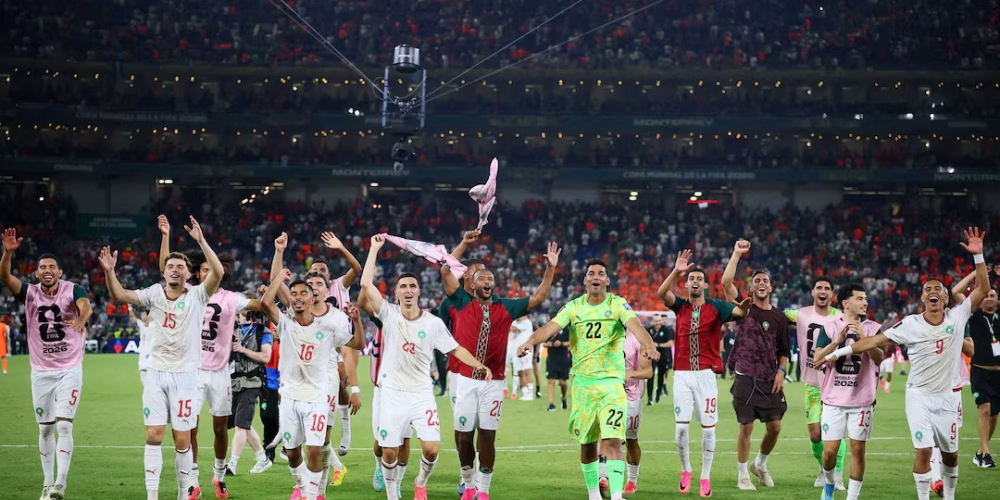
The dividends of this sustained capital injection are already visible on the international stage, transforming the men’s national squad into an elite global competitor. Following their historic fourth-place finish at the 2022 tournament in Qatar—where they eliminated European powerhouses Spain and Portugal—the squad has continued its upward trajectory. The national program further validated its elite status by capturing the prestigious 2025 Africa Cup of Nations title, cementing its reputation as a dominant force outside of traditional South American and European boundaries.
Furthermore, this industrial funding model allows the domestic federation to maintain independence from external financial pressures that often plague developing football nations. OCP Group’s long-term corporate commitments ensure that training facilities receive consistent, uninterrupted budgets regardless of short-term economic fluctuations. This financial stability enables the coaching staff to execute multi-year player development strategies, ensuring that the next generation of athletes is fully prepared to transition into demanding professional leagues across Europe and North America.
Why This Matters
The intersection of state resource management and elite sports programming offers a fascinating case study for corporate executives, sports franchises, and policymakers across the United States. As the commercial sports landscape in North America undergoes rapid changes driven by private equity investment, the Moroccan model demonstrates the immense power of centralized, long-term capital allocation. It proves that sustained, state-backed investment in youth development pipelines can successfully challenge traditional, multi-billion-dollar sports monopolies.
Additionally, Morocco’s stability in the global phosphate market carries profound implications for American agricultural businesses and everyday consumer food prices. The recent decision by the U.S. administration to ease import restrictions on Moroccan phosphate highlights just how dependent Western supply chains are on this specific North African trade relationship. As these fertilizer resources indirectly finance a global soccer powerhouse, American agricultural companies are observing how international trade dynamics can subtly shape the cultural and athletic landscapes of foreign nations.
NCN Analysis
The Moroccan experiment serves as a highly successful template for how developing nations can weaponize unique industrial monopolies to project soft power through international sports. By explicitly linking its most profitable state enterprise to the national soccer team, the government has generated immense domestic pride and international visibility. The profound sense of national unity and happiness observed across the country following recent tournament victories provides clear evidence that this capital expenditure yields immense social returns.
Looking ahead, the long-term success of this development framework will depend on the program’s ability to maintain its rigorous scouting standards as international expectations continue to skyrocket. With the national team now widely recognized as a permanent fixture in the knockout rounds of global tournaments, opponents will no longer treat them as an unpredictable underdog. The infrastructure built by OCP Group must continually evolve, ensuring that the domestic production of elite athletic talent keeps pace with the rapidly advancing tactical demands of modern global football.
The deliberate transformation of industrial mineral wealth into world-class athletic infrastructure proves that Morocco’s soccer success is built on a rock-solid economic foundation.
Reported by the NCN Editorial Team









