

KEY POINTS
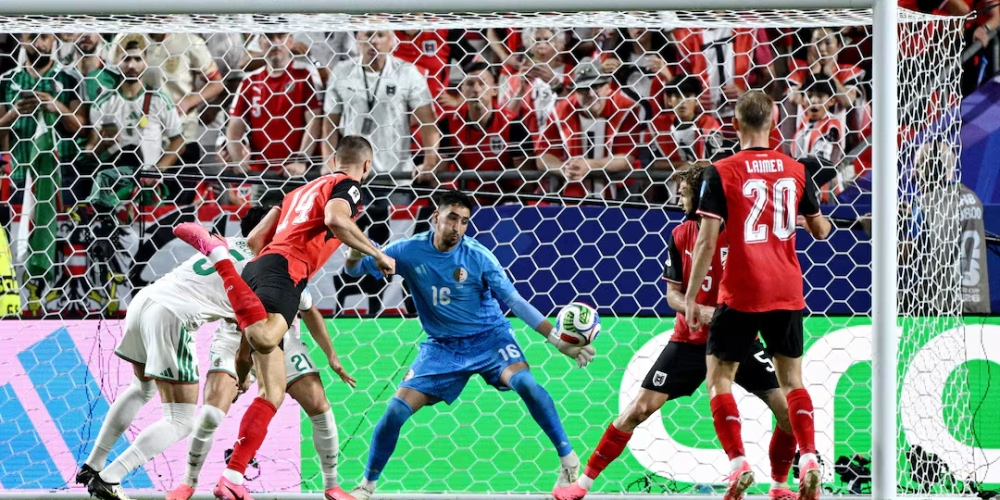
- Austria and Algeria advanced to the knockout stage following an unbelievable 3-3 draw in Missouri.
- A pedestrian second half exploded into pure chaos with two goals scored deep in injury time.
- The dramatic draw guaranteed both squads progress while officially eliminating undefeated Iran.
A Group J finale that critics feared would degenerate into a dull, mutually beneficial stalemate transformed into an all-time classic at the 2026 FIFA World Cup on Saturday night. Defying initial concerns surrounding tactical passivity under the tournament’s expanded structure, Austria and Algeria traded blows in a breathless encounter in Kansas City. For American spectators witnessing the global spectacle firsthand, the match served as a stunning advertisement for the drama that soccer can produce when everything is on the line.
What You Need to Know
The tournament expansion to 48 teams has drawn considerable criticism from soccer purists and sports strategists alike. Critics argued that the structure—specifically allowing the top third-placed teams to advance alongside the top two from each group—would disincentivize aggressive play in the final group matches. Entering the Saturday night match at Kansas City Stadium, both Austria and Algeria knew that a simple draw would be sufficient to steer both nations securely into the Round of 32, eliminating the risk of a high-stakes exit.
This dynamic naturally stoked fears of a repeat of historical controversies, most notably the infamous 1982 match between West Germany and Austria, where both teams stopped competing once a mutually favorable scoreline was reached. For the first hour in Kansas City, it appeared those cynical predictions might come true, as the game slowed to a crawl following an energetic first half. Loud whistles and boos echoed from the stands as the players passively circulated possession in the midfield, seemingly content to walk their way across the finish line.
However, soccer tournaments rarely follow a predictable script, and the delicate equilibrium was completely shattered as the match crossed into injury time. What was tracking to be a forgettable tactical exercise suddenly erupted into a sequence of events that will be replayed in World Cup highlight reels for decades. The thin margins separating tournament survival from immediate departure were laid bare in the heart of the American Midwest.
Late Fireworks Illuminate Kansas City Stadium
The match had opened with plenty of genuine competition before the mid-game lull took hold. Austrian veteran forward Marko Arnautovic broke the deadlock in the 28th minute, latching onto a precise long ball from David Alaba to scuff a clinical finish past the Algerian goalkeeper. Algeria responded just before the intermission when right back Rafik Belghali danced through the Austrian defense to equalize. The teams traded spectacular goals again early in the second half, with a thunderous blast from Austria’s Marcel Sabitzer quickly canceled out by an explosive wing play and finish from Algerian captain Riyad Mahrez.
Following that frantic sequence to make it 2-2, the conservative approach took over, setting the stage for a grandstand finish. In the 94th minute, Algeria broke the unspoken truce when Houssem Aouar exploited a sudden gap in the complacent Austrian defensive line. He delivered a perfectly weighted pass to Mahrez, who calmly slotted home his second goal of the night, sparking ecstatic celebrations from the Algerian bench and seemingly putting his side up 3-2 to secure second place in Group J.
With Austria suddenly staring at literal elimination from the competition in the final two minutes of play, manager Ralf Rangnick made a desperate final roll of the dice. He subbed on his towering 6-foot-7 forward, Sasa Kalajdzic, instructively gesturing for the entire team to flood the Algerian penalty box. The tactical gamble paid off instantly. In the 96th minute, a long, looping ball was flighted into the area, where Michael Gregoritsch managed to nod it across the face of the goal. Kalajdzic met the pass cleanly, powering a dramatic header into the back of the net with his very first touch of the match to secure the 3-3 draw.
Why This Matters
This spectacular showcase in Missouri fundamentally redefines the narrative surrounding the expanded format for North American audiences. While sports analysts had spent weeks warning that the 48-team layout would dilute the prestige of the group stage, this match proved that the mathematical tension can generate unmatched entertainment. The rapid-fire swings of fortune illustrated how wildcard permutations create an environment where no team is truly safe until the final whistle blows across multiple venues.
The economic and cultural ripple effects of this thriller will be felt immediately across the host cities. With both teams advancing, vibrant fanbases from central Europe and North Africa will continue to travel across the United States, injecting revenue into local hospitality, travel, and stadium sectors. Conversely, the result brings an abrupt end to the tournament journey for fans of Iran, demonstrating the brutal reality of multi-stadium tiebreakers where an undefeated group stage campaign still results in a ticket home.
NCN Analysis
From an editorial standpoint, the tactical anarchy displayed in the final minutes of this match provides a fascinating case study for the remainder of the knockout rounds. While both managers publicly dismissed any pre-match talk of collusion, the visible drop in intensity during the middle portion of the second half showed how heavily tournament mathematics weigh on coaching decisions. Yet, the sheer pride and competitive instinct of the players ultimately overrode any conservative game plans, delivering a chaotic spectacle that defied clinical calculation.
Looking forward, the paths diverge rapidly for the two newly qualified sides as they enter the single-elimination phase. Austria’s reward for finishing second in the group is a daunting Round of 32 clash against reigning European champions Spain, a fixture where they will undoubtedly enter as heavy underdogs. Algeria will line up against Switzerland in what projects to be a highly physical, evenly matched encounter. If this group stage finale is any indication, the remainder of this tournament will reward the teams that embrace risk rather than those trying to manage the clock.
A night that began with cynical fears of a manufactured stalemate concluded as an unforgettable testament to the beautiful game’s capacity for pure drama.
Reported by the NCN Editorial Team









