

KEY POINTS
- The Green Falcons earned a convincing 3-0 victory over Puerto Rico in an international friendly match staged in Austin, Texas.
- A severe thunderstorm forced a nearly two-hour delay in the first half before play could safely resume under local safety regulations.
- The triumphant performance marks the first international victory for newly appointed manager Georgios Donis ahead of the upcoming global tournament.
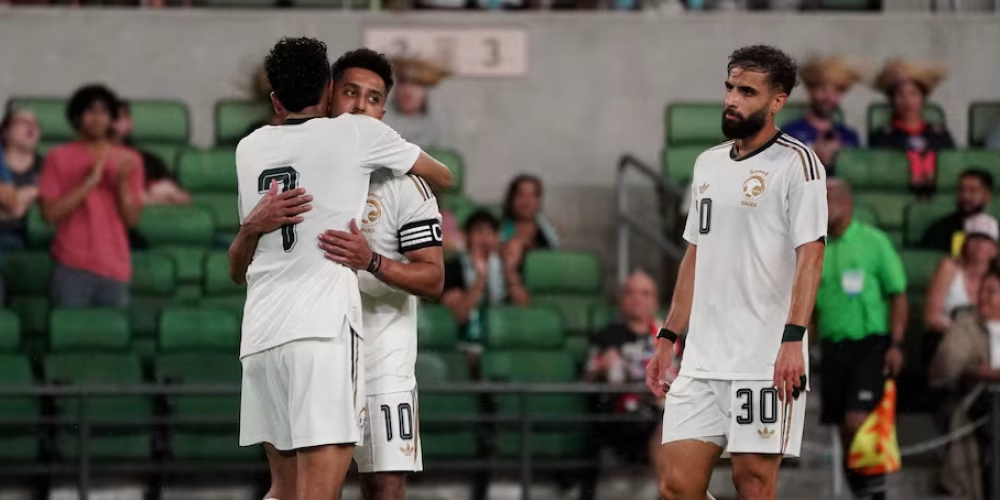
The Saudi Arabia national football team captured a decisive 3-0 victory against Puerto Rico on Saturday afternoon during a warm-up match heavily disrupted by extreme weather. Contested at the Q2 Stadium in Texas, the friendly encounter served as a critical preparation fixture for the Gulf nation as they fine-tune their tactical approach for the upcoming World Cup in North America. The dominant display provided an essential morale boost for the squad, rectifying recent defensive vulnerabilities and validating the strategic adjustments implemented by their new leadership.
What You Need to Know
International preparatory friendlies are vital for national football federations aiming to build competitive chemistry and assess squad depth before entering major global tournaments. For Saudi Arabia, this summer represents a high-stakes campaign as they prepare to compete in Group H alongside elite global footballing powers including Spain, Uruguay, and Cape Verde. Finding organizational rhythm under a newly implemented tactical regime is paramount if the team hopes to replicate or surpass historical knockout-stage appearances.
The fixture also served as a milestone event for newly appointed head coach Georgios Donis, who recently assumed management of the national program. Donis, a seasoned tactician with extensive experience navigating club football across Europe and the Middle East, was brought in to instill disciplined defensive structures and dynamic counter-pressing sequences. Having suffered a narrow 2-1 defeat to Ecuador in their previous public outing, securing a clean-sheet victory was critical to establishing administrative credibility and player buy-in.
Staging international matches in the United States during the early summer months routinely introduces environmental variables, particularly regarding severe localized weather patterns. American sporting venues enforce strict safety protocols regulated by regional federations, requiring immediate suspension of outdoor activities when lightning hazards manifest within a specific geographic perimeter. Managing player physiology, mental focus, and tactical adjustments during an extended mid-game intermission represents an advanced logistical challenge for any modern coaching staff.
Thunderstorms Fail to Soften Saudi Attack in Austin
The international contest started with considerable physical energy from both sides before environmental conditions intervened. In the 21st minute of play, match officials were forced to suspend the game as severe thunderstorms and lightning strikes developed directly over the stadium area. Following United States sports safety directives, which mandate a halt when lightning is detected within an eight-mile radius, players were ushered back into the dressing rooms while spectators sought immediate shelter inside the concourses.
The weather delay extended for nearly two hours, with multiple lightning strikes continuously resetting the mandatory 30-minute safety window. When conditions finally cleared and play resumed, the Asian powerhouse adapted much faster to the damp playing surface than their Caribbean opponents. The breakthrough materialized just before the halftime whistle blew, when winger Sultan Mandash alertly capitalized on a severe defensive miscommunication within the Puerto Rican penalty area to smash home the opening goal.
Maintaining their offensive momentum into the second half, the Green Falcons doubled their advantage in the 50th minute through sharp tactical pressing. Forward Abdullah Al Hamdan intercepted a careless pass deep in the opponent’s defensive third, driving forward before executing a perfectly weighted, composed finish over the advancing goalkeeper. The sequence highlighted the exact high-pressing philosophy that the new managerial staff has prioritized during recent training blocks.
The commanding performance concluded in spectacular fashion during the final minutes of regulation time. In the 88th minute, star playmaker and team captain Salem Al Dawsari embarked on a dazzling solo run from the flank, weaving past multiple defenders before placing a precise shot into the back of the net to make it 3-0. The clinical finish capped off a highly encouraging afternoon for the traveling contingent, who completely limited Puerto Rico’s transition opportunities throughout the remainder of the evening.
Why This Matters
For sports business analysts and global soccer enthusiasts, this Texas-based exhibition highlights the immense commercial expansion and logistical scaling currently shaping the international football economy. Staging high-profile preparatory matches involving Middle Eastern and Caribbean nations in major American municipal hubs reflects a deliberate strategy by organizers to maximize gate revenues, tap into diverse expatriate consumer markets, and test stadium infrastructure ahead of the expanded World Cup tournament.
Furthermore, the significant weather disruption illustrates the growing operational complexities that global broadcasting networks and corporate sponsors face during summer athletic calendars. A two-hour television programming delay requires rapid corporate adaptability, forcing networks to adjust ad-insertion blocks, manage digital streaming traffic, and maintain viewer engagement during prolonged periods of inactivity. As global climate patterns continue to induce unpredictable weather events, sports entertainment entities are increasingly investing in sophisticated climate-monitoring partnerships to mitigate financial risks.
NCN Analysis
This victory provides Georgios Donis with a highly valuable foundational blueprint as he prepares his final 26-man roster selection. The team’s ability to remain mentally resilient and physically warm during a two-hour environmental stoppage speaks volumes about the collective discipline inside the camp. Tactically, the smooth distribution from the midfield and the reduction of unforced turnovers show a marked improvement from the errors that plagued their recent loss to Ecuador.
However, the coaching staff will recognize that Puerto Rico, currently situated lower in the official global rankings, did not possess the tactical variation to truly exploit the gaps in the Saudi defensive line. The ultimate test of this system will occur on June 9, when the squad faces a physically dominant Senegal team in their final warm-up match before tournament play begins. Fans should watch closely to see if the midfield can replicate this level of ball retention when pressured by elite African opposition.
The Green Falcons will look to carry this newfound attacking confidence into their final training camp before launching their official global campaign.
Reported by the NCN Editorial Team









