

KEY POINTS
- Austria is ending a 28-year absence from the global tournament after successfully securing a spot on the grandest international stage.
- Head coach Ralf Rangnick has fully implemented his high-octane counter-pressing system, transforming Das Team into an elite European contender.
- Boasting a deep mix of experienced veterans and naturalized youth talents, the side aims to secure its first tournament knockout victory since 1954.
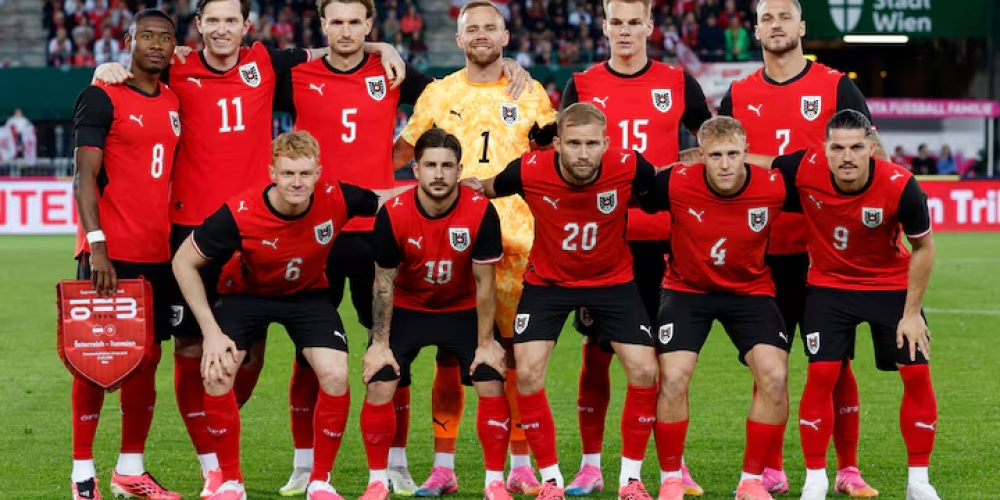
Austria has officially shattered a nearly three-decade residency in the international football wilderness, arriving at the global tournament backed by a highly tactical soccer revolution. Under the disciplined stewardship of mastermind manager Ralf Rangnick, the European nation is no longer content with merely qualifying for major events. The revitalized squad is landing in North America with a golden generation structurally engineered to disrupt the traditional global football hierarchy.
What You Need to Know
To understand Austria’s modern football renaissance, one must look back at their historic performance during the European Championships in Germany two years ago. Rangnick’s squad captured global attention by playing an incredibly fluid, fearless brand of attacking football, sensationally topping a brutal group that featured powerhouses France and the Netherlands. Though their journey was ultimately cut short by Turkey in a chaotic, thrilling round-of-16 clash, the performance proved that Austria possessed the raw capability to compete with the world’s absolute best.
The core catalyst behind this dramatic structural turnaround is Rangnick himself, widely revered within global football circles as the godfather of “gegenpressing.” This specialized tactical philosophy demands extreme physical conditioning, intense off-ball movement, and aggressive counter-pressing designed to win back possession immediately after a turnover. Since taking the reins, Rangnick has completely dismantled Austria’s historically conservative playing style, replacing it with a high-velocity system designed to transition the ball forward with devastating speed and precision.
Despite their continental success, Austria carries a historical burden that this current roster is desperate to erase. The nation has remarkably failed to win a single knockout stage fixture at a major tournament since 1954, creating a seven-decade psychological barrier. As they prepare to navigate a challenging group phase, the collective objective within the locker room has shifted from casual participation to achieving historic knockout-round progression.
The Last Stand for a Golden Generation
The upcoming group schedule presents an intriguing tactical path for Rangnick’s men, who find themselves placed in Group J alongside a highly diverse set of international opponents. Austria will launch their campaign with an opening fixture against tournament newcomers Jordan, a match where they will be heavily favored to establish early dominance. The difficulty curve spikes dramatically in their second match against defending champions Argentina, before they conclude group operations against an athletic and unpredictable Algeria side.
This tournament represents a critical crossroads for the roster, serving as a probable final world stage appearance for the spiritual core of Austria’s finest generation. Legendary forward Marko Arnautović, the country’s all-time top goalscorer and most-capped player, remains a vital focal point at 37 years of age, providing veteran savvy alongside 32-year-old striking alternative Michael Gregoritsch. Crucially, talismanic Real Madrid defender David Alaba returns to full fitness to anchor the backline, after being forced to watch the previous Euros from the sidelines due to a severe injury.
Austria Group J Schedule:
1. vs. Jordan (Tournament Debutants)
2. vs. Argentina (Defending Champions)
3. vs. Algeria (Continental Powerhouse)
To complement this aging core, the Austrian technical staff has aggressively integrated elite young talent into the midfield ranks. The squad has been significantly boosted by the inclusion of recently naturalized starlets, including 20-year-old playmaker Paul Wanner and 22-year-old midfield engine Carney Chukwuemeka. Driven forward by established European stars Marcel Sabitzer and Christoph Baumgartner, the midfield block possesses an ideal balance of defensive energy, technical maturity, and vertical distribution.
Why This Matters
The return of a highly competitive Austrian side adds immense depth and tactical intrigue to the global tournament layout. For soccer purists and tactical analysts worldwide, Austria serves as the ultimate litmus test for whether a club-defined, high-intensity pressing system can successfully translate to the international stage, where training time is notoriously limited. Their presence ensures that Group J will be one of the most heavily scrutinized sections of the entire tournament layout.
Furthermore, Austria’s resurgence highlights a broader trend regarding international sports migration and naturalization. By successfully integrating young talents like Wanner and Chukwuemeka into their national setup, the Austrian football federation has created a modern blueprint for how smaller European nations can aggressively upgrade their player pools. Their emergence as a legitimate threat provides an exciting dynamic for global viewers who enjoy seeing historic soccer hierarchies thoroughly challenged by well-coached underdogs.
NCN Analysis
Ralf Rangnick has managed to build something entirely unique in international football: an actual club culture within a national team framework. Typically, international managers adopt conservative, defensive shapes because complex pressing schemes require immense repetition to perfect. Rangnick has completely defied that conventional wisdom, demanding absolute physical sacrifice from his players, a strategy that has turned Austria into an incredibly exhausting opponent that nobody wants to face in a bracket format.
Readers should watch closely to see how Austria handles the grueling travel logistics and rapid turnaround times inherent to a North American tournament layout. If their aging stars can manage their physical recovery effectively between high-intensity matches, this team is entirely capable of pulling off a massive upset against tournament favorites. The long-awaited knockout victory since the mid-20th century is well within their grasp, and achieving it would cement Rangnick’s tactical revolution as a permanent turning point in Austrian sports history.
Austria’s high-octane tactical identity ensures they enter the tournament as Europe’s most dangerous dark horse, fully equipped to end their knockout drought.
Reported by the NCN Editorial Team









