

KEY POINTS
- A massive street celebration in Manhattan turned destructive following a historic playoff victory by the New York Knicks.
- Unruly crowds targeted public infrastructure, resulting in a city transit bus being set on fire in the middle of a major thoroughfare.
- Law enforcement deployed heavily across Midtown to disperse thousands of revelers and restore order to the city streets.
A historic sporting triumph quickly gave way to dangerous street violence in the heart of New York City on Sunday night. Following a monumental victory by the New York Knicks, thousands of ecstatic fans flooded the streets of Manhattan, transforming what should have been a night of athletic celebration into a chaotic scene of civil unrest. The situation rapidly deteriorated as crowds overwhelmed local law enforcement, leading to property damage and structural fires in one of the world’s busiest commercial districts.
What You Need to Know
The New York Knicks have long maintained one of the most passionate and fiercely loyal fanbases in North American professional sports. Decades of competitive frustration and near-misses have created a high-pressure environment where any major postseason success carries immense emotional weight for the city. When the team secured its latest high-stakes victory, the pent-up energy of generations of sports fans spilled out of Madison Square Garden and into the surrounding avenues.
Historically, major sports victories in metropolitan areas present unique challenges for municipal governments. While city officials routinely plan for organized parades and sanctioned public gatherings, spontaneous victory celebrations are notoriously difficult to control. The intersection of sports culture, alcohol consumption, and large crowds frequently tests the boundaries between joyful public expression and criminal behavior, a boundary that was severely crossed in Manhattan this weekend.
As sports fandom continues to evolve in the digital age, the desire for viral moments has altered how crowds behave during public gatherings. The immediate impulse to capture disruptive behavior for social media platforms often exacerbates crowd dynamics, drawing more people into volatile situations. Sunday night’s events highlight the ongoing struggle for city planners and emergency services to manage the unpredictable nature of modern metropolitan celebrations.
Manhattan Sports Celebrations Turn Destructive
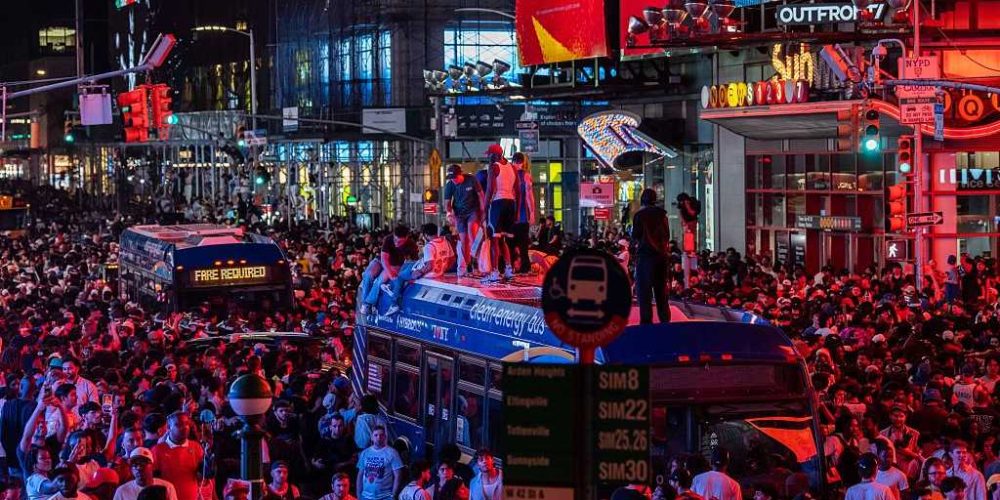
The unrest began almost immediately after the final buzzer sounded, as a massive wave of spectators exited the arena and merged with thousands of others who had gathered in the streets. Within an hour, the intersection of major avenues in Midtown Manhattan became entirely impassable. What started as synchronized chanting, flag-waving, and horn-honking escalated as individuals began climbing streetlights, scaffolding, and public transit structures to gain a vantage point over the growing sea of people.
The flashpoint of the evening occurred when a segment of the crowd surrounded a stationary city transit bus. Eyewitness accounts and video footage show individuals scaling the roof of the vehicle before breaking windows and igniting a fire inside the main cabin. Within minutes, the multi-ton public vehicle was engulfed in flames, sending thick plumes of black smoke into the Manhattan skyline and forcing nearby revelers to scatter in panic. Emergency responders faced significant delays navigating the dense crowds to reach the burning vehicle.
The New York Police Department (NYPD) rapidly activated emergency protocols, deploying hundreds of riot-control officers to the scene. Utilizing public address systems and strategic crowd-control formations, officers attempted to establish a perimeter around the burning bus and push the crowds back toward major transit hubs. Skirmishes broke out between police and small groups of agitators, who threw bottles, debris, and fireworks at responding personnel.
By the early hours of Monday morning, heavily reinforced police lines managed to clear the primary avenues, leaving behind a wake of shattered glass, overturned trash receptacles, and scorched pavement. City sanitation crews worked through the night alongside arson investigators to remove the destroyed transit bus and assess the structural damage done to the surrounding roadway and nearby commercial storefronts. Multiple arrests were made, with charges ranging from reckless endangerment to criminal mischief and inciting a riot.
Why This Matters
The outbreak of violence in Manhattan carries significant implications for urban residents, commuter networks, and the broader hospitality industry. For everyday Americans living and working in major metropolitan areas, such events underscore the inherent risks of localized civil disruption during major cultural or athletic milestones. The destruction of public transit assets directly impacts daily commuting infrastructure, forcing municipal agencies to divert taxpayer funds toward the replacement of expensive equipment and the repair of public roadways.
Furthermore, local businesses operating in the vicinity of sports arenas face immediate economic vulnerabilities when celebrations turn destructive. Storefront damages, increased insurance premiums, and the temporary loss of foot traffic during clean-up operations present heavy burdens for urban retailers. For the broader public, these incidents trigger a necessary conversation regarding the balance between public safety and the freedom to celebrate collective cultural achievements in open spaces.
NCN Analysis
The events in New York City reflect a broader, systemic issue facing modern urban centers tasked with managing massive public gatherings. The rapid escalation from a celebratory sports rally to an act of significant arson indicates that municipal security strategies must adapt to changing crowd dynamics. Relying solely on reactive policing is often insufficient when thousands of individuals occupy concentrated spaces with high emotional volatility. Going forward, city administrators will likely face pressure to implement stricter preventative perimeters and pre-planned traffic diversions during high-stakes sporting events.
Looking ahead, this incident will likely influence how future athletic victories are policed not only in New York but across the United States. Leagues and franchises may find themselves working in closer, more restrictive tandem with city governments to manage fan behavior outside arena walls. As the postseason progresses, the spotlight will remain on whether law enforcement can successfully deter criminal behavior while allowing peaceful fans to celebrate their teams’ historic milestones.
The destruction of public infrastructure in Manhattan serves as a stark reminder of how quickly civic pride can devolve into dangerous lawlessness.
Reported by the NCN Editorial Team









