

KEY POINTS
- A high-stakes showdown in New Jersey ended in a 1-1 draw as both global football powerhouses opened their tournament accounts.
- Morocco dominated the early proceedings, exposing structural vulnerabilities in the South American powerhouse’s central midfield.
- A moment of individual magic from a star forward rescued a point for the five-time world champions.
The Brazilian men’s national football team fought back to secure a 1-1 draw against a relentless Moroccan squad in their opening Group C fixture of the 2026 World Cup. Playing before a sold-out crowd at MetLife Stadium in East Rutherford, New Jersey, the South American giants endured a chaotic opening period before stabilizing their tactical formation in the second half. The highly anticipated match lived up to its billing as the first true heavyweight clash of the expanded tournament, leaving both nations with a single point in a competitive group.
What You Need to Know
The tournament opener carried immense narrative weight due to the high-profile managerial debut of Carlo Ancelotti on the World Cup stage with Brazil. The storied Italian tactician took the reins of the five-time world champions with the explicit mandate of restoring tactical discipline and positional balance to a roster traditionally celebrated for its individual flair. Confronting a major tournament environment right away, the new leadership structure faced immediate scrutiny regarding squad selection and midfield chemistry.
Morocco entered the tournament carrying the confidence of their historic semi-final run at the 2022 World Cup in Qatar, aiming to prove that their previous success was not an anomaly. Under their organized technical staff, the African giants have successfully blended a highly disciplined defensive shape with creative, rapid transition players operating in elite European leagues. Their established tactical continuity gave them a distinct cohesive advantage over a Brazilian side still adjusting to a new managerial philosophy.
The Group C landscape makes every single point critical, with Scotland and Haiti completing a balanced four-team pool. For Brazil, failing to secure a victory in an opening match adds unusual pressure to their upcoming group fixtures, shattering the assumption of an easy path to the knockout rounds. For Morocco, matching the most successful nation in football history stride for stride serves notice to the rest of the tournament that they remain legitimate contenders to make another deep postseason run.
How the Heavyweight Match Unfolded
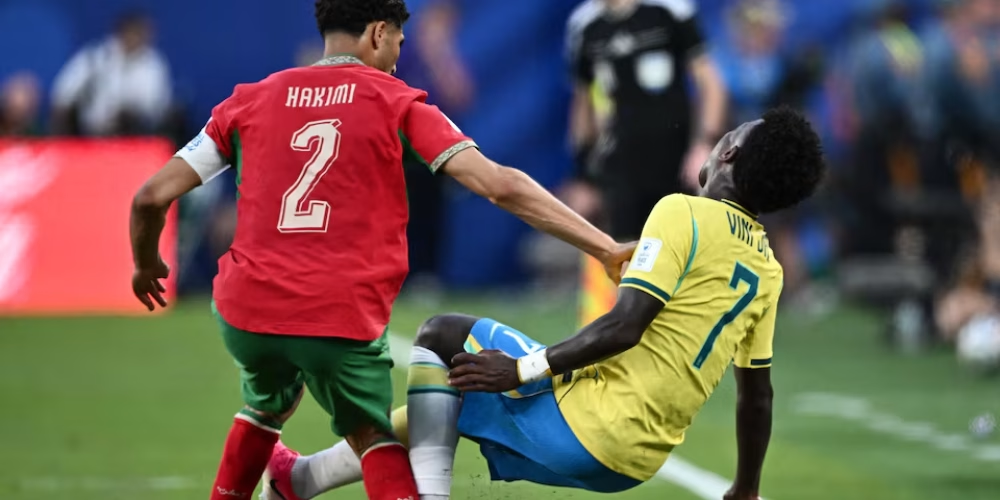
The opening half-hour belonged entirely to Morocco, whose aggressive high-pressing system completely unraveled Brazil’s central midfield trio of Casemiro, Lucas Paqueta, and Bruno Guimaraes. Operating with superior energy and tighter spatial positioning, the Atlas Lions consistently intercepted loose balls and exposed massive gaps between the Brazilian midfield and backline. The tactical breakthrough arrived in the 21st minute when a midfield turnover allowed Brahim Diaz to slide a perfect through-ball to Ismael Saibari. With Brazilian goalkeeper Alisson rushing off his line in an ill-timed challenge, Saibari calmly lifted a clever lob over the keeper to give Morocco a fully deserved lead.
The North African side continued to apply pressure, with Achraf Hakimi and Bilal El Khannouss generating dangerous overloads down the flanks that forced central defenders Marquinhos and Gabriel into desperate clearing actions. However, Brazil’s wealth of individual attacking talent rescued them from a worsening deficit in the 32nd minute. Receiving a short pass from Guimaraes on the left edge of the penalty area, Real Madrid winger Vinicius Junior cut sharply inside onto his right foot, curling a magnificent, unstoppable strike into the far top corner of Yassine Bounou’s net to equalize against the run of play.
Recognizing the severe structural imbalance of his lineup, Ancelotti made a double substitution at halftime, introducing Fabinho and Danilo to replace Casemiro and Roger Ibanez. These adjustments immediately stabilized the South American side, providing a secure defensive anchor that restricted Morocco’s counter-attacking transitions. While the second half featured greater possession and late scoring opportunities for Brazilian attackers Raphinha and Matheus Cunha, Morocco’s disciplined low block held firm until the final whistle.
Why This Matters
The tactical struggle witnessed in New Jersey provides vital structural lessons for football associations and sports analysts monitoring the rapid evolution of international play. The match demonstrated that elite individual talent can no longer completely dominate well-organized, cohesive defensive units that utilize aggressive pressing systems. For global English-speaking audiences and North American broadcasters, a highly competitive draw between traditional and emerging powers increases the overall entertainment value and television viewership metrics of the group stages.
Additionally, the fierce encounter highlights the physical demands placed on modern athletes competing in high-stakes summer tournaments across the United States. Managing player fatigue, executing timely squad rotations, and adapting tactical formations during cooling breaks will dictate which nations survive the grueling tournament schedule. The ability of an underdog to disrupt a powerhouse team’s rhythm through collective physical effort provides a clear blueprint for lower-ranked nations looking to secure upset results during the tournament.
NCN Analysis
The post-match evaluations from the Brazilian camp indicate a clear understanding that their central midfield structure requires immediate alteration before their next group appearance. Ancelotti’s willingness to bench senior figures like Casemiro at halftime suggests that reputation will not compromise tactical necessity as the tournament progresses. Observers should expect Fabinho to earn a starting role in the upcoming fixtures to ensure the defensive backline remains adequately protected during transition phases.
Meanwhile, Morocco walks away from the encounter as the psychological victors, having demonstrated the tactical maturity required to manage a game against elite opposition. Their ability to maintain a rigid defensive shape even as their energy levels waned in the second half proves they possess the mental resilience necessary for tournament longevity. If both nations can successfully navigate their upcoming matches against Scotland and Haiti, this opening draw will likely serve as the launching pad for two deep tournament runs.
The global football community witnessed an intense tactical battle that sets a highly competitive standard for the remainder of the group stage.
Reported by the NCN Editorial Team









