

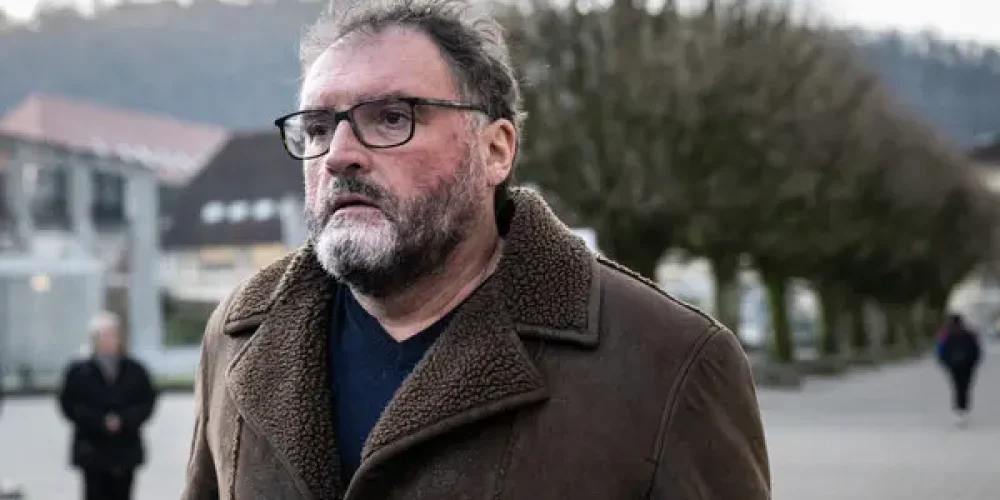
A French court has sentenced former anesthetist Frédéric Péchier to life in prison after finding him guilty of deliberately poisoning dozens of patients over nearly a decade, in one of the most disturbing medical crime cases in France’s history.
Péchier, 53, was convicted in the eastern city of Besançon following a four-month trial that examined a pattern of unexplained medical emergencies in operating rooms. Judges ruled that he intentionally tampered with infusion bags, injecting dangerous substances such as potassium chloride or adrenaline. These chemicals caused sudden cardiac arrests or severe internal bleeding during otherwise routine surgical procedures.
The court found Péchier responsible for poisoning 30 patients between 2008 and 2017. Twelve of those victims died. Others survived only after emergency intervention, often suffering long-term physical and psychological trauma. The youngest victim was a four-year-old child who survived two cardiac arrests during a tonsil operation. The oldest patient was 89 years old.
Prosecutors described Péchier as someone who turned a place of healing into a site of fear and death. They argued that his actions were driven by resentment toward fellow anesthetists. In many cases, he was not assigned as the primary anesthetist. Instead, investigators believe he arrived early to secretly contaminate infusion bags. When patients collapsed during surgery, Péchier frequently stepped in, diagnosed the crisis, and ordered the correct antidote, presenting himself as the hero who saved the day.
That pattern raised suspicion only years later. Alarms were finally triggered in 2017 when an unusually high concentration of potassium was discovered in an infusion bag used on a woman who suffered cardiac arrest during spinal surgery. A deeper investigation uncovered a striking anomaly at the Saint-Vincent private clinic in Besançon. The rate of fatal cardiac events under anesthesia there was more than six times the national average.
Investigators also noticed a chilling trend. When Péchier temporarily worked at another clinic, the unexplained emergencies stopped in Besançon and appeared at the new location instead. When he returned, the incidents resumed. After he was banned from practicing medicine in 2017, the abnormal events ended entirely.
Despite the evidence, Péchier consistently denied responsibility throughout the trial. He acknowledged that poisonings may have occurred but insisted he was not the perpetrator. His statements shifted over time, weakening his defense. Prosecutors pointed to his contradictory testimony and the strong circumstantial evidence linking him to every incident.
Psychological evaluations presented in court painted a complex portrait. Péchier, the son of medical professionals, was described as outwardly competent and confident, yet capable of extreme harm. Experts likened his personality to a “Dr Jekyll and Mr Hyde” profile. He had attempted suicide in both 2014 and 2021 and told the court his main concern was protecting his children.
Victims and their families described years of suffering and unanswered questions. Survivors expressed relief after the verdict, calling it the end of a long nightmare. As the life sentence was read, Péchier remained expressionless, even as his children wept in the courtroom.
The court ordered that Péchier must serve at least 22 years before becoming eligible for parole. He has the right to appeal within ten days, which would lead to a new trial. For now, the ruling stands as a landmark decision, sending a strong message about accountability in the medical profession and offering a measure of closure to victims whose lives were forever altered.









