

KEY POINTS
- FIFA integrated North American entertainment traditions into the 2026 tournament, featuring mandatory hydration stoppages, championship rings, and a extended 27-minute final halftime show.
- Mandatory mid-half breaks effectively split 45-minute halves into structured segments, providing managers with tactical timeouts and broadcasters with dedicated commercial inventory.
- European sports federations are already resisting the permanent adoption of these format adjustments as international soccer debates its traditional identity.
The 2026 FIFA World Cup concluded in North America having delivered a tournament defined as much by commercial innovation as on-field performance. FIFA’s deliberate adoption of the U.S. sports presentation model has ignited an intense international debate over how much of this American makeover should remain in global soccer.
What You Need to Know
For generations, international soccer guarded its traditional structure: 90 continuous minutes of running time, a strict 15-minute halftime intermission, and minimal commercial interruptions during play. That framework evolved during the North American tournament as event organizers merged the standard soccer match with American sports entertainment concepts.
To protect athlete safety amid summer heat across host cities in the United States, Mexico, and Canada, organizers mandated hydration stoppages midway through each half. While justified on player welfare grounds, these stoppages created two pre-planned operational breaks per match, turning traditional continuous play into four distinct tactical periods.
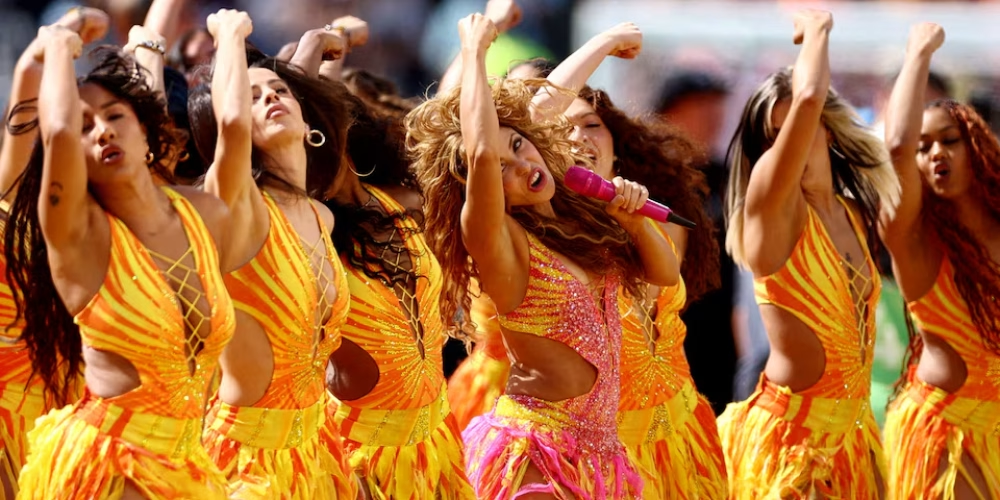
The spectacle reached its commercial peak at New York New Jersey Stadium during the final between Spain and Argentina. The match featured a star-studded musical halftime concert that extended the traditional 15-minute break to 27 minutes. Following their extra-time victory, Spanish players were presented with custom championship rings alongside the World Cup trophy—a direct adaptation of American championship celebrations.
Soccer Traditions vs Commercial Evolution in 2026
The structural alterations to match flow generated immediate tactical consequences. National team coaches utilized mid-half hydration breaks as functional timeouts, making tactical adjustments and delivering instructions in ways previously impossible under continuous match play. Broadcasters gained predictable commercial windows, pointing toward substantial revenue growth for future rights negotiations.
However, traditionalists argue these disruptions undermine soccer’s core identity. UEFA administrators signaled immediate resistance to adopting permanent multi-break structures for European competitions, confirming their intention to enforce strict one-minute hydration limits only when environmental conditions demand them.
The scale of the expanded 48-team, 104-match format presented additional logistical challenges. Expanding the field increased match volume and ticket sales, but critics contend the lengthy schedule diluted the urgency of the initial group stage.
Officiating remained a central focus of debate throughout the tournament. Despite refined VAR protocols and automated tracking technology, controversial interpretations of physical contact and handball rules generated widespread media scrutiny, illustrating the ongoing challenge of balancing technological precision with real-time referee decision-making.
What This Means for Americans
For American sports fans, venue operators, and commercial sponsors, the 2026 World Cup established North America as the global benchmark for high-revenue sports entertainment. The integration of halftime concerts, premium corporate hospitality, and entertainment-first match staging proved that soccer can generate commercial returns comparable to the Super Bowl or NBA Finals.
This commercial success reinforces major U.S. metropolitan areas as primary destinations for marquee international sporting events. American fans now enjoy direct access to world-class soccer inventory, while U.S. media executives hold unprecedented influence over how global sports broadcasts are structured and monetized for western audiences.
NCN Analysis
The 2026 World Cup demonstrated that while soccer’s global popularity remains unrivaled, its operational format is increasingly susceptible to commercial entertainment pressures. FIFA’s willingness to lengthen halftimes and introduce mid-half breaks confirms that governing bodies view the American entertainment model as a key driver for long-term financial expansion.
Looking ahead to the 2030 tournament across Europe and South America, soccer authorities face a structural balancing act. Broadcasters will push to retain high-value commercial windows, while European confederations and fan groups fight to preserve the continuous 90-minute format. The 2026 tournament established a new commercial precedent, but whether these changes become permanent standard practice remains soccer’s defining structural challenge.
North America delivered an unprecedented commercial spectacle, but global soccer must now decide where entertainment ends and the core sport begins.
Reported by the NCN Editorial Team









