

KEY POINTS
- United States striker Folarin Balogun admitted he knew FIFA’s unprecedented decision to pause his red card ban would trigger immense global backlash.
- The controversial ruling allowed the forward to play in the Round of 16 against Belgium after direct intervention from political figures, including U.S. President Donald Trump.
- Human rights organizations have since lodged formal complaints with the International Olympic Committee, targeting FIFA President Gianni Infantino over political neutrality.
United States national team striker Folarin Balogun has broken his silence on the massive disciplinary storm that overshadowed the host nation’s 2026 World Cup campaign. Speaking in a television interview on Tuesday, the 25-year-old forward admitted that while he was eager to help his teammates on the pitch, he knew the decision to temporarily overturn his automatic red-card suspension would ignite global controversy. The unprecedented ruling remains one of the tournament’s most heavily criticized talking points, drawing intense scrutiny to the relationship between political leaders and the governing bodies of international sports.
What You Need to Know
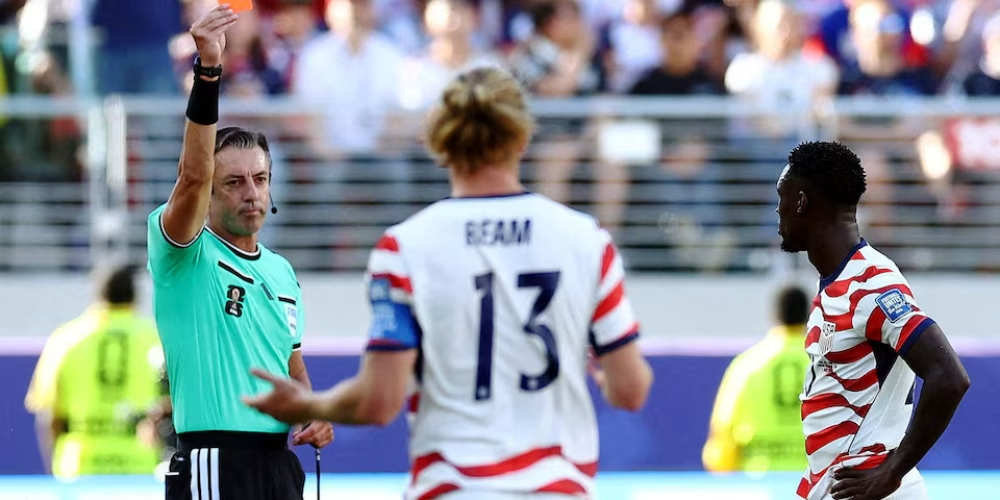
To fully understand the gravity of this situation, one must look back at the highly physical match that sparked the controversy. On July 1, the United States secured a historic 2-0 victory over Bosnia and Herzegovina in the World Cup Round of 32 in Santa Clara, California. During the 64th minute of that high-stakes match, Balogun was shown a straight red card for a challenging tackle on Bosnian defender Tarik Muharemovic. Under standard FIFA disciplinary procedures, a direct red card carries an automatic, non-appealable suspension for the following match.
However, the situation took a highly unusual turn when political forces intervened. United States President Donald Trump openly contacted FIFA President Gianni Infantino, publicly arguing that the tackle was merely an accidental collision between two elite athletes rather than a red-card offense. Following this high-level discussion, FIFA’s Disciplinary Committee made the shocking announcement that it would invoke Article 27 of its Disciplinary Code to put Balogun’s ban on hold for a one-year probationary period, effectively clearing him to play in the Round of 16 against Belgium.
This sudden reversal triggered immediate outrage across the international soccer community. European governing body UEFA and the Royal Belgian Football Association expressed deep anger, accusing FIFA of crossing a dangerous line and compromising the sporting integrity of the tournament. The controversy reached far beyond the pitch, as human rights organizations like FairSquare subsequently submitted formal complaints to the International Olympic Committee, alleging that Infantino breached strict codes regarding political neutrality.
Navigating the Noise in Seattle
The fallout from the ruling created an incredibly tense atmosphere for the United States squad as they prepared for their crucial knockout match in Seattle. Balogun revealed that the news of his clearance reached the team while they were traveling on the team bus to a training session. While the initial reaction inside the vehicle was filled with excitement and shouting, the striker quickly realized the heavy burden the decision would place on his teammates. He noted that he could sense a distinct level of nervousness within the squad, as the players struggled to comprehend the historic and highly irregular nature of the situation.
Despite the intense media storm and the hostility radiating from the Belgian delegation, Balogun maintained that his main focus was to block out the “outside noise” and prepare for the match. He continued to advocate that his initial tackle on Muharemovic was entirely unintentional and did not warrant a straight red card, though he recognized that the political theater surrounding his reinstatement had placed an unfair amount of pressure on the American team.
Ultimately, the structural distraction proved too much for the host nation to overcome on the field. A highly motivated Belgian team, fueled by the perceived injustice of the ruling, put on a clinical performance to defeat the United States 4-1, eliminating them from the tournament. While the defeat ended the USMNT’s World Cup run, the debate over how the governing body handled the disciplinary process has only intensified since the final whistle.
Why This Matters
The unprecedented political intervention in Balogun’s suspension has profound implications for soccer fans and sports institutions in the United States. For American sports enthusiasts accustomed to the rigid, independent disciplinary systems of domestic leagues like the NFL, NBA, or MLS, the idea of executive political influence directly altering a player’s eligibility is highly shocking. The incident has opened up a broader conversation among American fans about the governance, transparency, and ethics of global soccer organizations.
Furthermore, this controversy threatens to complicate the athletic legacy of the host nation’s tournament run. Rather than focusing on the USMNT’s historic achievement of winning their first World Cup knockout match in over two decades, the public narrative has been heavily dominated by the ethical questions surrounding the overturned ban. For young fans and local communities who rallied behind the team, the situation serves as a stark introduction to the complex, often messy intersection of geopolitics, sports diplomacy, and global athletic governance.
NCN Analysis
From an editorial perspective, FIFA’s handling of the Balogun affair is a devastating self-inflicted wound to its own sporting credibility. By allowing a sitting head of state to successfully lobby for the suspension of a standard disciplinary ruling during a World Cup, the governing body has set a highly problematic precedent. The use of Article 27 in this specific context feels less like a fair application of the rules and more like a convenient political compromise designed to appease a powerful host nation.
As the international community continues to digest the fallout, the long-term impact on FIFA’s leadership could be substantial. The formal complaints lodged with the International Olympic Committee ensure that this issue will not simply fade away with the conclusion of the tournament. If global soccer is to maintain its integrity, the governing bodies must establish clear, unbreachable barriers that protect the competitive rules of the game from the influence of external political interests.
The dramatic saga surrounding Folarin Balogun’s tournament run serves as a powerful reminder that when political power is allowed to dictate sporting rules, the integrity of the entire game is put at risk.
Reported by the NCN Editorial Team









