

KEY POINTS
- France must improve its attacking clinical sharpness ahead of their crucial showdown with Morocco.
- Head coach Didier Deschamps emphasizes tactical discipline to break down a notoriously rigid Moroccan defensive block.
- The upcoming match serves as a high-stakes rematch of their historic 2022 tournament encounter.
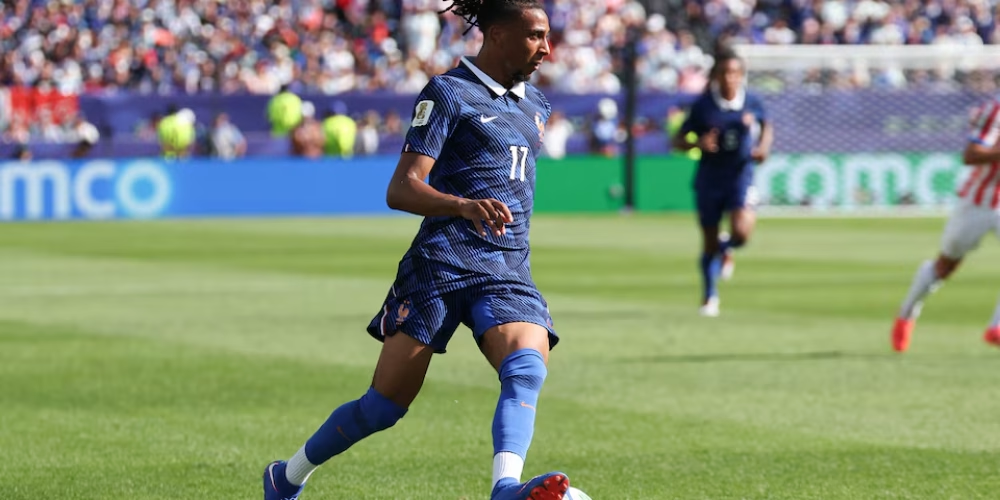
The French national football team faces an ultimate test of patience and precision as they prepare for a high-stakes clash against Morocco. Head coach Didier Deschamps has publicly issued a clear directive to his squad, demanding a significantly higher level of efficiency in the final third. With a spot in the later stages of the tournament on the line, Les Bleus cannot afford to waste opportunities against one of the most disciplined defensive units in international soccer.
What You Need to Know
The history between France and Morocco on the pitch carries immense weight, most notably highlighted by their memorable semifinal encounter during the 2022 World Cup in Qatar. In that tournament, Morocco captivated global audiences by becoming the first African nation to reach the final four, relying on an impenetrable defense and lightning-fast counter-attacks. France ultimately advanced with a hard-fought 2-2 structural victory, but the match exposed how difficult the Atlas Lions are to break down when they establish their defensive shape.
Since that historic run, Morocco has continued to refine its tactical setup, maintaining a core of elite European-based talent capable of neutralizing the world’s best attackers. Their defensive organization is not merely about sitting deep; it relies on intelligent pressing triggers and rapid transitions that catch overly extended opponents off guard. For France, a team known for its explosive pace and individual brilliance, facing this specific style requires an evolution from pure athleticism to calculated tactical breakdown.
Deschamps, who has guided France through multiple major tournament cycles, understands that past achievements mean very little in single-elimination football. The French squad enters this fixture under immense pressure from domestic fans and international pundits alike, who view anything less than a tournament victory as a disappointment. To secure their progression, the team must address recent bouts of inconsistency in front of the net that have occasionally plagued their otherwise dominant campaign.
Overcoming the Moroccan Defensive Wall
To dismantle the compact system deployed by Morocco, Deschamps is focusing heavily on structural ball movement and rapid shifts in play. In recent training sessions and press briefings, the tactical emphasis has been on reducing unnecessary touches in the midfield and executing quicker lateral passes to stretch the Moroccan backline. The French coaching staff recognizes that slow build-up play plays directly into the hands of an opponent comfortable defending in a low block for ninety minutes or longer.
Key individual matchups will dictate the rhythm of the game, particularly on the flanks where France traditionally generates its most potent attacking threats. The interaction between France’s dynamic wingers and Morocco’s disciplined full-backs will likely decide how many clean looks Les Bleus get inside the penalty area. Deschamps has challenged his frontline to show greater composure, noting that against a team of this caliber, clear-cut chances will be few and far between.
Furthermore, the role of the central midfield will shift from purely defensive coverage to creative orchestration. Players tasked with pulling the strings from deep positions must find ways to feed vertical passes between Morocco’s defensive lines, unlocking space for forward runs. The objective is to force the Moroccan center-backs out of position, creating temporary chaotic gaps that the clinical French attackers can exploit with one-touch finishing.
Why This Matters
For international soccer enthusiasts and the broader sports landscape, this matchup represents a fascinating battle of conflicting football philosophies. The contrast between France’s star-studded, high-powered offensive arsenal and Morocco’s collective defensive resilience offers a tactical masterclass that sets the standard for modern international competition. Beyond the tactical elements, the fixture carries profound cultural resonance for global audiences, drawing massive viewership numbers across North America and Europe due to the deep historical and social ties between the two nations.
For fans observing from the United States, the encounter demonstrates the rapidly evolving parity in global soccer, proving that structured defensive organization can successfully neutralize teams with superior individual market value. As the global game continues to expand its footprint, high-profile tactical battles of this nature serve to educate and captivate a growing American soccer fanbase ahead of major domestic sporting milestones. The outcome will set the narrative for how elite international managers approach defensively resilient opposition moving forward.
NCN Analysis
Deschamps’ public call for increased attacking efficiency is a calculated psychological move designed to sharpen his players’ focus before complacency can set in. Throughout his managerial tenure, Deschamps has preferred pragmatic efficiency over flamboyant displays, and he knows that a single wasted opportunity can lead to tournament elimination. By shifting the spotlight onto his team’s frontline execution, he is setting a benchmark for accountability that his veteran leaders must uphold on the pitch.
Expect France to start the match with sustained possession, attempting to probe the flanks early to test Morocco’s structural discipline. However, the true test will lie in how Les Bleus handle the frustration if an early breakthrough does not materialize. If Morocco manages to weather the initial storm and launch successful counter-attacks, France’s defensive transition will be tested just as severely as their attacking efficiency.
The decisive factor in this match will be whether individual brilliance can overcome collective organization under maximum pressure.
Reported by the NCN Editorial Team









