

KEY POINTS
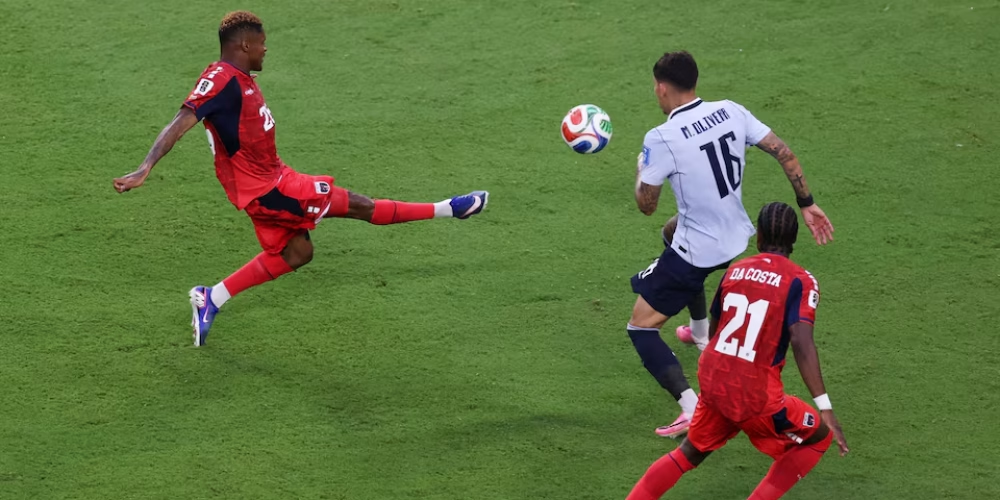
- Tournament debutants Cape Verde delivered a stunning performance to hold two-time champions Uruguay to an entertaining 2-2 draw in Florida.
- Midfielder Kevin Pina opened the scoring with an audacious 31-meter free kick, registering the nation’s first-ever goal at a global tournament.
- A critical second-half equalizer from substitute Helio Varela successfully canceled out Uruguay’s rapid double salvo just before halftime.
A captivating narrative of sporting bravery unfolded in Florida as newcomer Cape Verde stood entirely resolute against the immense footballing pedigree of Uruguay. Showing zero reverence for their opponent’s historical status, the African island nation played with a level of tactical boldness that completely disrupted the South American side’s rhythm. The hard-fought stalemate leaves the heavyweight favorites facing a highly complicated path to the single-elimination phase.
What You Need to Know
The statistical and historical gulf separating Cape Verde and Uruguay entering this high-stakes Group H encounter could not have been more pronounced. Separated by 51 places in the international rankings, Uruguay represents one of the traditional bastions of global soccer infrastructure, boasting a star-studded squad competing in elite European leagues. Conversely, Cape Verde arrived at the tournament celebrating their maiden appearance on the world stage, widely framed by commentators as massive group underdogs.
Despite these dramatic resource disparities, the Blue Sharks had already demonstrated their competitive viability in their opening match by grinding out a magnificent scoreless draw against Spain. That resilient defensive performance established the team’s structural integrity, earning widespread praise from sports media. However, many analysts questioned whether the tiny island nation possessed the necessary offensive firepower to consistently threaten a top-tier South American backline over ninety minutes.
The matchup took place under the blistering summer humidity of Miami Stadium, a climate that heavily tested the physical reserves of both rosters. Head coach Bubista opted to make three strategic alterations to his starting lineup, prioritizing vertical speed and rapid transition triggers to exploit Uruguay’s high defensive block. The tactical adjustments paid immediate dividends, ensuring the debutants would not simply retreat into a passive low block.
Bold Attack Shocks South American Giants
The fixture opened with Uruguay attempting to impose their physical presence, monopolizing central possession through midfielder Rodrigo Bentancur. Cape Verde responded with fearless individual skill, punctuated by winger Garry Rodrigues routinely bypassing defenders to draw roars from the crowd. The breakthrough arrived in the 21st minute when Telmo Arcanjo drew a foul after a explosive run through the center of the pitch.
From the resulting free kick, located an ambitious 31 meters out from goal, Kevin Pina unleashed a low, driving strike that squeezed directly through a fractured Uruguayan defensive wall. The powerful effort caught veteran goalkeeper Fernando Muslera completely off guard, nestling into the bottom corner to ignite absolute pandemonium in the stands. Rather than protecting their historic lead, Cape Verde pressed forward, attempting an audacious chip from their own half and a corner kick directed straight at the crossbar.
Uruguay responded to the perceived insolence with furious attacking pressure late in the first half. In the 44th minute, Maximiliano Araujo pounced on a loose rebound after Manuel Ugarte’s header struck the post, stooping low to nod home the equalizer. Deep into first-half stoppage time, Araujo turned provider, nodding a free kick across the penalty area for Agustin Canobbio to volley home, turning the match entirely on its head before the halftime whistle.
Why This Matters
For soccer fans and sports broadcast executives throughout North America, the emergence of Cape Verde as a legitimate competitive force provides the exact type of unpredictable human drama that elevates global tournaments. The intense, end-to-end spectacle in Florida proves that the expanding tournament format can foster elite parity rather than diluted competition. This captivating narrative expands casual television viewership and drives massive digital engagement across modern social media platforms.
Additionally, Cape Verde’s fearless tactical execution offers a powerful lesson to grassroots sports developments across the United States. It demonstrates that meticulous organizational framework and collective physical endurance can completely neutralize massive discrepancies in financial market valuation. For domestic club academies, the match serves as an elite blueprint for maximizing tactical efficiency when facing heavily favored opposition.
NCN Analysis
The strategic masterclass engineered by manager Bubista establishes Cape Verde as an incredibly dangerous opponent heading into the final matchday of the group stage. By proving they can score high-quality goals against a premier South American defense, the Blue Sharks have shed the one-dimensional label of a purely defensive unit. With a decisive final fixture looming against Saudi Arabia, the African side controls their own destiny and possesses all the mental momentum required to lock down a historic Round of 32 position.
For Uruguay, the consecutive stalemates represent a profound structural emergency that threatens their entire tournament survival. The catastrophic lack of communication between Olivera and Muslera on the second goal highlights deep-seated defensive anxieties under aggressive pressing systems. Facing a mandatory results scenario against group leaders Spain, the South American heavyweights must rapidly stabilize their defensive transition phases or suffer a highly embarrassing, premature departure from the global stage.
The vibrant celebrations following the final whistle clearly demonstrate that collective discipline and unwavering belief can successfully challenge the sport’s traditional elite hierarchy.
Reported by the NCN Editorial Team









