

KEY POINTS
- Arsenal manager Mikel Arteta has publicly demanded swift and aggressive summer recruitment to bridge the remaining gap to elite European honors.
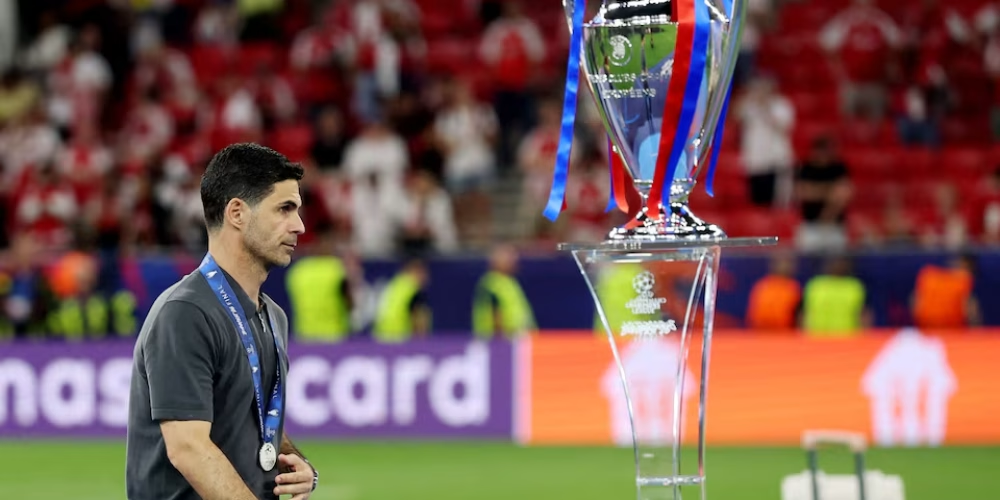
- Following a heartbreaking penalty shootout defeat in the Champions League final, the Spanish tactician emphasized the need for squad evolution.
- The Gunners intend to navigate a highly competitive summer transfer market to secure top-tier clinical attacking talent and midfield depth.
Arsenal manager Mikel Arteta has issued an assertive directive to his club’s executive board, calling for rapid, intelligent, and courageous movements in the upcoming summer transfer window. Speaking shortly after his side’s emotionally draining defeat to Paris Saint-Germain in the UEFA Champions League final, the manager made it clear that maintaining the current squad status quo is not an option if the club wishes to maintain its upward trajectory. The Spanish tactician stressed that the competitive landscape of modern football requires immediate, high-stakes evolution to prevent regression.
What You Need to Know
Under Arteta’s meticulous stewardship, Arsenal has undergone a dramatic structural metamorphosis over the past few seasons, transforming from a top-four challenger into a genuine European powerhouse. The North London club has pushed domestic rivals to the absolute limit while re-establishing its presence among the continental elite. However, despite assembling a cohesive, deeply talented roster headlined by individual stars like Martin Ødegaard and Bukayo Saka, the final, elite-level silverware has remained agonisingly out of reach.
The context of this transfer demand is deeply rooted in the margins of elite sport. Arsenal’s agonizing penalty shootout loss in Budapest highlighted a lingering vulnerability: the absence of ruthless, game-defining squad depth when key starters experience physical fatigue. In the modern sports industry, the period immediately following a near-miss is considered a critical operational window for executive recruitment strategy, as standing still often allows domestic rivals to close the gap.
Furthermore, the financial and regulatory environment of European club football places extreme premium on efficient market execution. With strict Profit and Sustainability Regulations dictating corporate spending limits across the English Premier League, clubs cannot afford expensive recruitment blunders. Arteta’s public call for “smart” business emphasizes a desire for strategic precision over simply spending massive quantities of liquid capital.
Navigating a Crucial Transfer Window
The blueprint laid out by the Arsenal manager requires the club’s scouting networks and sporting directors to act with unprecedented efficiency before the formal pre-season training cycle begins. Historical trends indicate that clubs completing their primary business early in the summer enjoy significantly better tactical integration and physical preparation. For a manager who demands extreme conceptual synchronization from his players, having new signings present for early training camps is non-negotiable.
Speculation within international football circles suggests that Arsenal will prioritize a dynamic, elite central striker capable of converting low-probability chances in tightly contested matches. While the club’s fluid attacking system produced a high volume of goals throughout the domestic campaign, the lack of a clinical, physical focal point was visibly apparent during the cagey, low-scoring European knockout rounds. Additionally, upgrading the central midfield infrastructure remains a key component of the club’s long-term tactical planning.
The corporate leadership at Arsenal, led by sporting director Edu Gaspar, faces the daunting task of matching Arteta’s ambition while navigating a highly inflated player valuation market. Elite European competitors like Real Madrid, Manchester City, and Paris Saint-Germain are expected to compete for the exact same pool of tier-one athletic talent. To succeed, the North London club must leverage its sporting stability, Champions League pedigree, and the attractive developmental environment fostered by their coaching staff.
Why This Matters
This administrative and tactical crossroads at Arsenal carries immense significance for sports consumers, media broadcast partners, and commercial investors across global English-speaking markets. For the rapidly expanding American soccer fanbase, the competitive trajectory of high-profile Premier League clubs directly influences viewership metrics and merchandise consumption. A bold, successful summer recruitment drive ensures that Arsenal remains a primary prime-time television draw across North American sports networks.
Moreover, the club’s strategic decisions will reverberate across the wider financial ecosystem of professional sports. Large-scale player acquisitions drive significant digital media engagement, fantasy sports participation, and corporate sponsorship valuations. For international fans tracking the sport’s global commercial evolution, Arsenal’s capacity to execute bold executive decisions serves as an informative case study on how modern sporting organizations manage growth, fan expectations, and high-stakes financial risk.
NCN Analysis
From our editorial viewpoint, Mikel Arteta’s public statements represent a calculated piece of internal political leveraging. By articulating his demands immediately after a major final, the manager is ensuring that the emotional and competitive urgency felt by the sporting staff is mirrored within the corporate boardroom. He recognizes that the emotional disappointment of finishing as European runners-up can either cause a psychological hangover or serve as the ultimate catalyst for systemic improvement.
The upcoming months will provide a definitive answer regarding the true scope of Arsenal’s long-term institutional ambition. If the executive hierarchy responds with conservative, reactive signings late in the window, they risk damaging the immense cultural momentum built over the past three years. However, if they execute the fast and courageous strategy demanded by their manager, the Gunners will position themselves as absolute front-runners for major domestic and continental honors in the upcoming campaign.
Ultimately, identifying elite talent is only half the battle, and Arsenal’s success will depend entirely on their administrative capacity to close high-profile deals swiftly in a cutthroat summer market.
Reported by the NCN Editorial Team









