

KEY POINTS
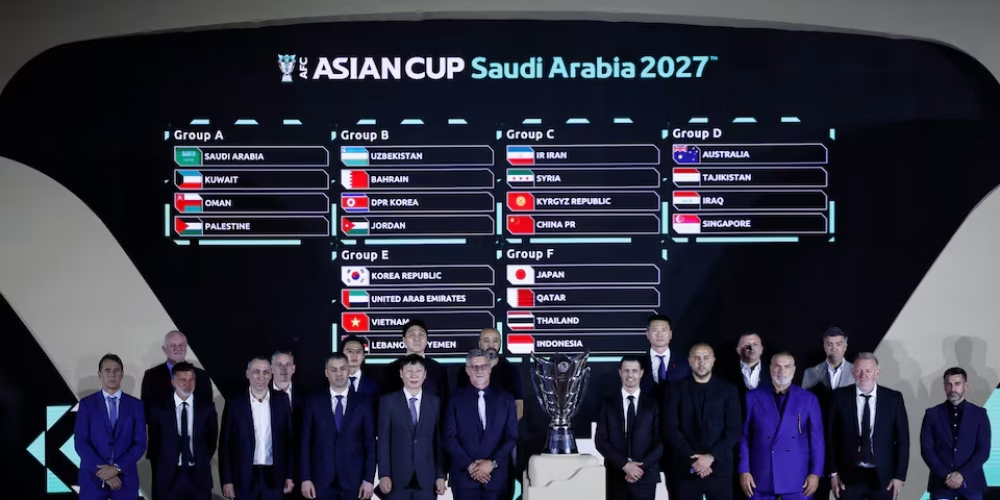
- Saudi Arabia will face a challenging all-Arab lineup in Group A, competing against Jordan, Palestine, and Yemen.
- Defending champions Qatar are set for a high-profile showdown against Japan in Group E, a rematch of the 2019 final.
- The 2027 tournament marks the first time Saudi Arabia will host the prestigious continental championship across four major cities.
The roadmap for the 2027 Asian Cup is officially set following a high-stakes draw in Riyadh that placed host nation Saudi Arabia in a grueling all-Arab group. As the kingdom prepares to host the continent’s premier football event for the first time, the draw ensures that regional rivalries will take center stage right from the opening whistle. For global fans and the American audience tracking the rapid rise of Middle Eastern sports influence, this tournament represents a critical milestone in the lead-up to the 2034 World Cup.
What You Need to Know
The Asian Cup is the primary association football competition for senior men’s national teams in Asia, held every four years to determine the continental champion. Historically, the tournament has been dominated by powers like Japan, Iran, and South Korea, but recent years have seen a dramatic shift in the balance of power toward the Gulf nations. Saudi Arabia, a three-time champion, has not hoisted the trophy since 1996, making the 2027 home-turf advantage a pivotal moment for their national sports program.
Hosting this event is part of a much larger geopolitical and economic strategy. The kingdom has invested billions into sports infrastructure and player development as part of its Vision 2030 initiative. By securing the hosting rights for 2027, Saudi officials aim to demonstrate their logistical capability to manage massive international crowds and high-security athletic events. The tournament will utilize state-of-the-art stadiums in Riyadh, Jeddah, Dammam, and the newly planned futuristic hubs, showcasing a blend of traditional hospitality and modern technology.
Furthermore, the expansion of the tournament to 24 teams has allowed for more diverse representation, bringing in nations like Palestine and Yemen. This inclusivity adds layers of social and political narrative to the matches, as football often serves as a rare point of unity and international visibility for countries facing internal hardships. The 2027 iteration is expected to be the most-watched in history, with broadcast deals expanding significantly into North American and European markets.
2027 Asian Cup Group Pairings
The draw ceremony, held with the backdrop of Riyadh’s rapid urban expansion, produced several “Groups of Death” that will likely dictate the narrative of the early stages. Saudi Arabia’s placement in Group A alongside Jordan, Palestine, and Yemen creates a concentrated pocket of Middle Eastern intensity. Jordan recently proved their mettle by reaching the 2023 final, while Palestine’s resilient squad has become a sentimental favorite for many neutral observers worldwide. These matches are expected to sell out rapidly, given the geographical proximity and shared cultural ties of the fans.
In Group E, a heavyweight clash looms between Qatar and Japan. This pairing is particularly significant as it features the winners of the last two tournaments; Qatar claimed back-to-back titles in 2019 and 2023, while Japan remains the most successful team in the competition’s history with four titles. Their encounter in the group stage is a rare early meeting of giants that could determine the bracket path for the knockout rounds. Japan, often referred to as the “Samurai Blue,” will look to reclaim their status as Asia’s top-ranked side after a disappointing exit in the previous edition.
Other notable groupings include Group B, where South Korea—led by some of the world’s most recognizable talent playing in the English Premier League—will face off against Iraq, Lebanon, and India. South Korea has endured a long title drought, having last won the Asian Cup in 1960. For their fans, anything less than a deep run into the final will be considered a failure, especially as their “Golden Generation” enters its peak years. Meanwhile, Group C features Iran and the United Arab Emirates, two teams with a long-standing competitive history that often produces some of the most technical and physical football in the region.
The logistics of the 2027 tournament are designed to be “compact,” similar to the 2022 World Cup model, allowing fans to attend multiple matches in a single day. This is made possible by the high-speed rail links connecting the host cities. Organizers have confirmed that the final will be held at the iconic King Salman International Stadium in Riyadh, a venue currently undergoing massive renovations to meet elite international standards.
Why This Matters
For American readers and global English-speaking audiences, the 2027 Asian Cup is more than just a regional football tournament; it is a preview of the future of global sports. The massive influx of capital into the Saudi Pro League has already drawn household names like Cristiano Ronaldo and Neymar to the region. As these stars bring global eyes to Middle Eastern pitches, the quality of the Asian Cup directly impacts the brand value of the clubs where these players compete. American investors, who have increasingly moved into European and Middle Eastern sports assets, are watching this tournament as a bellwether for the region’s long-term commercial viability.
Additionally, the tournament provides a vital case study in sports diplomacy. For US-based organizations and fans, seeing how the international community engages with Saudi Arabia as a host provides insight into what the 2034 World Cup might look like. The inclusion of the Palestinian team, in particular, often draws significant media attention in the United States, highlighting the intersection of international sport and global politics. As soccer continues to grow in popularity in the US, the performance of Asian teams—many of whom now have players in Major League Soccer (MLS)—becomes increasingly relevant to domestic fans.
NCN Analysis
From our perspective at NextClickNews, the 2027 Asian Cup draw indicates a tournament that will be defined by intense regional sentiment and high-pressure tactical battles. Saudi Arabia has put itself in a “no-excuses” position. By hosting and drawing a group filled with regional neighbors, they have maximized the potential for high stadium attendance, but they have also increased the risk of a high-profile upset. Jordan, coming off a historic runner-up finish, is no longer an underdog and will be a legitimate threat to win Group A.
We expect the biggest story of the tournament to be the tactical evolution of the Middle Eastern teams versus the traditional dominance of the East Asian giants like Japan and South Korea. The gap is closing rapidly. Furthermore, keep a close eye on the technological integration of the tournament; expect to see advancements in AI-driven officiating and fan engagement tools that will likely become the standard for the 2026 World Cup in North America. This event is the final “dress rehearsal” on the world stage before the globe turns its attention to the Americas, and then back to Saudi Arabia in 2034.
The 2027 Asian Cup is set to be a transformative event that solidifies the Middle East as the new center of gravity in the international sporting world.
Reported by the NCN Editorial Team









