

KEY POINTS
- World Cup winner Andrea Pirlo was dropped from consideration for the Italy head coach position following intense political backlash over his commercial ties to Russian betting firm Fonbet.
- Newly elected Italian Football Federation (FIGC) President Giovanni Malagò halted negotiations despite strong backing for Pirlo from technical director Paolo Maldini.
- The collapse leaves the Azzurri without a manager as the national federation searches for leadership after missing a third consecutive FIFA World Cup.
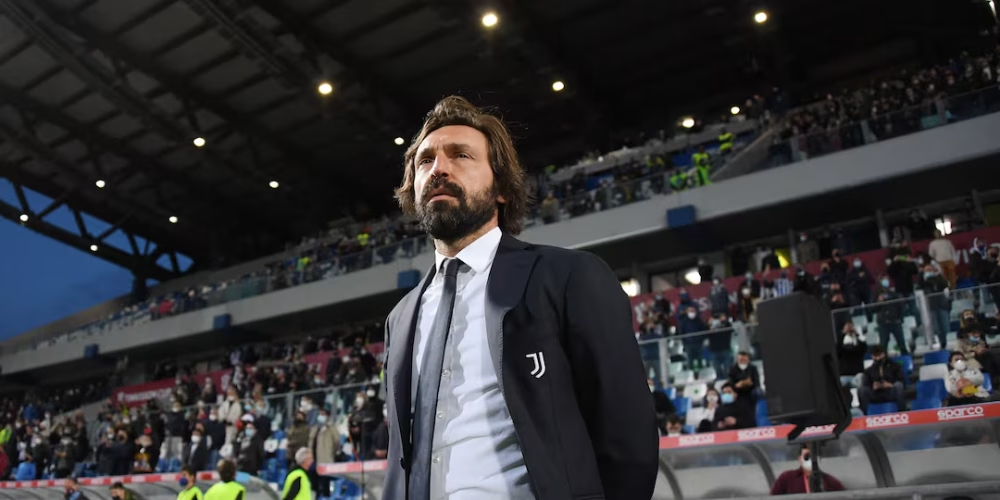
The Italian Football Federation has abandoned plans to appoint legend Andrea Pirlo as the national team’s new head coach following a wave of political and public backlash over his endorsement deal with Russian sports betting company Fonbet. The 47-year-old former Juventus manager revealed on social media that FIGC leadership informed him he was no longer under consideration for the role, abruptly ending high-level negotiations for a four-year contract.
What You Need to Know
Italian soccer remains in a state of crisis following the national team’s failure to qualify for the 2026 FIFA World Cup—marking the third consecutive time the four-time world champions have missed the global tournament. Following the departure of previous head coach Gennaro Gattuso in the spring, newly elected FIGC President Giovanni Malagò and technical director Paolo Maldini launched an extensive search to rebuild the national program.
After high-profile managers including Pep Guardiola and Carlo Ancelotti turned down inquiries to lead the rebuild, Pirlo emerged as the leading candidate to assume control. The former midfielder, who earned 116 caps and won the 2006 World Cup with Italy, enjoyed firm backing from Maldini and special advisor Leonardo. Preliminary contract discussions had progressed toward a formal multi-year agreement before details regarding his commercial obligations brought negotiations to a sudden halt.
The primary obstacle stemmed from Pirlo’s multi-year agreement as a global ambassador for Fonbet, Russia’s largest sports gambling operator. Signed while managing United Arab Emirates Pro League side United FC in Dubai—a club owned by Russian businessman Sergey Lomakin—the partnership drew fierce scrutiny from lawmakers in Rome and administrative figures within Italian sports governing bodies.
Russian Betting Ambassador Role Triggers Political Fallout in Rome
Opposition within the Italian parliament grew rapidly after lawmakers highlighted the geopolitical and legal friction surrounding Pirlo’s commercial activities. Scrutiny intensified over media coverage of Pirlo and former international teammate Marco Materazzi attending a high-profile promotional event hosted by Fonbet at Moscow’s Luzhniki Stadium in late May. Italian officials argued that maintaining an active sponsorship arrangement with a Russian gambling operator was fundamentally incompatible with serving as the public face of Italy’s national sporting institution.
Addressing the situation in a statement released on his official digital channels, Pirlo expressed deep disappointment over how his candidacy was handled. He defended his association with Fonbet as a purely commercial and sporting arrangement established during his coaching tenure in the United Arab Emirates, denying any political motivation or endorsement behind the partnership.
“Out of respect for the institutions, the federation, and everybody involved, I chose to remain silent until now,” Pirlo stated. “However, after learning that I am no longer a candidate for the Italy national team position, I feel it is necessary to clarify that this professional collaboration was exclusively of a commercial nature. Attributing political significance to that work attributes beliefs to me that I have never expressed.”
What This Means for Global Readers
For international football followers and European sports policy observers, the collapse of Pirlo’s candidacy highlights the growing intersection between geopolitical sanctions, corporate sports betting, and national team governance. As international federations enforce stricter ethical and compliance standards on key appointments, high-profile managers are facing heightened scrutiny regarding their personal commercial portfolios.
The impasse also highlights the ongoing institutional dysfunction within Italian soccer governance. As major European nations refine their athletic development and tactical frameworks, Italy’s prolonged search for a executive coaching figurehead threatens to further delay necessary structural reforms across their domestic talent pipeline.
NCN Analysis
The decision to discard Andrea Pirlo’s candidacy demonstrates how fragile the political landscape remains for Italian sports administrators navigating a historic structural downturn. While Paolo Maldini prioritized soccer credibility and tactical familiarity by targeting his former teammate, President Giovanni Malagò recognized that appointing an ambassador for a state-linked Russian gambling entity posed an indefensible public relations liability for an organization requiring public trust.
From a sporting perspective, this abrupt reversal leaves the FIGC back at square one with limited marquee options available in the managerial market. With top-tier international managers distancing themselves from the federation’s restructuring project, the leadership in Rome must now consider alternative candidates, including former managers Roberto Mancini and Antonio Conte. Without clear direction at the executive level, the process of modernizing Italian soccer will remain stalled.
Italian football’s road to recovery remains dangerously blocked by political friction and organizational indecision.
Reported by the NCN Editorial Team









