

KEY POINTS
- Anthony Joshua overcame two first-round knockdowns to defeat Albania’s Kristian Prenga by second-round technical knockout.
- The ring return marked Joshua’s first appearance since surviving a severe December vehicle accident in Nigeria.
- The thrilling comeback win keeps the path clear for a long-awaited showdown against Tyson Fury later this year.
Former two-time world heavyweight champion Anthony Joshua survived a terrifying opening minute in Jeddah to score a dramatic second-round knockout victory over Kristian Prenga. Floored twice in the opening frame, the 36-year-old British contender showed remarkable durability before overwhelming his opponent with relentless power punches. The dramatic triumph keeps a massive, long-negotiated domestic blockbuster match on schedule for the autumn.
What You Need to Know
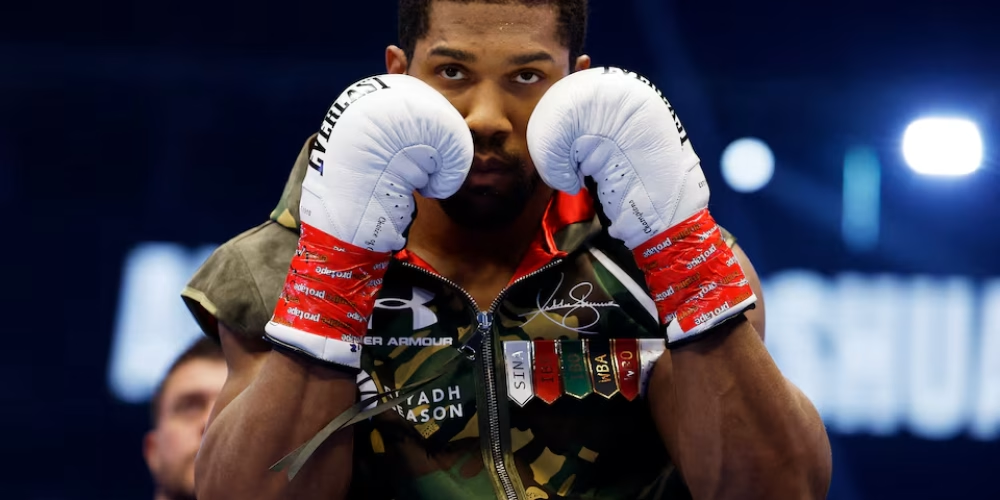
The heavyweight clash in Saudi Arabia was far more than an ordinary tune-up bout for the former unified champion. It marked Joshua’s first return to professional action following a tragic automobile collision in Nigeria seven months prior. The December crash left the boxer injured and took the lives of two of his closest companions and team members, Sina Ghami and Latif Ayodele. Entering the arena in customized gear bearing tribute to his late friends, Joshua carried immense emotional weight into the ring.
From a purely competitive perspective, the match was intended as a final tune-up obstacle before finalizing terms for an all-British megafight against Tyson Fury. Fury completed his half of the proposition 24 hours earlier in Thailand by forcing veteran Mariusz Wach to retire on his stool. With high stakes riding on the outcome, any slip-up by Joshua would have completely shattered plans for one of the highest-grossing prize fights in modern boxing history.
Despite entering as a heavy favorite against Prenga—an Albanian puncher with an impressive career stoppage ratio—Joshua encountered immediate structural trouble. Working under new corner instruction from Oleksandr Usyk’s tactical team and stepping onto the scale at a leaner 251 pounds, Joshua sought to display a faster, more elusive boxing style. However, the initial seconds of the bout proved chaotic as Prenga came out firing heavy power shots.
Anthony Joshua Knockout Comeback Details
Within twenty seconds of the opening bell, Prenga caught the former champion off-balance, landing a sharp right uppercut that sent Joshua crashing to the canvas. Joshua regained his footing quickly, but his movement remained noticeably compromised as he attempted to clear his head. Sensing a monumental upset, Prenga maintained pressure across the ring, trapping Joshua against the ropes and scoring a second official knockdown with a heavy combination before the end of the round.
The dynamic shifted dramatically in the second frame as Joshua abandoned his tentative approach and went on the attack. Pressing forward behind a stiff jab, the former champion backed Prenga toward the ropes with power rights. Sensing his opponent was weakening, Joshua unleashed a thunderous right hook across the jaw that crumpled Prenga into the lower ropes, prompting the referee to halt the contest without a full count.
The dramatic turnaround improved Joshua’s professional record to 30-4 with 27 knockouts. Speaking in the ring afterward, an emotional Joshua dedicated the victory to the memory of his deceased friends, crediting spiritual resilience for his ability to pull himself up from early adversity. With both combatants securing victories on the same weekend, promoter accounts confirm that terms remain aligned for the long-awaited Joshua-Fury clash later in the year.
Why This Matters
For combat sports fans across North America and around the globe, Joshua’s survival keeps alive the premier mega-event in modern boxing. A loss for the British heavyweight would have effectively neutralized years of multi-million dollar promotional negotiations and destroyed the commercial luster of a showdown with Tyson Fury. By climbing off the canvas to secure a stoppage, Joshua preserved a blockbuster event that is projected to generate massive pay-per-view numbers across US and European broadcast platforms.
Additionally, the wild, unpredictable nature of the fight underscores the enduring draw of heavyweight boxing in the global sports landscape. In an era where major boxing events compete heavily against mixed martial arts and digital entertainment, high-stakes drama featuring marquee names continues to command worldwide media attention. The narrative of resilience—surviving personal tragedy and ring adversity—resonates broadly with international audiences tracking elite sports.
NCN Analysis
Joshua’s performance against Prenga presented two contrasting realities for boxing analysts evaluating his upcoming fight with Tyson Fury. On one hand, his willingness to engage and his devastating punch power remain elite tools capable of ending any fight in a single sequence. His mental toughness in fighting through severe early distress demonstrates that his competitive drive remains intact despite significant personal hardships.
On the other hand, defensive vulnerabilities in the opening round raise serious tactical red flags. Getting dropped twice by an unheralded opponent inside three minutes suggests that Joshua’s defensive positioning and early reaction times require urgent correction before facing a world-class operator like Fury. If Joshua allows Fury to establish early control or land clean power shots early in their anticipated autumn bout, he may not find the same room for a miraculous comeback.
Anthony Joshua’s dramatic comeback proves his punching power remains elite, but fixing early defensive lapses will be essential before stepping into the ring against Tyson Fury.
Reported by the NCN Editorial Team









