

KEY POINTS
- Early strikes from Julián Quiñones and Raúl Jiménez secured a historic 2-0 victory for Mexico over Ecuador.
- The triumph snaps a 40-year drought without a World Cup knockout stage win for El Tri dating back to 1986.
- Co-hosts Mexico advance to the round of 16, maintaining their perfect defensive record in the tournament.
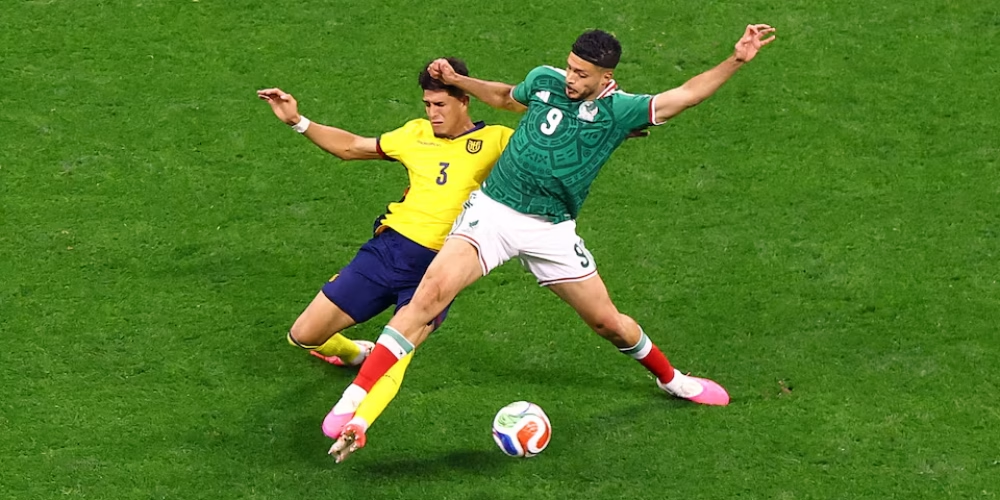
Mexico’s national soccer team produced a masterclass in efficiency and emotional resilience to vanquish Ecuador 2-0, breaking a modern sports curse that has haunted the nation for four decades. Playing before a raucous home crowd under the lights of their iconic capital stadium, El Tri dominated the opening half to punch their ticket to the round of 16. This monumental win sets off a wave of celebration across North America, signaling that the co-hosts are a legitimate threat to go deep into the tournament.
What You Need to Know
For generations of Mexican soccer fans, the phrase “quinto partido” (the fifth game) has served as both an obsession and a psychological barrier. Not since hosting the global tournament in 1986 had Mexico managed to win a single knockout match on the world stage. Between 1994 and 2018, El Tri suffered a heartbreaking string of seven consecutive exits in the first elimination round, a streak of futility that became an institutional burden for the country’s sporting federation.
The pressure surrounding the 2026 campaign reached an absolute fever pitch given Mexico’s role as co-hosts alongside the United States and Canada. After a disappointing group-stage exit at the previous tournament in Qatar, the national team underwent a radical structural overhaul designed to maximize home-field advantage. Entering this high-stakes round-of-32 clash against a dangerous South American opponent, the narrative was clear: it was time to finally rewrite history or face an unprecedented national sporting crisis.
Ecuador entered the elimination phase representing the trademark physicality and technical counter-attacking style of South American football. Having progressed through a grueling qualification cycle, the Andean nation possessed the defensive solidity and veteran leadership capable of spoiling the host nation’s party. With historical statistics favoring South American sides in previous cross-continental knockout meetings, the stage was set for an intense tactical battle.
El Tri Shatters the Knockout Hoodoo
The historic evening began with dramatic tension even before the first ball was kicked, as severe regional thunderstorms forced an hour-long delay. When the match finally got underway, the electric atmosphere inside the venue seemed to supercharge the Mexican squad, who immediately pushed forward with waves of aggressive, high-pressing football. Young prodigy Gilberto Mora made history just by stepping onto the pitch, becoming the second-youngest player to ever start a World Cup knockout game, trailing only the legendary Pelé.
Mexico’s aggressive tactical approach paid dividends in the 22nd minute when Roberto Alvarado executed a sublime pass that sliced directly through Ecuador’s high defensive line. Forward Julián Quiñones collected the ball on the left wing, used his physical strength to hold off defender Willian Pacho, and cut inside to unleash a ferocious strike into the top corner. The spectacular goal marked Quiñones’s third tally of the tournament and ignited deafening celebrations that reverberated across the host city.
Sensing vulnerability, the home side refused to ease off the pressure and doubled their advantage just nine minutes later following a catastrophic defensive turnover by Ecuador near their own penalty area. Quiñones turned provider this time, recovering the loose ball and sliding a precise pass to veteran striker Raúl Jiménez. The experienced forward made no mistake, hammering a devastating rocket past the helpless Ecuadorian goalkeeper to put Mexico firmly in control before the halftime whistle.
The second half saw a predictable shift in dynamics as Ecuador threw extra attackers onto the pitch in a desperate attempt to rescue their tournament life. While the South American side managed to string together several dangerous passing sequences, the Mexican defensive unit remained completely unyielding. Led by disciplined center-backs, the backline absorbed the pressure comfortably, preserving their astonishing record of not conceding a single goal in the tournament so far. A miserable night for Ecuador was compounded in second-half stoppage time when defender Piero Hincapié was shown a red card following a heated confrontation.
Why This Matters
This landmark victory carries profound economic and cultural implications for corporate stakeholders and media broadcasters across North America. Mexico’s continuation in the tournament guarantees sustained viewer engagement and record-breaking television ratings for broadcasting networks catering to the massive Spanish-speaking and Hispanic demographics. From a commercial standpoint, the extended stay of one of the tournament’s most marketable host nations ensures that merchandise sales, fan festival attendance, and local hospitality revenues will remain at an absolute premium.
On a broader sporting level, the result demonstrates the shifting power dynamics within international football. By becoming the first CONCACAF nation to eliminate a South American CONMEBOL opponent in a World Cup knockout match after five previous failures, Mexico has provided a massive psychological boost to its regional peers. This breakthrough validates the substantial investments made into North American soccer infrastructure over the past decade, proving that the region can elite-level tactical challenges on the global stage.
NCN Analysis
From our editorial viewpoint, Mexico’s clinical performance establishes them as one of the most balanced and dangerous defensive units in the entire tournament. While traditional European powerhouses often command the majority of media headlines, El Tri’s perfect defensive record through four matches reveals a level of tactical maturity that was sorely lacking in previous generations. Under immense psychological pressure, the squad played with a calculating calmness that suggests the ghost of their historical knockout failures has been permanently exorcised.
Looking forward, Mexico will return to their iconic capital stadium on Sunday to face either England or the Democratic Republic of Congo for a coveted spot in the quarterfinals. Remaining on home soil provides an immeasurable logistical and emotional advantage, as the unique altitude and fanatical home support make the venue an absolute fortress. If the midfield can continue to provide high-quality service to the clinical duo of Quiñones and Jiménez, this historic march could very well extend deep into the summer.
A historic sporting curse has finally been shattered, positioning a re-energized Mexican squad as a formidable force in the tournament’s remaining elimination rounds.
Reported by the NCN Editorial Team









