

KEY POINTS
- Algeria bounced back from a crushing opening defeat to secure a 2-1 victory over Jordan in Group J.
- Captain Riyad Mahrez and match-winner Amine Gouiri spearheaded the crucial second-half comeback.
- The North African side will face Austria next with tournament progression completely in their hands.
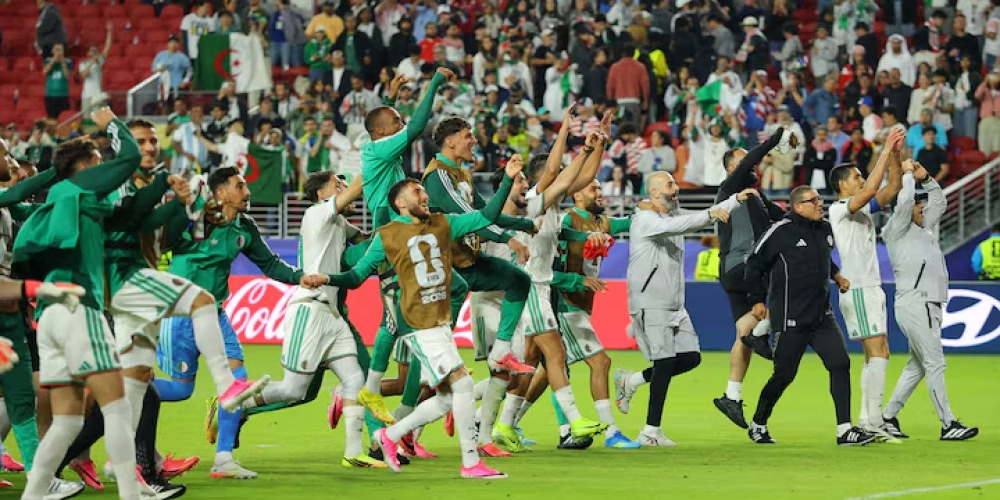
Algeria’s national soccer team completely revived its international campaign on Monday night by staging a gritty second-half comeback to defeat Jordan 2-1 at the San Francisco Bay Area Stadium in Santa Clara, California. Following a demoralizing opening match where they were comprehensively outclassed by defending champions Argentina, the Fennec Foxes displayed immense tactical resilience to keep their tournament dreams alive in front of a packed stadium. For American sports enthusiasts watching the expanded 48-team tournament unfold across domestic venues, the high-stakes clash offered a perfect showcase of the drama and unpredictability that defines elite global football.
What You Need to Know
The road to the 2026 FIFA World Cup has been a journey of redemption for the Algerian national team, a football program steeped in historical significance but plagued by recent tournament absences. Having missed out on the previous edition of the tournament, the North African powerhouse entered this expanded cycle determined to recapture the magic of their historic 2014 run, where they pushed eventual champions Germany to the absolute limit in the knockout stages. Under the guidance of head coach Vladimir Petkovic, the squad underwent a significant structural overhaul, blending veteran leaders who achieved continental glory in the late 2010s with an influx of dynamic, European-born dual-national talents.
However, the immense burden of national expectation threatened to derail their campaign before it could even get started. Drawn into a highly competitive Group J alongside global heavyweights Argentina, a disciplined Austrian side, and tournament newcomers Jordan, the Algerians knew that every single tactical decision would be amplified under the intense media spotlight. Their opening match in Kansas City proved to be a harsh reality check, as the legendary Lionel Messi dismantled the Algerian defensive structure with a masterful hat-trick, handing Petkovic’s men a humbling 3-0 defeat. The heavy loss left the team reeling, facing severe criticism from domestic analysts back home in Algiers and placing immense psychological pressure on the roster ahead of their second group fixture.
To navigate this crisis, the coaching staff opted to utilize a quiet college town in the American heartland as their emotional anchor. Selecting Lawrence, Kansas, as their tournament base camp, the Algerian delegation found an unexpected sanctuary away from the chaotic media hubs of the major host cities. The local community enthusiastically adopted the North African team, illuminating storefronts in green and white and turning out in massive numbers to support the squad during open training sessions. This deep grassroots connection provided a vital psychological lift for the players, transforming a collection of individuals playing across seven different European domestic leagues into a cohesive, motivated unit determined to repay the hospitality of their American hosts.
Algeria World Cup Comeback Keeps Group J Hopes Alive
The tactical response to their opening defeat was evident from the opening whistle at the San Francisco Bay Area Stadium, where Petkovic made several critical adjustments to his starting eleven. Most notably, the decision to give veteran captain Riyad Mahrez a starting role paid immediate dividends, as the former Manchester City winger injected a sense of urgency, poise, and experience into an attacking line that had looked entirely isolated against Argentina. Operating primarily from the right flank, Mahrez consistently drew multiple defenders out of position, creating vital pockets of space for his younger technical teammates to exploit through the center of the pitch.
Despite controlling the initial phases of possession, the Algerians were forced to show extreme mental fortitude after a defensive lapse allowed Jordan to open the scoring. Jordan, riding a massive wave of global goodwill and emotional euphoria surrounding their historic first-ever appearance at a World Cup finals, utilized a highly physical, low-block defensive system that stifled Algeria’s wingers and looked lethal on counter-attacking transitions. When Nizar Al-Rashdan found the back of the net for Jordan in the first half following a poorly cleared set-piece, the specter of an early tournament exit loomed large over the Algerian dugout.
The second half, however, showcased the tactical maturity and technical depth that Petkovic has spent months cultivating within this roster. Refusing to panic, the Algerians adjusted their passing patterns, bypassing the heavily congested flanks to exploit space directly through the central channels. The breakthrough arrived when Mahrez delivered a phenomenally placed corner kick into the heart of the penalty box, allowing forward Nadhir Benbouali to rise above the Jordanian central defenders and power home a magnificent headed equalizer. The goal completely shifted the psychological momentum of the match, re-energizing the thousands of traveling Algerian supporters in the stands and forcing Jordan out of their defensive shell.
With the clock ticking down and the match hanging in the balance, it was Marseille’s clinical forward Amine Gouiri who delivered the definitive moment of the evening. Linking up masterfully with Bayer Leverkusen’s rising midfield star Ibrahim Maza, Gouiri consistently asked questions of the tiring Jordanian backline with his intelligent off-the-ball movement. Eight minutes before the final whistle, Gouiri capitalized on a momentary miscommunication in the box, pouncing on a loose ball and poking it past the despairing goalkeeper to trigger unbridled celebrations across the pitch. The victory not only secured three invaluable points but also officially eliminated a courageous Jordan squad from the competition.
Why This Matters
The dramatic resurgence of the Algerian national team holds substantial economic and cultural relevance for sports communities across the United States. In the college town of Lawrence, Kansas, the local business community has experienced a notable financial windfall due to their adoption of the Algerian team, with hospitality venues, restaurants, and retail outlets reporting record-breaking summer revenues. This unique cross-cultural connection highlights how the decentralization of World Cup base camps can bring tangible economic development to American municipalities outside of the primary metropolitan host cities.
Furthermore, the team’s survival preserves one of the most compelling human-interest storylines of the tournament for domestic television broadcasters like Fox Sports and international streaming platforms. American sports consumers have historically demonstrated a strong affinity for redemption narratives, and an African side fighting back from a legendary superstar’s masterclass to control their own destiny provides ideal prime-time programming. The high-quality technical display from a roster featuring prominent athletes from elite European clubs helps elevate the overall profile of soccer within the highly competitive American sports landscape.
NCN Analysis
From our editorial perspective, Algeria’s triumphant response to adversity confirms that the tactical foundation built by Vladimir Petkovic is built to withstand tournament pressure. While the initial 3-0 defeat to Argentina highlighted obvious vulnerabilities in their transitional defense, the character displayed against Jordan proves that the locker room remains fully unified behind the technical staff’s vision. By securing this victory, Algeria has successfully placed its destiny entirely within its own hands heading into the final matchday of the group stage.
The upcoming showdown against Austria promises to be a masterclass in tactical contrast, pitting Algeria’s intricate, possession-based style against a high-intensity, physical European pressing system. With both nations currently level on three points in Group J, the match is effectively a single-elimination playoff where the tactical discipline of the respective midfields will decide tournament survival. If the Algerian technical leaders can replicate the composure they demonstrated in Santa Clara while tightening up their defensive set-piece coverage, they possess all the necessary ingredients to secure a historic spot in the knockout rounds.
The global sports world will be watching closely as this resilient North African team attempts to finalize an extraordinary journey of redemption on American soil.
Reported by the NCN Editorial Team









