

KEY POINTS
- Sabri Lamouchi becomes the first manager in football history to be dismissed after one World Cup match.
- A brutal 5-1 loss to Sweden prompts immediate executive action from the Tunisian Football Federation.
- Master tactician Hervé Renard takes the reins ahead of critical group stage fixtures.
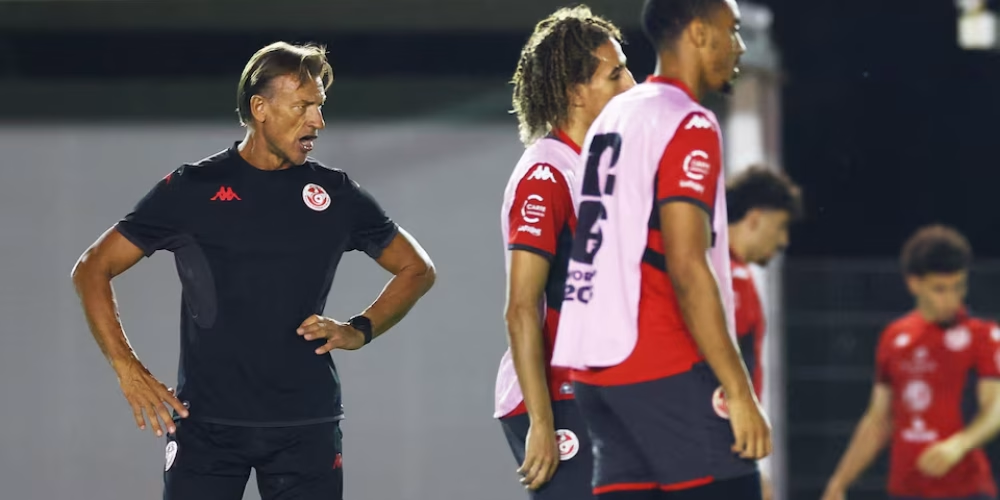
The Tunisian Football Federation has enacted one of the most drastic leadership changes in tournament history, relieving head coach Sabri Lamouchi of his duties just one match into their global campaign and immediately appointing international journeyman Hervé Renard as his replacement. The decisive institutional pivot comes on the heels of an absolute defensive collapse in Monterrey, Mexico, where Tunisia suffered a humiliating 5-1 thrashing at the hands of Sweden. Recognizing that their tournament lifespan is on life support, team executives opted for an immediate cultural shake-up rather than allowing the previous regime to navigate the remainder of the group stage.
What You Need to Know
In the highly pressurized environment of the global game, coaching changes are typically structural decisions planned over months or entire qualification cycles. Lamouchi, who took charge of the North African side in January on a long-term contract meant to run until 2028, had struggled to implement a cohesive identity during his brief tenure. Under his stewardship, the Eagles of Carthage won just one of their five total fixtures—a modest 1-0 friendly victory over Haiti in March—while enduring heavily lopsided exhibition defeats to European heavyweights.
The comprehensive blowout against Sweden during the opening match of Group F shattered any remaining patience within the federation’s board of directors. Allowing five goals in an opening fixture not only severely damages a team’s goal-difference metrics but also leaves deep psychological wounds on a roster that is expected to compete against elite tactical blocks. Historically, no manager had ever been dismissed after a single game of a modern finals tournament, making Lamouchi’s rapid termination a historic milestone of executive impatience.
Faced with an unprecedented sporting crisis, the Tunisian federation initially considered structural paths involving domestic interim staff. However, they rapidly shifted focus to secure a proven tournament entity capable of yielding immediate motivational dividends. Renard’s swift arrival at the team’s base camp represents a high-stakes gamble designed to shock the squad back into competitive relevance before their mathematical elimination is finalized.
Tactician Steps into the International Spotlight
The tactical transition was confirmed directly via the Tunisian Football Federation’s official media channels, establishing that Renard will guide the national team through the remainder of this summer’s campaign. The monetary parameters of his short-term contract mirror the previous agreement, with both parties explicitly acknowledging that formal negotiations regarding a multi-year partnership will only commence following the conclusion of the team’s current tournament run. The overarching sports objective remains abundantly clear: stabilize a leaky defense and extract results from their final two group games.
Renard arrives with an iconic international resume that makes him uniquely suited for a high-intensity rescue mission. The French tactician famously guided Saudi Arabia to a stunning, world-shocking group stage victory over eventual champions Argentina at the 2022 tournament in Qatar. Having also secured continental championships with both Zambia and the Ivory Coast, Renard possesses a deep familiarity with North African football dynamics, giving him the necessary cultural authority to demand immediate discipline from his new dressing room.
Why This Matters
For soccer fans and tactical analysts across the United States, this unprecedented managerial drama provides a fascinating case study in crisis management on the world stage. Mainstream sports culture in North America is highly accustomed to mid-season coaching changes in domestic leagues, but seeing an elite international side pull the trigger after a single match highlights the unforgiving, cutthroat pressure of tournament football. It shows domestic viewers that at this level, performance metrics are scrutinized in real-time, and historical reputations offer zero protection.
Furthermore, this rapid coaching carousel directly impacts the broader commercial landscape of the tournament group. Television networks broadcasting the upcoming matches will now feature Tunisia’s tactical desperation as a headline narrative, generating heightened curiosity from casual viewers who want to see if Renard can orchestrate another signature miracle. This narrative-driven engagement keeps the casual fan base invested in teams outside of the traditional North American or European powerhouses.
NCN Analysis
The appointment of Renard is an absolute masterstroke of short-term damage control, but it leaves the new manager with zero margin for error or tactical experimentation. Transitioning a squad from a disorganized low-block into a rigid, disciplined unit within a matter of days is one of the steepest challenges a coach can face. Renard will likely strip down the tactical playbook entirely, prioritizing defensive numbers and physical containment to ensure they stop conceding early goals.
The primary factor to monitor on Saturday will be how quickly the Tunisian players buy into Renard’s high-energy, emotionally charged leadership style. Their upcoming match against Japan is a must-win fixture; anything less than a victory will render their final group game against the Netherlands completely inconsequential. Readers should look closely at the starting lineup adjustments to see which veteran defenders are sacrificed in Renard’s bid to restore national pride.
The Eagles of Carthage have completely rewritten the tournament script off the pitch, setting up a captivating battle for survival on it.
Reported by the NCN Editorial Team









