

KEY POINTS
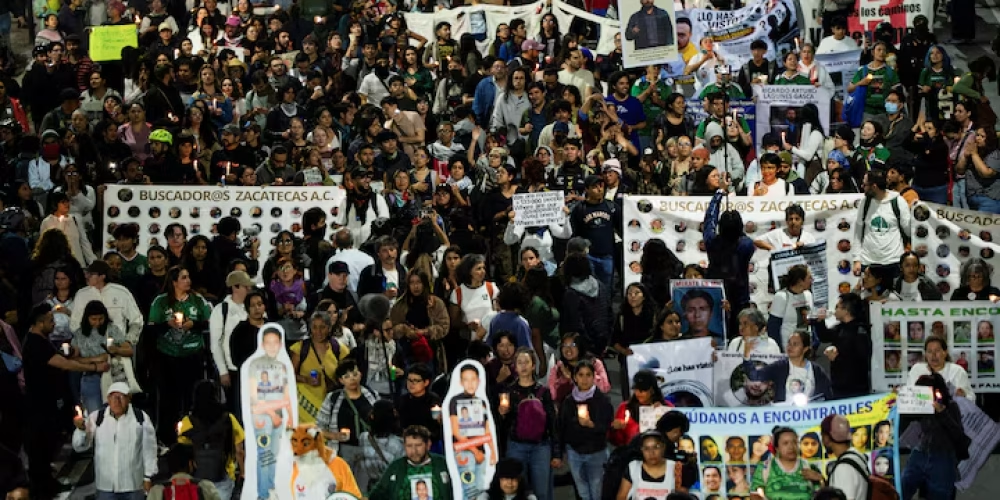
- Grassroots groups use the high-profile sporting event to draw international attention to the country’s disappearance crisis.
- Relatives of the missing express deep grief as football celebrations contrast sharply with a national human rights tragedy.
- Activists criticize bureaucratic hurdles and demand more state resources to support investigations in volatile areas.
The return of the world’s premier football tournament to Mexico has inadvertently amplified the voices of thousands of families grieving for vanished relatives. On the opening days of the global competition, grassroots activist groups organized demonstrations and candlelight vigils outside major sporting venues, determined to capitalize on the international media presence. For these families, the festive atmosphere surrounding the matches does not mask a painful, ongoing domestic reality: a profound humanitarian crisis involving tens of thousands of missing citizens.
What You Need to Know
Mexico has a storied football history, becoming the first country to host the tournament multiple times after holding celebrated editions in 1970 and 1986. The current multi-nation tournament cycle brings the global community back to iconic venues like the stadium in Mexico City. While local municipalities and international football executives have spent years preparing infrastructure, deploying extensive security details, and promoting an atmosphere of festive celebration, the sheer scale of the event has exposed deep social fractures within the host nation.
Beneath the sports spectacle lies a stark domestic crisis that has intensified over the last two decades. Official estimates indicate that Mexico has more than 135,000 registered missing persons, a staggering figure that escalated dramatically following a federal militarized crackdown on regional drug syndicates launched in 2006. The human cost of this prolonged conflict is felt most acutely by ordinary citizens, with families frequently left to navigate a harrowing landscape of cartel territorial disputes, local corruption, and unexplained disappearances.
Faced with a backlogged and underfunded legal system, desperate relatives have taken matters into their own hands by forming local search collectives known as “madres buscadoras” (searching mothers). These volunteer groups routinely venture into highly volatile, cartel-dominated territories to follow up on anonymous tips, unearth clandestine graves, and collect forensic data. For these activists, the enormous expenditure allocated to hosting a sports tournament highlights a severe misallocation of national priorities, given the desperate shortage of resources dedicated to locating their loved ones.
Activists Highlight Generational Toll of Disappearances
The painful intersection of football and family tragedy is vividly illustrated by individual stories emerging from border communities. In Ciudad Juarez, a prominent industrial hub near the Texas border, local mothers recall how their missing children once found joy on local playing fields. Norma Laguna, whose teenage daughter Idaly Juache was an avid striker for a community team before vanishing in 2010, still holds onto her daughter’s old jersey. For Laguna and countless others, the omnipresent tournament marketing serves as a painful reminder of the promising athletic and personal futures cut short by violence.
The tragedy for many Mexican families is not confined to a single generation, reflecting a systemic cycle of insecurity that continues to claim young lives. Years after Juache’s partial remains were identified in a dry riverbed miles away from her hometown, Laguna’s teenage grandson, Edgar Ruiz, also vanished after visiting the very same soccer field where his aunt once trained. This compounding grief fuels the determination of search groups, who argue that the high rates of unresolved criminal cases effectively mask the true extent of violence in the country.
While fans gather inside pristine stadiums, search collectives continue their grueling work just miles away in the surrounding countrysides. Recent search operations in states like Zacatecas and Jalisco have uncovered multiple hidden burial sites containing human remains, blindfolds, and scattered clothing—grim evidence pointing to active kidnapping rings. Activists coordinate these perilous digs independently, often providing their own equipment and security before local forensic teams arrive to begin the slow process of DNA cross-referencing.
The contrast between corporate sports pageantry and grassroots forensic searches has drawn sharp criticism from local human rights leaders. Activists argue that municipal governments have deliberately polished their public images to present a facade of modernity and safety for international visitors while neglecting localized security threats. By staging high-visibility demonstrations during match days, the collectives are successfully forcing international broadcasters and foreign journalists to confront the complex humanitarian realities existing outside the stadium gates.
Why This Matters
For citizens, civic groups, and policy analysts in the United States and global English-speaking markets, Mexico’s domestic crisis carries significant security, humanitarian, and diplomatic implications. The geographic proximity of the crisis ensures that the social instability caused by cartel networks directly impacts cross-border immigration patterns and binational security operations. Understanding the deep emotional toll on Mexican communities helps international observers look past the commercial veneer of global sports events to comprehend the real-world challenges facing a vital neighboring trading partner.
Furthermore, the visibility of these grassroots protests underscores the increasing role that major sporting events play as platforms for political expression and social justice. Global corporations, marketing sponsors, and international bodies investing billions of dollars into tournament infrastructure face growing consumer pressure to acknowledge human rights conditions within host nations. The strategies employed by Mexican search groups illustrate how localized advocacy movements can effectively leverage international media windows to pressure sovereign governments for institutional accountability.
NCN Analysis
From an editorial perspective, the protests surrounding the tournament demonstrate that global entertainment spectacles can no longer be completely insulated from deep-seated political realities. FIFA and local organizing committees have traditionally sought to maintain a strictly celebratory tone, yet the persistence of the search collectives has successfully injected a critical human rights dialogue into the tournament narrative. The contrast between state-of-the-art stadiums and nearby search fields represents a powerful visual that will likely linger in the public consciousness long after the closing ceremonies conclude.
Looking ahead, the international community should watch whether this heightened media exposure translates into sustained legislative reform or increased financial backing for forensic investigations within Mexico. A United Nations committee on enforced disappearances recently invoked a mechanism calling for global forensic and investigative support, a step that could gain traction if foreign governments maintain diplomatic pressure. Readers should monitor whether the Mexican administration implements more robust protections for searching mothers, who continue to risk their lives daily in the pursuit of truth and institutional justice.
The global tournament has provided a vital international stage for Mexican families demanding justice and accountability for more than 135,000 missing persons.
Reported by the NCN Editorial Team









