

KEY POINTS
- Kylian Mbappe cements his place in history during a high-stakes group encounter.
- Fragile defensive lapses expose the former world champions to dangerous opposition counter-attacks.
- Positional adjustments and attacking depth offer a blueprint for tournament progression.
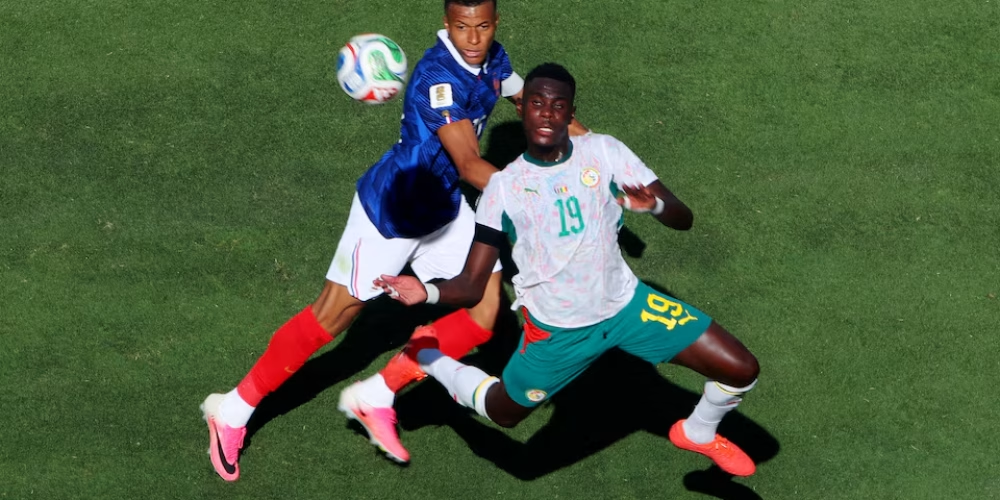
The French national team launched its latest quest for global football supremacy with an explosive 3-1 victory over Senegal, demonstrating that their championship aspirations may rely entirely on their elite attacking core outscoring tactical deficiencies at the back. While the scoreline reflects a convincing margin of victory, the narrative inside the stadium revealed a far more complicated reality for Didier Deschamps’ men. For fans watching across the globe, the contrasting nature of France’s clinical frontline and their highly disorganized backline promises a high-stakes, drama-filled summer campaign.
What You Need to Know
Entering the tournament as one of the heavy favorites, France has consistently grappled with balancing an embarrassment of riches in the attacking third with an increasingly fragile defensive structure. The tactical blueprint deployed by manager Didier Deschamps frequently relies on individual technical brilliance to solve structural deadlocks, a philosophy that places massive psychological weight on the team’s forward players. Against highly organized, physically imposing opposition, any breakdown in communication among the back four can immediately jeopardize their tournament lifespan.
The opener in East Rutherford, New Jersey, highlighted these systemic struggles during an error-strewn first half where Senegal routinely bypassed the French midfield. With premier defenders like William Saliba battling physical ailments leading up to the opening match, the structural integrity of the backline was severely tested. Historically, teams that lift the coveted trophy rely on defensive resilience, but the modern French strategy appears to challenge that traditional footballing dogma.
With the tournament expanded and the stakes higher than ever, there is virtually no room for defensive experimentation during the initial group phase. Powerhouses that fail to secure their defensive zones risk being caught out by rapid transitional teams built to exploit structural gaps. France’s ability to survive these early defensive scares will dictate how deep they can play into the knockout rounds.
Firepower Outshines Structural Frailties
The match developed into a stark tale of two completely different halves, as a disjointed opening period gave way to a display of pure offensive ruthlessness. Senegal set the initial tempo, utilizing lightning-fast transitions down the left flank to torment the French fullbacks and rattle the midfield. Forward Nicolas Jackson came agonizingly close to breaking the deadlock after a swift counter-attack, rattling the post and exposing a massive gap in the center of the French defense. France struggled heavily to establish any meaningful rhythm before the intermission, leaving Deschamps to address his squad’s tactical positioning.
The tactical landscape shifted dramatically in the second half when Deschamps instructed Michael Olise to operate more centrally, a move that successfully connected the midfield to the frontline. The strategic alteration paid immediate dividends in the 66th minute when captain Kylian Mbappe latched onto a visionary pass from Olise, splitting the African defense to slot home a precise opener. As Senegal pushed forward to find an equalizer, French substitute Bradley Barcola doubled the advantage by calmly finishing another brilliant through ball with just eight minutes remaining on the clock.
Despite the late cushion, defensive anxieties resurfaced deep into added time when Senegal’s Ibrahim Mbaye found room to fire a rising strike past goalkeeper Mike Maignan. The momentary lapse highlighted the lingering frailties that continue to follow Les Bleus. However, Mbappe answered the challenge instantly, unleashing a swerving, dipping long-range effort seconds before the final whistle to secure his second goal of the night. The strike brought his international tally to 58 goals, surpassing Olivier Giroud as his country’s all-time leading goalscorer.
Why This Matters
For soccer fans and sporting networks across the United States, the vibrant, high-scoring nature of France’s tactical approach provides premium entertainment value. Casual American sports consumers are drawn to high-octane offenses led by world-class superstars who can change a game in a single sequence. Mbappe’s record-breaking night at MetLife Stadium ensures that mainstream sports media will keep a sharp focus on the tournament, boosting viewership numbers during early time slots.
On a broader scale, the tactical vulnerabilities displayed by tournament favorites give hope to dark-horse competitors and future opponents across the region. As American soccer enthusiasts analyze the structural flaws of elite nations, it creates a much more engaging narrative surrounding tactical coaching and squad selection. This analytical engagement helps mature the sports culture in North America, transforming casual viewers into deeply knowledgeable soccer tacticians.
NCN Analysis
France’s opening match reinforces the reality that they possess an attacking arsenal capable of masking almost any defensive blunder. The tactical flexibility shown by moving Olise into a central role proves that Deschamps still has the strategic intelligence to fix in-game issues on the fly. However, relying on Mbappe to consistently produce moments of individual magic from outside the penalty box is an unsustainable long-term strategy against elite European or South American tactical blocks.
As the tournament moves toward the second matchday, the French coaching staff must prioritize tightening the spaces between the midfield line and the central defenders. If the fullbacks continue to leave themselves isolated against fast wingers, more clinical teams will punish Les Bleus far more severely than Senegal did in the opening 45 minutes. Expect Deschamps to work heavily on defensive containment drills before taking the pitch for their next group game.
The path to international glory remains open for France, but it will be a high-wire act driven by offensive brilliance.
Reported by the NCN Editorial Team









