

KEY POINTS
- Tehran warned that team staff will halt matches if fans display unofficial flags or chant political slogans targeting the squad.
- The severe diplomatic friction comes alongside a sudden withdrawal of the Iranian federation’s entire tournament ticket allocation.
- The squad faces significant travel restrictions, operating out of a Mexican training base with strict day-of-game entry permits for the US.
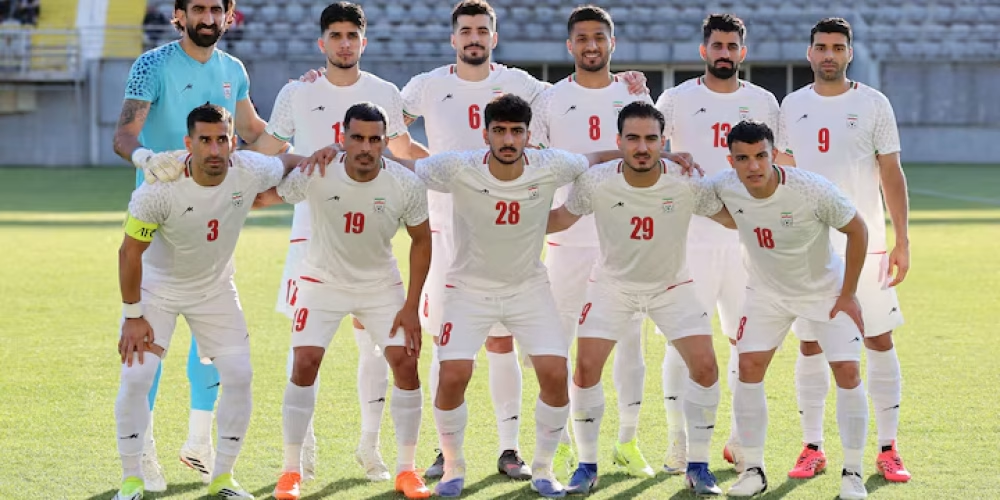
The Iranian government has threatened to pull its national soccer team off the field during the FIFA World Cup if spectators display unauthorized flags or chant critical political slogans inside stadiums. Sports Minister Ahmad Donyamali announced that the nation has formally notified world football’s governing body that team managers will be instructed to stop matches in response to any coordinated protests. The strict ultimatum adds an intense layer of geopolitical tension to the prestigious tournament just days before the team opens its group-stage campaign on American soil.
What You Need to Know
The upcoming matches involving the Iranian national team are unfolding against a backdrop of prolonged civil dissent and complex international relations between Tehran and Western nations. Activists and human rights organizations have repeatedly targeted major sporting events to stage visual protests, frequently utilizing pre-revolutionary symbols like the lion and sun flag to show opposition to the current theological administration. During the build-up to this tournament, demonstrators gathered at the FIFA Congress in Vancouver to demand a total ban on the federation, arguing the team functions as an arm of the state rather than a representative of the general population.
To manage the heavy political climate and ongoing visa friction with Washington, the Football Federation Islamic Republic of Iran executed a rare logistical pivot by basing its training camp in Tijuana, Mexico, instead of the United States. Under a unique protocol established by the Department of Homeland Security, the athletic delegation is permitted to enter US territory only twenty-four hours before each scheduled kickoff, returning to Mexico immediately after the final whistle. This rigid operational structure illustrates how deeply non-sporting disputes have infiltrated the organization of the summer showcase.
The administrative environment grew even more chaotic this week following a sudden decision to revoke the Iranian football federation’s direct access to its official ticket inventory. Under standing tournament rules, each participating country is entitled to roughly eight percent of the seating capacity for their group matches to distribute to domestic supporters. The unexpected cancellation of this distribution network has left thousands of traveling enthusiasts who already funded extensive flights and hotel bookings completely stranded outside the security gates.
Standoff Over Stadium Expression Escalates
The official decree from Tehran places an immense burden of responsibility directly onto the coaching staff and team coordinators on the sideline. According to statements published by domestic media networks, the government expects the team manager to immediately intervene and suspend active play if stadium security personnel fail to confiscate political imagery or suppress critical chants. While the country’s sports leadership claims it received firm assurances that no disruptive demonstrations will occur during their final group game against Egypt, the matches scheduled in California remain a major point of concern.
The final group fixture in the Pacific Northwest has generated additional controversy due to overlapping cultural events in the host city. Regional tournament organizers previously designated the June 26 match as an official celebration to align with local annual festivities, prompting formal joint complaints from both the Iranian and Egyptian football associations. Both organizations have actively petitioned leadership to completely censor any visible human rights or advocacy symbols during the broadcast windows, citing a desire to strictly preserve athletic neutrality.
Meanwhile, the sudden restriction on fan ticket distribution has drawn fierce condemnation from Iranian soccer executives, who labeled the development a direct violation of international sporting equality. The federation argued that blocking access for legitimate ticket holders introduces blatant political interference into a neutral tournament framework. The identity of the regulatory body or agency that initiated the ticket seizure has not been publicly confirmed, leaving the traveling fanbase in a state of absolute logistical limbo.
Why This Matters
The intersection of international diplomacy and elite tournament soccer creates severe operational risks for stadium operators, corporate sponsors, and broadcasting networks across the United States. A sudden match stoppage during a prime-time global broadcast disrupts tightly scheduled television programming windows and creates significant financial liabilities for commercial advertisers. Furthermore, the presence of conflicting political factions within massive metropolitan venues presents a complex crowd-management challenge for local law enforcement agencies tasked with maintaining public safety.
For North American consumers and local tournament organizers, these disputes underscore the immense difficulty of hosting multicultural mega-events during periods of heightened international volatility. The rigid entry rules applied to visiting delegations highlight the domestic government’s strict stance on border security, even when dealing with globally recognized athletes. The situation demonstrates that modern sports journalism can no longer separate on-field athletic achievements from the complex economic and regulatory policies implemented by sovereign states.
NCN Analysis
Tehran’s public threat to halt World Cup fixtures represents a high-stakes gamble that could result in severe institutional discipline, including automatic match forfeitures and extended bans from future international competitions. By placing the onus on team managers to disrupt play, the political leadership is effectively forcing the athletic roster to act as enforcement agents for state policy under the bright lights of global television. This internal pressure is highly likely to impact the squad’s on-field performance, as players must navigate an incredibly hostile psychological environment while trying to compete against elite global opponents.
From an organizational standpoint, FIFA is facing a critical test of its stated commitment to political neutrality and stadium security. While the governing body traditionally bans overt political messaging inside tournament perimeters, enforcing a total block on spontaneous vocal chants or personal flags across an audience of tens of thousands is practically impossible. Readers should watch closely to see how refereeing crews and match commissioners respond during the opening match in Los Angeles if the visiting bench attempts to follow through on its radical walkout warning.
The unfolding diplomatic standoff ensures that the group phase will be defined as much by political maneuvering as by athletic merit.
Reported by the NCN Editorial Team









