

KEY POINTS
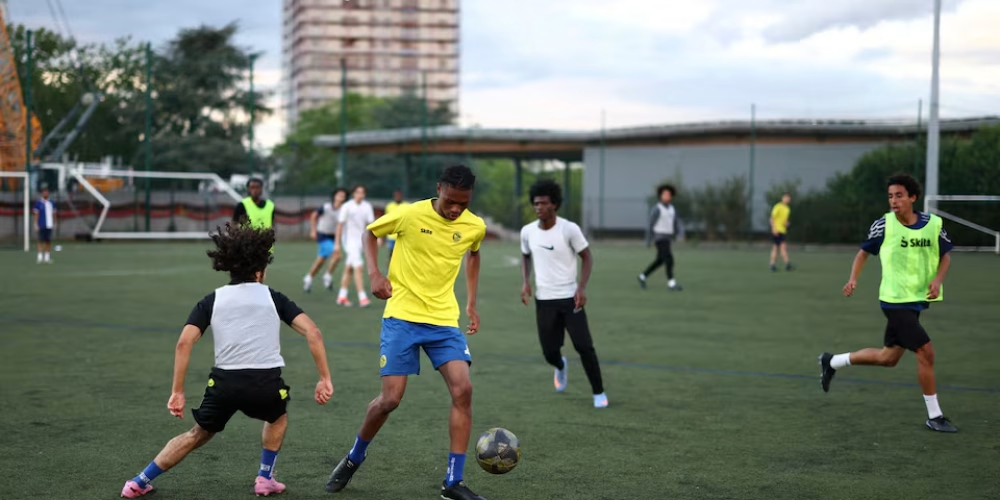
- The peripheral neighborhoods surrounding Paris, known locally as the banlieues, have transformed into the most prolific talent pipeline in international soccer.
- High-density housing estates and small concrete pitches have fostered a unique, hyper-technical style of street soccer that prioritizes close control, agility, and rapid decision-making.
- Elite national infrastructure, anchored by academies like Clairefontaine, systematically refines this raw urban talent to supply top-tier clubs globally and fuel the French national team.
The outer rings of Paris are quietly reinforcing their status as the absolute epicenter of the global soccer talent pool. Far from the glamorous boulevards of the inner city, the concrete public courts and high-density housing developments of the Parisian suburbs are churning out elite athletes at an unprecedented rate. This geographic concentration of athletic excellence has fundamentally altered how international scouts, major European franchises, and sports analysts view the development of elite soccer players.
For decades, the standard narrative of global soccer dominance focused heavily on the street cultures of South America or the highly regimented youth systems of Central Europe. However, a structural shift over the last twenty years has turned the French capital’s periphery into a literal factory for the sport’s finest technical players. By blending an intense, unstructured urban playing culture with a highly sophisticated national coaching infrastructure, France has built a talent production system that is currently unmatched anywhere in the Western world.
What You Need to Know
To understand the rise of the Parisian suburbs, or banlieues, one must understand the socioeconomic and architectural landscape that defines them. Built largely during the post-war housing boom to accommodate influxes of working-class citizens and immigrant populations, these high-density neighborhoods feature sprawling apartment blocks clustered around public spaces. Because green spaces are often limited, municipal governments heavily invested in small, fenced-in concrete sports courts known widely as city stades.
These hard-surface courts became the breeding ground for a distinctly localized variation of soccer. In these confined spaces, traditional tactics like long-distance passing, crosses, or sweeping aerial duels are virtually impossible. Instead, the environment forces children to master tight spatial awareness, lightning-fast footwork, and aggressive, short-range passing sequences. The game played here values individual flair, an ability to escape double-teams in tight corners, and structural improvisation.
What began as a localized recreational outlet quickly caught the attention of the French Football Federation (FFF). Recognizing the staggering volume of raw athletic talent concentrated in these working-class hubs, sports authorities established a network of elite developmental centers. The crown jewel of this system is Clairefontaine, a state-run, hyper-selective academy located just outside the city. Clairefontaine acts as a finishing school, taking the raw, creative instincts forged on concrete pitches and layering them with world-class tactical discipline and physical conditioning.
The Suburban Blueprint for Soccer Dominance
The results of this dual system—unstructured urban play meeting elite state refinement—are visible at the absolute highest levels of international sports. A remarkable percentage of the players who anchored France’s recent deep runs in major international tournaments, including successive World Cup final appearances, traces their roots directly back to these specific suburban neighborhoods. Icon exemplars like Kylian Mbappé, who grew up playing in the northern suburb of Bondy, embody this exact combination of blazing speed, audacious dribbling, and clinical execution.
This phenomenon is not limited to a few isolated superstars. The sheer depth of the talent pool means that the Parisian suburbs are effectively supplying high-end talent to top-flight leagues across England, Spain, Germany, and Italy. Entire communities, such as Les Ulis or Sarcelles, have achieved legendary status among international sports scouts for consistently producing Champions League-caliber athletes. Scout networks that once combed through South American academies are now spending significant portions of their capital monitoring the youth matches of minor clubs in the Paris metropolitan area.
The timeline of this developmental explosion showcases a deliberate, decades-long curve. Following a period of relative international stagnation in the mid-20th century, the foundational restructuring of French youth development began to pay dividends by the late 1990s. By the time the 2026 international cycle arrived, the depth of the French player pipeline had become so pronounced that sports analysts frequently noted the country could easily field three separate, world-class national squads using players born within a thirty-mile radius of the Eiffel Tower.
The structural advantage of this pipeline lies in its self-perpetuating nature. Young children growing up in these estates do not view professional sports stardom as a distant, abstract dream; they see it as a tangible reality achieved by their immediate neighbors. When a youth player sees a teenager from their own apartment block sign a developmental contract with a major European club, it establishes a clear roadmap and intensifies the competitive nature of the local street games, driving overall performance standards even higher.
Why This Matters
For sports fans, executives, and athletic directors in the United States, the spectacular rise of the Parisian talent machine offers a highly critical blueprint. The US sports landscape has traditionally relied on a “pay-to-play” model for youth soccer, where access to elite coaching and competitive travel leagues is often dictated by suburban family wealth rather than raw athletic merit. The French model demonstrates that the most potent, resilient talent pools are frequently found in dense, working-class urban centers when public infrastructure is provided.
As soccer continues to explode in popularity across North America ahead of major domestic tournaments, American sports organizations are searching for ways to close the competitive gap with European powerhouses. Analyzing how municipal investments like city stades can catalyze organic athletic development could completely reshape how American cities design public parks and community centers. It underscores the reality that elite athletic infrastructure does not necessarily require manicured, multi-million-dollar grass complexes; sometimes, a well-placed concrete court in an underserved neighborhood can yield far greater results.
NCN Analysis
The sustained dominance of the Paris suburbs as an athletic incubator challenges several long-held dogmas about youth player development. For years, major franchises believed that highly structured, heavily coached environments from an early age were necessary to produce elite tactical minds. The French experiment proves that allowing children to play unstructured, high-stakes street sports well into their pre-teen years fosters a level of creative problem-solving and spatial intuition that cannot be replicated in a formal practice setting.
Moving forward, the primary challenge for French sports authorities will be managing the immense commercial pressures now squeezing these suburban communities. With elite clubs from the English Premier League and wealthy international consortiums scouting children at increasingly younger ages, protecting youth players from premature exploitation is a growing concern. Readers should closely watch how international governing bodies update transfer regulations to ensure that the local grassroots clubs actually producing these superstars receive fair financial compensation for their vital role in the global sports ecosystem.
The ultimate takeaway is that the modern soccer superstar is no longer defined by traditional regional archetypes, but by the concrete proving grounds of the Parisian periphery.
Reported by the NCN Editorial Team









