

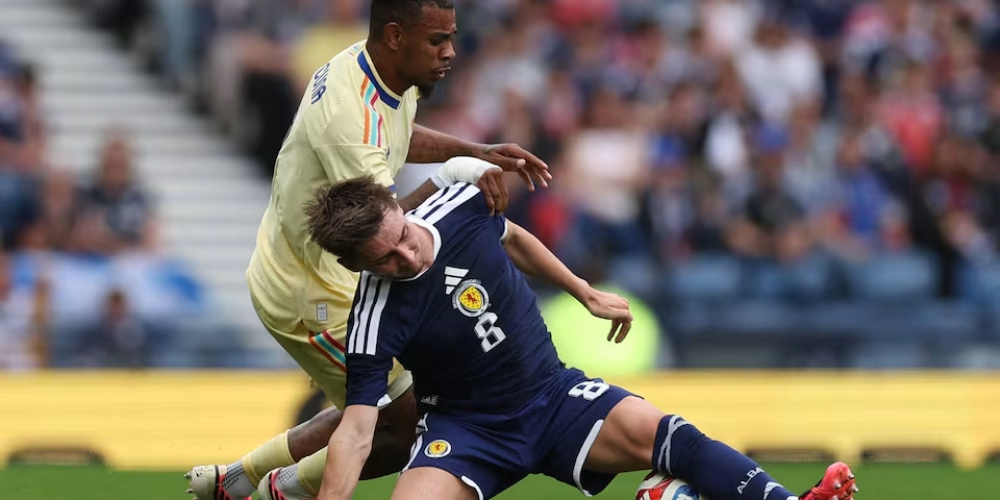
KEY POINTS
- Scotland midfielder Billy Gilmour will miss the upcoming FIFA World Cup due to a severe knee ligament injury sustained during a warm-up match.
- The 24-year-old SSC Napoli playmaker was forced off the pitch just before halftime during Scotland’s final international preparation fixture.
- Head coach Steve Clarke faces a massive tactical selection dilemma as the squad prepares to travel to North America without their primary midfield anchor.
The Scotland men’s national football team has suffered a devastating blow on the absolute eve of the FIFA World Cup, with star midfielder Billy Gilmour officially ruled out of the tournament due to a severe knee injury. The technical playmaker was forced to withdraw from the squad after scans confirmed significant ligament damage suffered during a final warm-up exhibition on Saturday. For a Scottish side arriving at the tournament with ambitious knockout-stage expectations, losing their fundamental engine in the center of the pitch alters their entire competitive outlook.
What You Need to Know
The upcoming FIFA World Cup, hosted across Canada, Mexico, and the United States, represents a historic milestone for global football, expanding to a massive 48-team format for the first time. For Scotland, qualification was viewed as a generational opportunity to showcase their modern, possession-oriented style on the grandest corporate sports stage. Billy Gilmour was widely recognized as the indispensable architectural pulse of that system, dictating tempo and transitions against elite international opposition.
Since ascending from elite youth academies into senior prominence, Gilmour has established a reputation as a highly intelligent, press-resistant deep-lying midfielder. His recent domestic success in Italy’s Serie A with Napoli further elevated his international profile, making him one of the first names on manager Steve Clarke’s team sheet. His unique capacity to retain possession under physical duress is historically difficult to replicate within Scotland’s current player pool.
International tournament preparation plans are notoriously fragile, and untimely physical setbacks frequently derail months of meticulous coaching strategy. For Scotland, an administrative and athletic program that prides itself on structural cohesion over individual depth, this sudden vacancy in the starting eleven forces an immediate, high-stakes tactical redesign. The medical confirmation comes at the worst possible chronological moment, leaving the coaching staff with minimal time to test alternative midfield combinations.
Heartbreak in the Final Warm-Up
The injury materialized during what was supposed to be a celebratory international send-off fixture designed to fine-tune tactical movements. Operating in his familiar central role, Gilmour was orchestrating a fluid attacking sequence late in the first half when an awkward, off-the-ball twisting motion left him visibly distressed on the turf. Medical personnel immediately signaled to the technical area that the player could not continue, casting a somber mood over the entire stadium.
Subsequent clinical evaluations and MRI scans performed on Sunday morning revealed the true extent of the structural damage to the knee. The diagnostic results rendered any accelerated rehabilitation timeline impossible, forcing Scotland’s medical department to recommend an immediate withdrawal from the traveling delegation. Gilmour will instead remain in Europe to undergo a specialized surgical procedure followed by a lengthy, multi-month orthopedic recovery program.
With the tournament schedule commencing in less than two weeks, Steve Clarke must rapidly submit an amended squad registry to FIFA’s tournament directors. The sudden loss of Gilmour leaves a massive void alongside fellow Premier League and continental veterans like Scott McTominay and John McGinn. The coaching staff must now pivot toward a more conservative, defensive posture or fast-track an unproven domestic prospect into the high-intensity environment of a World Cup group stage.
Why This Matters
This high-profile injury carries massive commercial and athletic implications for global sports fans, domestic broadcasters, and North American tournament organizers. For American soccer consumers preparing to attend group-stage matches in major metropolitan venues, the absence of marquee, elite European talent slightly alters the aesthetic draw of the fixtures. The tournament’s commercial success relies heavily on casual fans engaging with recognizable star athletes across the expanded bracket.
Furthermore, this development directly impacts corporate sports betting markets and fantasy sports platforms across global English-speaking audiences. Scotland’s statistical probability of advancing from their assigned group has shifted noticeably across major international sportsbooks following the medical announcement. For tactical analysts and television networks mapping out match previews, the narrative around Scotland transitions from an intriguing sleeper team to a program facing an uphill battle for survival.
NCN Analysis
From our editorial perspective, Gilmour’s absence entirely compromises Scotland’s capacity to play a progressive, front-footed style of football in North America. While Scotland possesses plenty of industrious, hard-tackling midfielders, they do not have another player capable of collecting the ball directly from the central defenders and turning away from an aggressive opponent press. Steve Clarke will likely be forced to abandon his preferred possession structures in favor of a low-block, counter-attacking blueprint that relies heavily on set pieces.
This unfortunate scenario should serve as a stark warning to international football governing bodies regarding the relentless intensity of the modern athletic calendar. The physical demands placed on elite players transitioning directly from grueling domestic club seasons into international tournament cycles are unsustainable. Moving forward, readers should watch closely to see if Scotland fast-tracks an ultra-young prospect into the roster, or if they rely on veteran pragmatism to survive their opening match.
Ultimately, the cruel timing of this physical setback deprives a brilliant young technician of his definitive career milestone while forcing Scotland into an emergency tactical rebuild.
Reported by the NCN Editorial Team









