

KEY POINTS
- Australian midfielder Jackson Irvine intends to prioritize team success over individual social advocacy at the upcoming tournament.
- The national team composition has shifted significantly toward younger players since their collective social protests in 2022.
- Rising geopolitical tensions and tournament regulations complicate player expressions on global sports platforms.
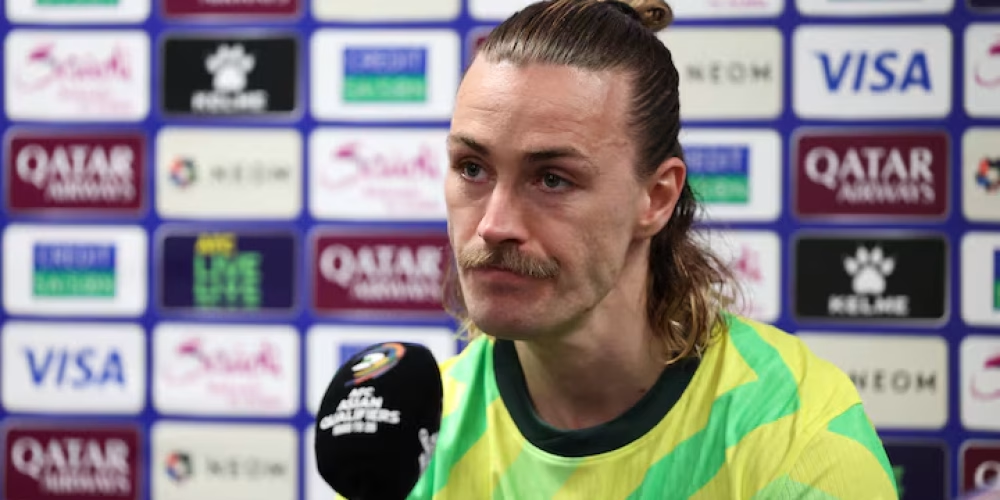
Australian midfielder Jackson Irvine will emphasize on-field performance rather than individual social activism when the 2026 FIFA World Cup kicks off this June. The veteran playmaker, highly regarded across global football for his outspoken stances on human rights and labor equity, indicated that he will not use the multi-national tournament as a personal platform for political expression. The decision marks a notable shift in approach for the national squad, which made international headlines for its unified social messaging ahead of the previous global tournament.
What You Need to Know
Jackson Irvine has established a distinct identity within professional sports as an active unionist and a staunch champion of workplace inclusion. In his role as the co-president of Professional Footballers Australia, the national players’ union, the 33-year-old has consistently pushed sports governing bodies to align their marquee commercial properties with robust human rights charters. Professionally, he captains German club FC St. Pauli, a Hamburg-based organization globally recognized for its progressive culture, local community service initiatives, and active collaboration with humanitarian organizations.
The Australian national team previously made significant waves across the international sporting landscape ahead of the 2022 tournament in Qatar. Irvine and 15 of his international teammates collaborated on a highly publicized, collective video message that openly questioned the working conditions of migrant laborers and advocated for the decriminalization of same-sex relationships in the host nation. That coordinated demonstration represented one of the most thorough and unified social statements delivered by an active squad in modern tournament history.
Unlike standard athlete protests that frequently rely on symbolic gestures, the Australian squad invested more than six months conducting extensive homework prior to their 2022 announcement. The players consulted directly with international labor associations, migrant worker networks, and independent human rights organizations to ensure their statements possessed deep factual backing. The thorough preparation allowed the team to successfully deliver their message and immediately shift their focus back to athletic performance, ultimately leading to the country’s most successful knockout-stage finish.
Changing Squad Dynamics Reshape World Cup Approach
As the national team prepares to travel to North America for their upcoming Group D matches against Turkey, Paraguay, and the host United States, the internal dynamic of the roster has transformed considerably. The current squad features a substantially younger group of athletes compared to the veteran-heavy roster of four years ago. This youthful generational turnover has naturally altered the collective priorities of the dressing room, with the newer players heavily focused on securing their individual standing and executing tactical assignments on the world stage.
Furthermore, Irvine’s individual availability over the past 12 months has been restricted due to a lingering foot injury that required extensive medical rehabilitation. Because he spent significant time away from the core national training environment while recovering in Germany, the veteran leader noted that he has not had the opportunity to engage in deep, systemic conversations with the younger contingent regarding external political or social issues. Consequently, the team enters the tournament without a unified, pre-planned socio-political agenda.
The decision to minimize off-field distractions arrives amid intensifying scrutiny surrounding international soccer regulations and host-nation politics. Governing body FIFA maintains strict institutional prohibitions against displaying political, religious, or personal slogans on team apparel or athletic equipment. While global human rights groups and player unions continue to urge organizers to protect free expression, the baseline parameters leave active competitors navigating a highly restrictive corporate environment where unsanctioned gestures carry immediate disciplinary risks.
Despite his personal history of public commentary—including recent public criticisms regarding the soccer federation’s administrative decisions—Irvine remains absolute regarding his responsibilities to the broader collective. The veteran midfielder emphasized that his primary purpose in North America is to help anchor a competitive engine capable of advancing deep into the expanded 48-team tournament structure. The focus remains entirely on delivering professional results for a fanbase eagerly anticipating a historic sporting summer.
Why This Matters
The strategic balance struck by premium international athletes like Jackson Irvine carries profound commercial and cultural relevance for sports entertainment consumers and media markets across the United States. High-profile political demonstrations during premier sporting events frequently polarize television audiences, creating complex public relations challenges for broadcasting networks and corporate brand sponsors. When prominent team leaders decide to separate their individual advocacy from team performance, it provides a stable environment for corporate partners looking to maximize their advertising investments without navigating social controversy.
From a regulatory perspective, the evolution of player-led advocacy highlights the ongoing friction between international athletic unions and global governing bodies. Active players are increasingly demanding that global tournaments respect modern human rights charters, forcing organizations like FIFA to re-evaluate how they select future host destinations and manage labor interests. The shifting approach of the Australian squad demonstrates that modern athletes are becoming highly sophisticated tactical planners, recognizing when to deploy their collective leverage and when to prioritize the raw commercial and competitive demands of their primary profession.
NCN Analysis
Jackson Irvine’s measured approach ahead of the summer tournament displays a high level of leadership maturity, recognizing that an individual crusade must never compromise a collective team objective. In an era where athlete advocacy can easily degenerate into superficial online gestures, the Australian captain’s commitment to thorough preparation and group alignment sets a premium standard. By acknowledging that a younger, evolving locker room requires a different focus than the 2022 squad, he successfully protects his teammates from unnecessary external media pressure.
Moving forward, readers should watch how the global players’ union, Fifpro, utilizes its institutional channels to address systemic human rights concerns within the North American hosting infrastructure while the players focus purely on the pitch. With matches distributed across the United States, Canada, and Mexico, non-governmental organizations will likely maintain high volumes of independent advocacy surrounding labor rights and immigration policies. The separation of duties between active athletes and their administrative unions will likely become the definitive structural template for athlete activism in the modern corporate sports era.
The ability to maintain personal convictions while executing elite professional duties remains the ultimate hallmark of a true sporting ambassador.
Reported by the NCN Editorial Team









